



Professional license: CPA Vietnam Auditors
Experience: Over 30 years of experience in Accounting, Auditing, and Financial Consulting.
Organizational restructuring is essential when businesses expand, change their business strategy, or face operational crises. Reorganizing the structure goes beyond simply reorganizing departments; it can impact personnel costs, operational processes, and legal compliance.
The information in this article is compiled and referenced based on regulations of Enterprise Law 2020 and the 2019 Labor Code.
What is organizational restructuring?
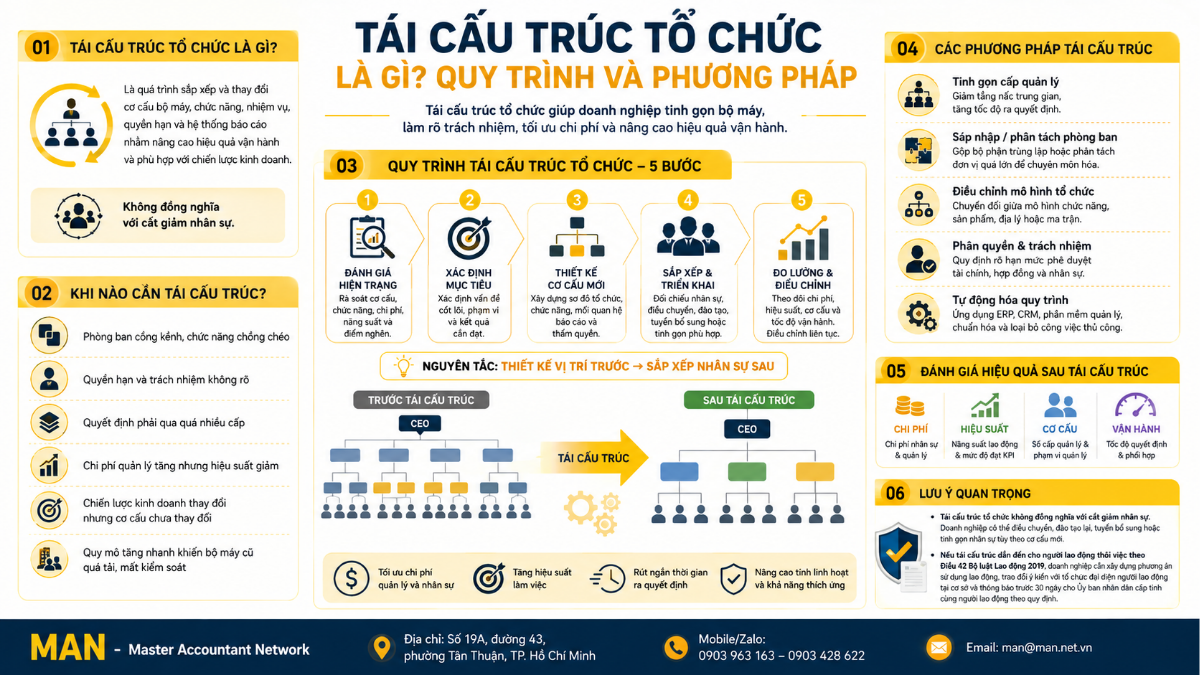
Organizational restructuring is the process of reviewing, rearranging, and changing the organizational structure, functions, responsibilities, authority, and reporting systems to improve operational efficiency and adapt to a new business strategy. This activity focuses on how the business allocates resources, defines responsibilities, and maintains a smooth flow of information between management levels.
Many business owners often confuse organizational restructuring with staff reduction. In reality, organizational restructuring aims at the long-term goal of making the structure more suitable to the scale and development direction, rather than simply being a temporary solution to reduce salary costs in the short term.
How is organizational restructuring different from business restructuring?
Business restructuring is a comprehensive reform process encompassing finance, operations, markets, and management. Organizational restructuring is a crucial part of this, focusing intensively on departmental structures, hierarchical systems, and internal operating mechanisms within the enterprise.
To make a clear distinction, business restructuring encompasses a wide range of strategic areas such as debt resolution, asset restructuring (financial restructuring), or changes to production processes and supply chains (operational restructuring). Conversely, organizational restructuring focuses on organizational structure, functions, authority, personnel, and internal operating mechanisms to ensure smooth operation.
The goals of organizational restructuring
The primary goal of organizational restructuring is to build a lean operational structure, eliminate bottlenecks, and optimize management costs. This process clarifies the authority and responsibilities of each position, shortens decision-making time, and aligns the organizational structure with the company's business development strategy.
When restructuring its organization, the company focuses on specific elements:
- Streamline the organizational structure: Eliminate middle management layers that do not add value.
- Reduce functional overlap: Clearly define the responsibilities of each department, eliminating situations where multiple departments are involved in the same task or no one takes responsibility.
- Clarify authority and responsibilities: Establish a specific delegation of authority mechanism for each level of management, limiting the shifting of responsibility.
- Shorten the decision-making process: Reducing cumbersome approval processes helps businesses respond quickly to market changes.
- Allocate resources appropriately: Place the right people in the right positions according to the actual requirements of the new organizational chart.
Signs that a business needs organizational restructuring.
Signs that a business needs organizational restructuring appear when management costs increase but operational efficiency decreases, information becomes congested between departments, and decision-making progress slows down. Early identification of these signs allows leadership to intervene promptly before the system becomes severely stagnant.
The departmental structure is cumbersome and overlapping.
Businesses often have many departments with similar functions or departments that frequently clash over scope of work. This situation wastes salary budgets and reduces employee initiative.
Authority and responsibilities are unclear.
When operational errors occur, departments blame each other because responsibilities are not clearly defined. Employees are unclear about their authority to make decisions and to whom they must report.
Decisions go through too many levels.
A simple proposal has to go through multiple levels of approval, from deputy directors and managers to the board of directors. As a result, business opportunities are lost and information flow is distorted due to too many intermediaries.
Management costs increased, but efficiency decreased.
The ratio of business management expenses to total revenue has been steadily increasing, the number of management-level personnel has grown, but the overall company-wide key performance indicators (KPIs) have been declining.
The business strategy has changed, but the structure remains the same.
Businesses shift their business model (for example, from traditional sales to e-commerce) but retain the old organizational structure. This mismatch prevents the system from effectively implementing the new strategy.
The company's size has increased, but the old organizational structure is no longer suitable.
Rapid increases in revenue, staff, or branches can overwhelm the initial centralized management model, leading to a loss of operational control.
Organizational restructuring process
A standard organizational restructuring process includes five steps: assessing the current situation, defining objectives and scope, designing a new model, assigning personnel for implementation, and measuring and adjusting. Businesses need to identify position needs before assigning personnel to avoid building a structure centered around existing individuals.
Assessing the current state of the organization
Businesses should review their entire current organizational chart, job descriptions, approval authority, and interdepartmental coordination processes. This assessment should be based on factual data regarding costs, productivity, and bottlenecks that disrupt workflow.
Define the goals and scope of the restructuring.
The leadership team clearly identifies the core problem that needs to be solved and the scale of the change. If the bottleneck lies only in the business or operations division, the company should focus on restructuring that department instead of disrupting the entire company.
Designing a new organizational model
The company develops a new organizational chart, clearly defining the functions and responsibilities of each department, reporting relationships, and levels of authority. The goal of this step is to create a standardized operational framework that aligns with the development strategy for the next phase.
Personnel arrangement and implementation
A key principle in organizational restructuring is to design the structure and job requirements first, and then compare and arrange personnel into the established framework. Businesses should not begin by retaining the current workforce and then building the structure around those personnel.
After identifying competency gaps, businesses implement retraining, retraining, recruitment, or streamlining of positions that are no longer suitable, while clearly communicating the new direction to employees.
Measurement and adjustment
After implementing the new model, the management team needs to closely monitor key indicators such as personnel costs, work processing speed, and departmental coordination. Continuous minor adjustments are necessary to optimize the system according to real-world conditions.
Organizational restructuring methods
Common organizational restructuring methods include streamlining management, merging or splitting departments, adjusting governance models, delegating responsibilities, and automating processes. The choice of method depends on the size, operational bottlenecks, and strategic objectives of the business.
Streamline management structure.
Reducing middle management levels helps bridge the gap between the Board of Directors and direct employees. This approach can accelerate decision-making and optimize management costs, depending on the scale and specifics of operations.
Merge or split departments
Merging departments with overlapping functions or splitting overly large departments into more specialized units helps optimize resource sharing and enhance expertise.
Adjusting the organizational model
Switch between management models such as the functional model, product line model, geographic model, or matrix model to suit market size and product specifics.
Delegation of authority and assignment of responsibilities
Re-establishing the delegation of authority clearly defines the approval limits for finances, contracts, and personnel at each level. This frees up time for senior management to focus on strategy.
Automation and operational process change
Applying management technologies (ERP, CRM, task management software) combined with process standardization. Eliminating manual steps reduces workload and the need for manual processing, while also limiting reliance on individuals.
Does organizational restructuring mean cutting staff?
Organizational restructuring does not necessarily mean layoffs. Job cuts are just one of the possible consequences when the new structure no longer has suitable positions. The core objective of restructuring is to optimize the system; therefore, businesses can completely reassign, retrain, or even recruit additional personnel for new strategic departments.
If organizational restructuring results in the termination of employment under Article 42 Labor Code 2019, Businesses must develop a labor utilization plan, consult with the employee representative organization at the workplace, and notify the provincial People's Committee and the employees 30 days in advance.
Evaluating the effectiveness of organizational restructuring.
The effectiveness of organizational restructuring is evaluated through four groups of indicators: personnel costs, work efficiency, structural leanness, and operational speed. Regular measurement helps management determine whether the new structure is achieving the initial strategic goals.
Cost assessment
Monitor fluctuations in total payroll costs, business management costs, and the ratio of operating expenses to revenue. The new system should aim to optimize costs in relation to the value created.
Performance evaluation
Measure the average labor productivity, work process completion time, and KPI achievement level of each department after implementing the new organizational chart.
Structural assessment
Review the remaining number of management levels, the scope of authority of each department head, and the level of responsibilities to determine if any overlaps have been eliminated.
Operational evaluation
The survey examines the speed of decision-making from leadership down to implementation, the flexibility of inter-departmental coordination, and the ability to respond to new market demands.
An illustrative example of organizational restructuring.
Hypothetical scenario
The figures and scenarios below are designed to illustrate the organizational restructuring process and are not actual data from a specific business.
Consider the situation at Company X Trading Co., Ltd. (with 150 employees). After 5 years of development, the company found that management costs increased by 25% annually, but the order processing speed became increasingly slow.
The company conducted an analysis of its current organizational structure and identified the obstacles:
- The Business Unit has three separate departments that perform similar customer outreach tasks.
- All discount proposals on 2% must go through 4 levels of approval: Team Leader -> Department Head -> Sales Director -> General Director.
To address these shortcomings, the company is implementing a restructuring process in stages:
- Assessment and Design: Company X redefined its organizational chart, deciding to merge three sales departments into a single Business Unit, divided by geographical region.
- Authorization: Authorize the Sales Director to decide on discount levels up to 5%, and the Department Head to decide up to 3%.
- Personnel arrangement: The company established a new positional framework. Several former department heads were transferred to the new Market Development department, and some redundant administrative staff were retrained to move to the Customer Service department.
Following the transition, the company observed positive changes:
- Contract approval time has been reduced from 3 days to 4 hours.
- Management costs decreased by 15% after 6 months of operation.
- No labor disputes arose thanks to effective internal communication.
Risks and considerations when restructuring an organization.
Restructuring the organization involves significant risks related to operational disruption, personnel changes, and additional costs, taxes, and labor legal issues. Businesses need to carefully prepare contingency plans to ensure compliance and stability.
Structural and operational risks
Changing the organizational chart on paper without changing the actual work processes leads to a situation of "new wine in old bottles." An inappropriate organizational structure can also disrupt information flow and temporarily reduce operational productivity.
Personnel risks
Implementing staff reductions or reshuffles before clearly defining the new organizational structure will cause confusion among the entire team. The risk of labor disputes is very high if the company does not follow the correct legal procedures when terminating employment contracts.
Notes regarding accounting, finance, and legal matters.
Depending on the restructuring plan, businesses may incur costs for retraining, job transfers, or costs related to the termination of employment contracts as stipulated by law. Businesses need to coordinate closely with the accounting and finance department to plan the budget, account for, and track these costs in accordance with applicable regulations.
In cases where organizational restructuring involves changes in legal form such as division, separation, merger, acquisition of a business, or dissolution of a subsidiary, the business may incur tax obligations, terminate or adjust its tax identification number, and complete the corresponding legal procedures as prescribed. Government Electronic Information Portal and administrative guidance documents.
Particularly for foreign-invested enterprises (FDI), if restructuring leads to changes in shareholder structure, representatives, or project scale, adjustments are necessary. Investment Certificate It is mandatory to ensure legality in operation.
In cases of extensive restructuring leading to changes in operating models or preparation for dissolution or market exit, seeking expert advice from reputable consulting firms such as MAN – Master Accountant Network This will help businesses comprehensively control financial risks, tax obligations, and legal matters.
Conclusion on organizational restructuring
Organizational restructuring requires a systematic approach following a continuous process, starting from assessing the current situation, defining objectives and scope, designing the structure, arranging personnel, implementation, and finally measuring and adjusting. Following the correct process helps businesses build a flexible operating system, optimize costs, and improve operational efficiency.
If your business is struggling with evaluating operational efficiency, standardizing personnel costs, or needs advice on a comprehensive restructuring plan that optimizes tax and legal costs, please refer to our in-depth solutions. Business Restructuring Services Contact MAN for direct support from their team of experts.