


A company with tax debts can still proceed with dissolution procedures; however, the business is required to fulfill all tax obligations and close its tax registration number before the business registration authority approves the removal of its name from the business register. In practice, the question arises... Can a company that owes taxes be dissolved? This always comes with a prerequisite: tax debts are not automatically written off but must be paid in full. In case of inability to pay, the business must consider initiating bankruptcy proceedings according to the law to protect the personal rights of the legal representative.
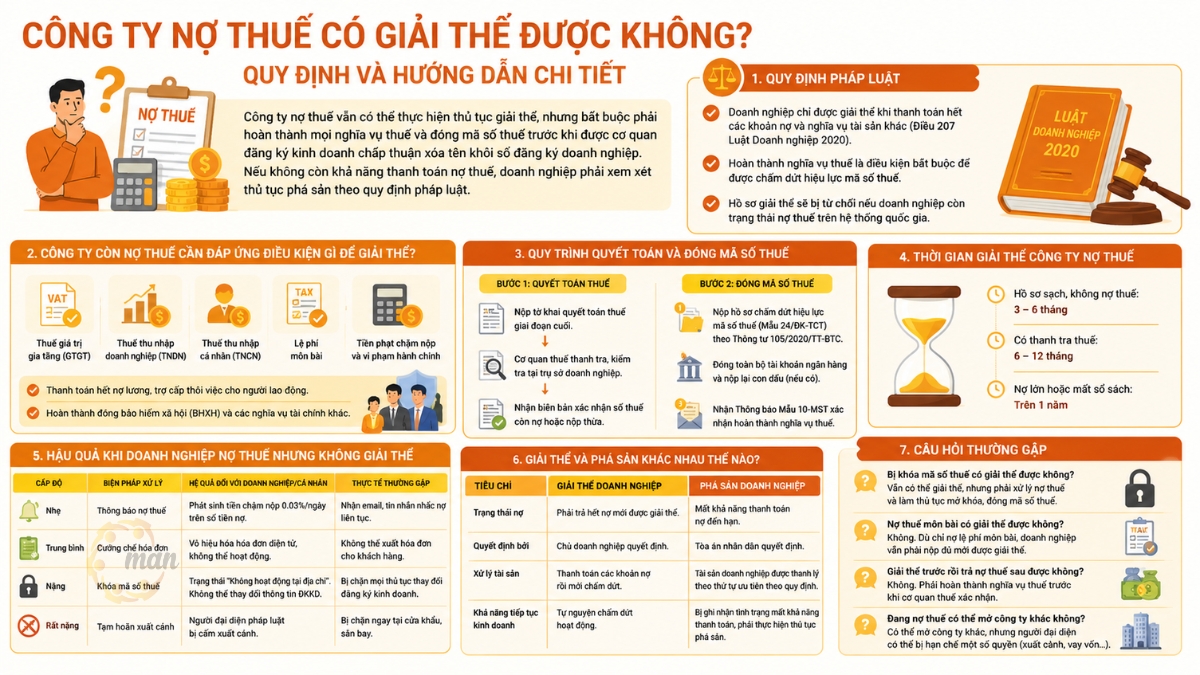
Legal regulations regarding the dissolution of a company while still owing taxes.
According to current Vietnamese law, the right of a legal entity to dissolve is linked to its financial responsibility. This ensures that creditors, especially the state budget, do not suffer losses when an economic entity ceases to exist.
The core principles are defined as follows: Enterprise Law 2020 It is stated that a business can only be dissolved when it ensures that all debts and other financial obligations are fully paid. In particular, fulfilling tax obligations is a mandatory step to receive notification of tax code termination from the directly managing tax authority.
Your dissolution application will be rejected by the system if the business still has outstanding tax debts in the national tax management system. Therefore, to fully answer this question... Can a company that owes taxes be dissolved?, We need to understand that the process can be started but cannot be completed until all taxes have been paid.
Will the dissolution of a company with outstanding tax debts be rejected?
Rejection of applications is a very common scenario when businesses haven't settled their outstanding debts. The main reasons why the process is halted include:
- The national system has not yet received the "Tax obligations fulfilled" status.
- The business has not yet completed the procedure for closing its tax identification number at the local tax office.
- Late payment fees of 0.03%/day are incurred, causing the outstanding balance to fluctuate constantly.
What conditions must a company with outstanding tax debts meet to be dissolved?

For a business with outstanding tax debts to proceed with legal dissolution, the business owner needs to fulfill the following obligations:
- Value Added Tax (VAT): Settlement of accounts up to the point of cessation of operations.
- Corporate income tax (CIT): Based on the final financial report.
- Personal Income Tax (PIT): Settling employee accounts and making payments on their behalf.
- Business license fee: Complete the remaining years.
- Fine: This includes penalties for late payment and administrative penalties for tax violations.
In addition, businesses must settle all outstanding payroll and complete social insurance contributions. This is often the stage where many errors occur due to lost documents, so you should carefully review your records before submitting the official application.
The process of settling accounts and closing the tax code for dissolved businesses.

Processing the tax identification number is the most crucial step in the entire process of dissolving a business that owes taxes. This process consists of two main stages:
Complete tax settlement with the direct tax authority.
Businesses submit their final tax return. The tax authorities will conduct an on-site inspection to verify the actual outstanding tax amount. You will receive a confirmation document stating the remaining tax payable.
Procedures for closing a business's tax identification number.
After paying all taxes as stated in the inspection report, you should proceed as follows:
- Submit the application for termination of tax identification number (Form 24/ĐK-TCT) as follows: Circular 105/2020/TT-BTC.
- Receive the Form 10-MST notification confirming the completion of tax obligations. This is the "passport" to submit documents to the Department of Planning and Investment.
How long does it take to dissolve a company that owes taxes?
- Case with a clean record: 3-6 months.
- In case of a tax audit: 6-12 months (depending on when the tax authorities schedule the work).
- In case of large debts or lost accounting records: This process can take over a year due to the need to recover accounting data.
Consequences when a business owes taxes but fails to go through the dissolution process.
Many businesses choose to cease operations but fail to complete the dissolution process while still owing taxes. Neglecting the business (ceasing operations but not taking steps to legally terminate its status) leads to far worse legal consequences than simply settling the debt.
| Level | Remedial measures | Consequences for businesses/individuals | Common occurrences |
|---|---|---|---|
| Light | Tax debt notice | Late payment fees are incurred daily. | I'm constantly receiving debt reminder emails. |
| Medium | Enforcing invoices | Disable electronic invoices. | It was not possible to sign a new contract. |
| Heavy | Tax code lock | Status: “Not working at this address”. | It is not possible to change any business registration information. |
| Very heavy | Temporary suspension of departure | The representative is banned from leaving the country. | Blocked right at the border crossing. |
Distinguishing between dissolution and bankruptcy when a company owes taxes.
When a business is truly unable to pay its tax debts, the choice between... dissolution and bankruptcy It will depend on the asset's liquidity.
| Criteria | Business dissolution | Business bankruptcy |
|---|---|---|
| Debt status | Debts must be paid off in full before the name can be removed from the register. | Inability to pay debts when they become due. |
| Decision by | Businesses take the initiative to implement it. | The People's Court issued the decision. |
| Asset liquidation | Liquidation to pay off debts to creditors. | Assets are liquidated according to the priority order of payment as stipulated in the Bankruptcy Law. |
| Business potential | Voluntary termination of legal entity existence. | The company has officially declared insolvency. |
Who is responsible for the company's tax debt?
In joint-stock companies or limited liability companies, financial liability is usually limited to the amount of capital contributed. However, if mismanagement or intentional asset concealment to evade tax debts is discovered, the legal representative and shareholders may be held liable with their personal assets or even face criminal prosecution.
Frequently Asked Questions When Dissolving a Company with Tax Debt
Can a company be dissolved if its tax identification number is locked?
How long do I have to wait for my tax identification number to be blocked if I owe taxes?
Can a business be dissolved if it owes business license tax?
Can we dissolve the company first and pay the taxes later?
Is it permissible to open another company while owing taxes?
Conclude
Can a company that owes taxes be dissolved? It's no longer a difficult question if you understand the process: Pay off debts -> Close tax registration -> File dissolution documents. Proactively handling outstanding debts not only helps to professionally close down old business operations but also protects the reputation and personal freedom of the owner. If you encounter difficulties in the settlement process or restoring accounting records, businesses should seek support from professional units to ensure compliance with legal regulations.
Contact information for MAN – Master Accountant Network
- Address: 19A, 43rd Street, Tan Thuan Ward, Ho Chi Minh City
- Mobile/Zalo: 0903 963 163 – 0903 428 622
- Email: man@man.net.vn
Content production is overseen by: Mr. Le Hoang Tuyen – Founder & CEO of MAN – Master Accountant Network, CPA Vietnam with over 30 years of experience in accounting, auditing, and financial consulting.