


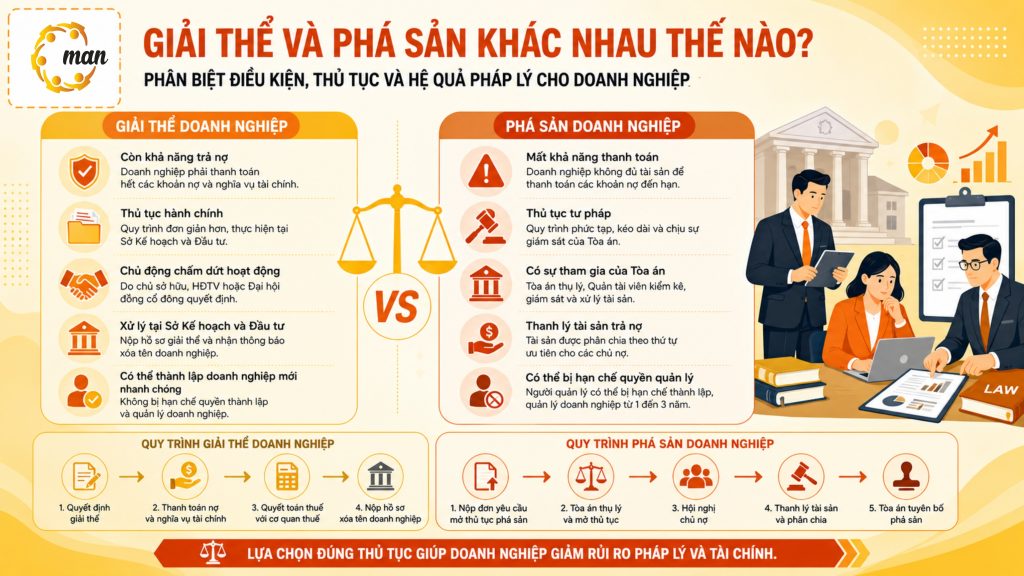
Many business owners wonder about the difference between dissolution and bankruptcy when their company faces financial difficulties or wants to cease operations. While both lead to the cessation of business activity, the legal nature, conditions for implementation, and responsibilities of managers differ significantly. This article will provide a detailed analysis based on the 2020 Enterprise Law and the 2014 Bankruptcy Law to help you gain the most accurate understanding before making this important decision for your legal entity.
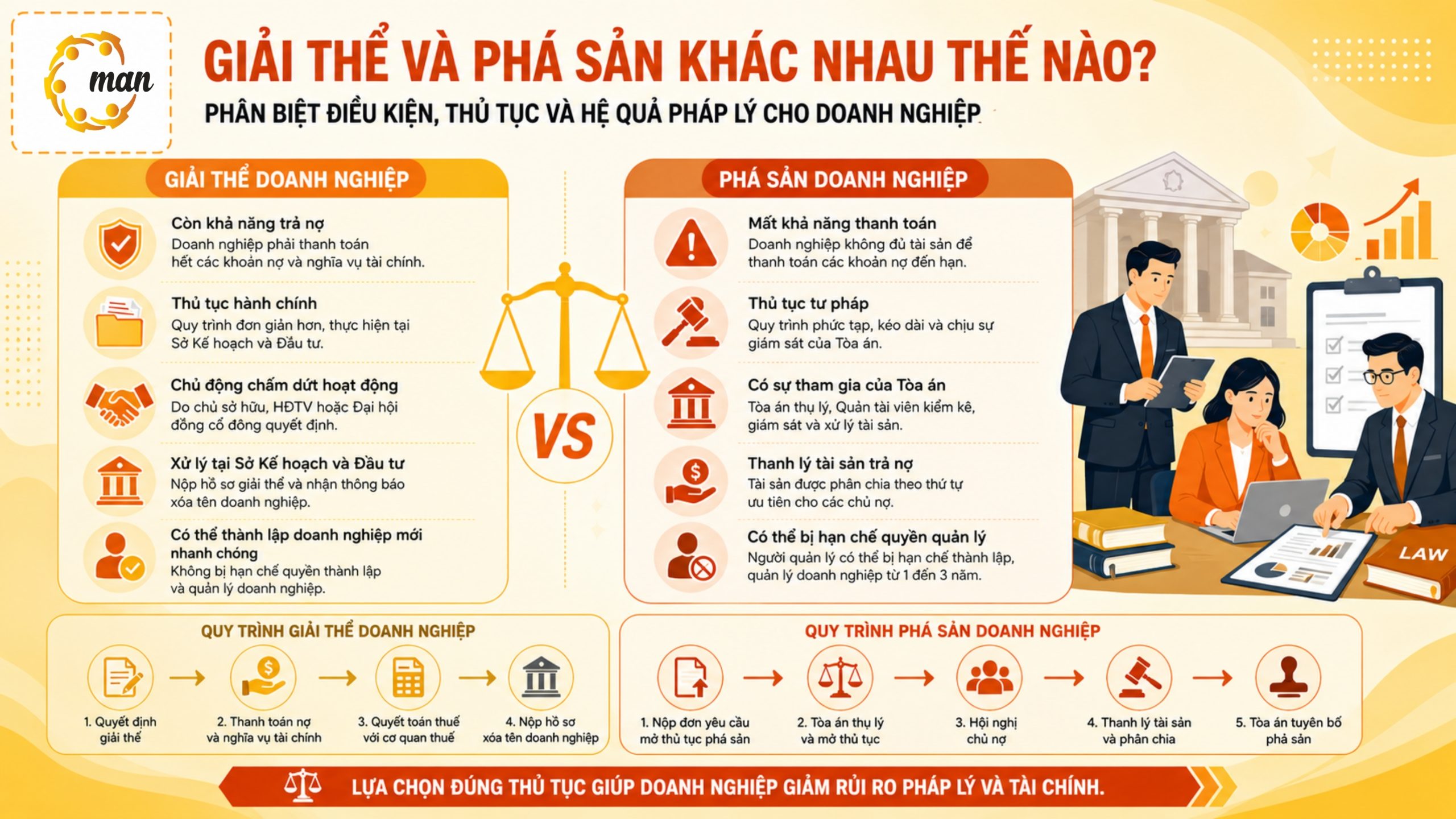
What is the difference between dissolution and bankruptcy? A detailed comparison table.
Quickly grasping the fundamental differences between these two forms will help business owners process their paperwork more quickly and accurately. Below is a summary of the most important criteria for distinguishing between dissolution and bankruptcy:
| Criteria | Business dissolution | Business bankruptcy |
|---|---|---|
| financial status | Be proactive and act quickly; all debts must be paid off. | Passive, complex; inability to repay debts when due. |
| Decision-maker | Owner (Board of Members/Shareholders) | People's Court |
| Conditions for implementation | The business must pay off all its debts. | Insufficient assets to pay off the debt. |
| Procedural nature | Administrative (voluntary or mandatory) | Judicial (complex and lengthy process) |
| Processing agency | Department of Planning and Investment | People's Court |
| Third-party involvement | Optional | There is a Receiver and the Court overseeing the process. |
| Legal consequences | Operations ceased, debts were fully repaid. | Cessation of operations may result in restrictions on business rights. |
| Establish a new company | Allowed to proceed immediately | They may be banned for 1 to 3 years. |
| Level of reputational influence | Low, indicating a proactive retreat. | High, affecting personal profile |
Note: The comparison table above summarizes the quick identification characteristics according to current legal regulations. To ensure legal and tax safety, businesses need to delve into the details of each concept below.
What is business dissolution according to the 2020 Enterprise Law?

Business dissolution is the termination of a business entity's existence, either voluntarily or upon expiration, provided that all debts are paid. It is an administrative process aimed at ending the legal status of a business entity at the will of the owner or due to intervention by regulatory authorities in case of violations.
According to the provisions of Article 207 Enterprise Law 2020, specific cases include:
- The company's operating period, as stated in its Articles of Association, has expired without renewal.
- Voluntary decision by the owner of a private enterprise, the Board of Members, or the General Meeting of Shareholders.
- The company has not had the minimum number of members for six consecutive months.
- The business registration certificate was revoked by the Department of Planning and Investment (mandatory dissolution).
What is business bankruptcy?
Business bankruptcy is a legal situation that occurs when a business entity becomes insolvent and is declared bankrupt by a People's Court. The bankruptcy procedure is essentially a judicial process aimed at declaring a business "dead" because it is unable to fulfill its financial obligations.
According to Article 4 Bankruptcy Law 2014, To identify a business that is going bankrupt, you should look for the following signs:
- The business is unable to pay its debts when they become due.: This refers to the failure to fulfill payment obligations for a debt within 3 months of its due date.
- Court interventionUnlike dissolution, bankruptcy involves the direct participation of the Court and Receiver to divide the remaining assets proportionally among the creditors.
When is a business required to file for bankruptcy?
In management, sometimes "reorganization" is no longer effective and bankruptcy becomes a mandatory legal obligation:
- The inability to pay debts due has lasted for more than 3 months.
- The legal representative, director, or chairman of the board of directors is responsible for submitting the application for opening. business bankruptcy procedures if it is determined that the company no longer has the financial resources.
- Liability riskIf a business is already in negative equity but its managers intentionally engage in asset disposal transactions or fail to file for bankruptcy on time, they may be held jointly liable with their personal assets and have their right to establish new businesses restricted.
Distinguishing between dissolution and bankruptcy from a legal perspective.
To understand the differences between dissolution and bankruptcy, we need to analyze the entities and legal processes involved in depth.
Financial conditions for implementation
Business dissolution is only possible when the entity guarantees the payment of all debts and other financial obligations. Unlike bankruptcy, a business is not allowed to voluntarily close its tax registration number until all debts are paid. In contrast, bankruptcy allows a business to close down even if it no longer has sufficient assets to pay off all debts.

The entity with the right to decide
While dissolution is the self-determination of the business owner, bankruptcy is a judgment of the People's Court. In bankruptcy, the business owner's control over assets is limited and partially transferred to another party. Receiver monitor.
Implementation sequence and procedures
Business dissolution process Simpler administrative procedures:
- Through the decision to dissolve.
- Liquidate assets and settle debts to partners and outstanding salaries.
- Set up a tax settlement with the local tax authority.
- Remove the name from the Department of Planning and Investment.
The corporate bankruptcy process is more complex and time-consuming:
- Submit the application to the court.
- The court accepts the case and the receiver inventories the assets.
- Convene a creditors' meeting.
- Liquidate remaining assets, distribute them proportionally, and declare bankruptcy.
Should a business be dissolved or declared bankrupt in each case?
Based on the advice provided at MAN – Master Accountant Network, the choice depends on your financial health:
- It should be dissolved whenThe company still has the ability to repay its debts, wants to withdraw smoothly and protect its reputation, and will establish a new company immediately afterward.
- When should you go bankrupt?Businesses with high levels of debt and inability to pay their debts when due can benefit from this legal shield, which helps business owners avoid violent debt collection tactics and resolve their debts in accordance with the law.
Practical exampleA construction company with outstanding tax and social insurance debts will have its tax identification number suspended and will be unable to dissolve. At this point, if recovery or reorganization is impossible, filing for bankruptcy is the only way to terminate the legal liability of the representative. In reality, many business owners have had their tax identification numbers suspended indefinitely due to attempts to dissolve before settling their tax obligations.
Which is better: dissolution or bankruptcy?
The answer depends on your goals. Dissolution is better in terms of time and procedure if you have sufficient finances. This form of dissolution helps you maintain a clean personal record so you can immediately move on to other business ventures.
Bankruptcy is a better option if you want to legally terminate your debt obligations when you are no longer able to pay. It prevents personal financial ruin under the pressure of an inability to repay debts. Accurately assessing your debt situation and ability to pay from the outset will help you make the most appropriate choice, thereby reducing the risk of prolonged legal liability.
Order of debt payment during dissolution and bankruptcy
The order of payment priority is a key point in both procedures:
Regarding business dissolution:
- Unpaid wages, benefits, and social insurance contributions for employees.
- Tax debt at the Tax Office.
- Unsecured debts to partners.
- The remaining assets are divided among the contributing members.
Regarding corporate bankruptcy (Article 54 of the 2014 Bankruptcy Law):
- Bankruptcy costs (Administrator fees, court fees).
- Unpaid wages and insurance contributions for employees.
- Debts incurred after the commencement of business recovery proceedings.
- Financial obligations to the State (tax debt).
- Unsecured debt for creditors.
Frequently Asked Questions about Dissolution and Bankruptcy
Can a company that owes taxes be dissolved?
Can a heavily indebted business be dissolved?
Is it possible to transition from dissolution to bankruptcy?
How long does a business bankruptcy procedure take?
What are the consequences of being declared bankrupt?
Conclude
Understanding the difference between dissolution and bankruptcy helps you choose the right path to cessation of operations. Businesses should carefully assess their financial status and tax obligations before choosing the appropriate procedure to avoid prolonged legal risks. If you need in-depth support with debt review and legal documentation, experts at MAN – Master Accountant Network are always ready to work with you to find the safest exit solution.
Contact information for MAN – Master Accountant Network
- Address: 19A, 43rd Street, Tan Thuan Ward, Ho Chi Minh City
- Mobile/Zalo: 0903 963 163 – 0903 428 622
- Email: man@man.net.vn
Content production is overseen by: Mr. Le Hoang Tuyen – Founder & CEO of MAN – Master Accountant Network, CPA Vietnam with over 30 years of experience in accounting, auditing, and financial consulting.