



Professional license: CPA Vietnam Auditors
Experience: Over 30 years of experience in Accounting, Auditing, and Financial Consulting.
The business dissolution procedure is the process of terminating the legal status of a business after it has disposed of its assets, paid its debts, and fulfilled its tax obligations as required. A business can only be dissolved when it ensures that all debts and other financial obligations have been paid and it is not currently involved in any disputes in court or arbitration.
For businesses with outstanding accounting, invoicing, labor, or debt, dissolution is not simply a matter of submitting a set of documents to the business registration authority. Businesses need to simultaneously handle asset liquidation, settlement of obligations, tax processing, and dissolution registration.
Legal basis for business dissolution
The regulations regarding business dissolution are currently implemented primarily on the basis of... Law on Enterprises No. 59/2020/QH14 and regulations on business registration. Decree 168/2025/ND-CP was issued by the Government on June 30, 2025, and came into effect on July 1, 2025. Decree 296/2026/ND-CP was issued and came into effect on July 23, 2026, amending and supplementing some provisions of Decree 168/2025/ND-CP.
For dissolution registration procedures, businesses can directly refer to the current guidelines. National portal for business registration, which publishes the required documents and procedures for registering for dissolution.
Key factors include:
- The Enterprise Law No. 59/2020/QH14, promulgated on June 17, 2020, came into effect on January 1, 2021.
- Government Decree 168/2025/ND-CP dated June 30, 2025, on business registration, takes effect from July 1, 2025.
- Government Decree 296/2026/ND-CP, effective from July 23, 2026, amends and supplements some provisions of Decree 168/2025/ND-CP.
Conditions for dissolving a business
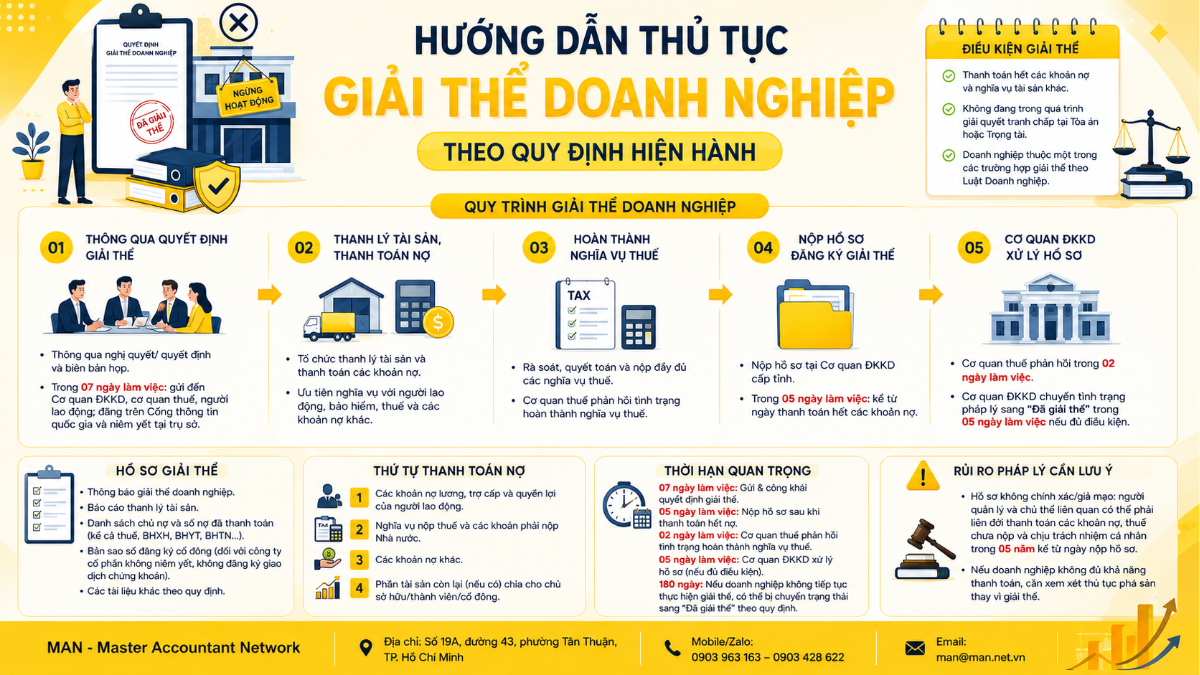
A business can only be dissolved when it has ensured that all debts and other financial obligations have been paid, and it is not currently involved in any ongoing disputes in court or arbitration. This is a core condition that distinguishes dissolution from a business that is no longer able to pay its debts and requires bankruptcy proceedings.
Cases of business dissolution
Businesses may be dissolved upon the expiration of their operating term without renewal; by resolution or decision of a competent authority; when they no longer have the minimum number of members required by law without changing their legal form; or in cases where the business registration certificate is revoked and the law permits dissolution.
These cases need to be properly identified according to the specific type and legal status of the business. For businesses with foreign investment, the review of business registration documents and project documents should also be carried out simultaneously.
Businesses can cross-reference additional information about Enterprise Registration Certificate (ERC) when reviewing the business registration status before carrying out the procedure for ceasing operations.
Conditions regarding debt and disputes
Having outstanding debts does not mean a business can disregard its payment obligations to complete the dissolution process. A crucial condition is that the business must ensure all debts and other financial obligations are paid before the dissolution is finalized, and that it is not currently involved in any ongoing disputes in court or arbitration.
Before deciding to dissolve, businesses should review their accounts payable, accounts receivable, ongoing contracts, obligations to employees, and tax obligations. This step helps prevent situations where legal procedures have been initiated but the dissolution process is delayed due to unresolved obligations.
Business dissolution process
The process of dissolving a business can be viewed as a series of steps: making a dissolution decision, disclosing information, liquidating assets and settling obligations, completing tax procedures, and then submitting the dissolution registration application to the provincial business registration authority.
Step 1. Pass a resolution or decision to dissolve.
The resolution or decision to dissolve serves as the basis for initiating the process. This document must include key information such as the name, registered office address, reason for dissolution, timeframe and procedures for contract liquidation, debt settlement, plan for handling obligations arising from employment contracts, and the signature of the authorized person.
Within the timeframe 7 working days From the date the resolution or decision to dissolve is adopted, the enterprise shall submit and disclose information as prescribed. The resolution or decision to dissolve and the meeting minutes must be sent to the Business Registration Authority, the tax authority, and the employees of the enterprise; and shall also be publicly disclosed as prescribed.
Step 2. Liquidate assets and pay off debts.
After the dissolution decision is approved, the business organizes the liquidation of assets and fulfills outstanding financial obligations. The liquidation must be carried out based on actual accounting data and liabilities to ensure that the list of creditors, the amount of debt paid, and the asset liquidation report are consistent.
In practice, accountants should review the following groups of obligations:
- Accounts receivable and accounts payable.
- Wages, allowances, and related benefits for employees.
- Insurance payments are still due.
- Taxes and other payments due to the state budget.
- Obligations arising from contracts with customers, suppliers, and related parties.
- Assets, inventory, and items that need to be disposed of before the liquidation process is complete.
The decision to dissolve does not eliminate existing financial obligations. The business must still handle these obligations during the liquidation process.
Step 3. Fulfill your tax obligations.
Fulfilling tax obligations is a crucial part of the dissolution process. After a business completes the dissolution registration procedure, the provincial business registration authority sends information to the tax authority to coordinate in determining the status of tax obligation fulfillment as prescribed.
Businesses need to review their tax obligations and accounting records before requesting confirmation of tax compliance. It should not be assumed that filing for dissolution automatically means the business has fulfilled its tax obligations.
From a professional standpoint, this is also the stage where accounting data should be compared with tax returns, invoices, and accounts payable. If discrepancies are found, addressing them before finalizing the dissolution process will help reduce the risk of requiring additional documentation or delays.
Step 4. Submit the dissolution registration application to the Business Registration Authority.
After settling all debts, the business submits a dissolution registration application to the provincial business registration authority where its head office is located. According to current regulations, the dissolution registration application must be submitted within 5 working days from the date all debts are settled.
The core documents include the Notice of Business Dissolution; the Business Asset Liquidation Report; a list of creditors and the amount of debt paid, including tax debts and employee insurance contributions, as applicable. Instructions for registering for the current tournament. This is the official source for verifying the components of the application and forms at the time of submission.
Step 5. The business registration authority processes the dissolution application.
After receiving the dissolution registration application, the provincial business registration authority coordinates with the tax authority to determine the status of tax compliance. According to the procedures stipulated in Decree 168/2025/ND-CP and updated by Decree 296/2026/ND-CP, there are interconnected processing milestones between the business registration authority and the tax authority that businesses need to monitor.
Decree 296/2026/ND-CP has amended several regulations related to the dissolution process and updating the legal status of enterprises. Enterprises can refer to MAN's professional analysis regarding this matter. Decree 296/2026/ND-CP and new points regarding business registration. when preparing documents according to applicable regulations.
Documents required for business dissolution
The dissolution dossier must reflect that the enterprise has completed the liquidation and settlement of related obligations. According to current guidelines on the National Business Registration Portal, the dissolution registration dossier includes: Notice of Enterprise Dissolution; Report on Liquidation of Enterprise Assets; List of Creditors and the amount of debt paid, including tax and employee insurance debts, as applicable.
Key documents include:
- Notice of business dissolution.
- Report on the liquidation of company assets.
- A list of creditors and the amount of debt paid, including tax debts and employee insurance contributions.
- Other relevant documents may be required depending on the specific type and circumstances, as required by law.
For businesses with foreign investment, the business registration documents and project documents need to be reviewed simultaneously. Businesses can refer to the following information: IRC Investment Registration Certificate To identify the project information that needs to be cross-referenced when handling the legal status of FDI enterprises.
A key point when preparing the documentation is that the figures in the liquidation report, the list of creditors, and the accounting documents must be consistent. Legal documents should not be prepared separately from the accounting records and the actual debt situation.
Deadline for business dissolution
There is no fixed timeframe for business dissolution that applies to all cases. The actual time depends on asset liquidation, debt settlement, tax obligations fulfillment, and the status of the documentation. Notable milestones include 7 working days for sending and publicizing the dissolution decision, 5 working days for submitting the dissolution registration documents after all debts have been settled, and the processing deadlines for inter-agency coordination between the Business Registration Authority and the Tax Authority.
The 180-day milestone in the dissolution process.
180 days is a particularly important milestone in the dissolution process. According to current regulations, after this period from the date the provincial business registration authority notifies the company that it is undergoing dissolution procedures, if no dissolution registration documents are received and no written objections are submitted as required by law, the company's legal status may be changed to "already dissolved".
Therefore, businesses should not interpret 180 days as a period during which they can neglect the dissolution process. If they wish to halt the dissolution, they must carry out the procedure to revoke the resolution or decision on dissolution within the conditions and timeframe prescribed by law.
Order of payment when dissolving a business
The order of payment has a direct impact on the rights of employees, the State, and creditors. Businesses need to fully determine their obligations before disposing of remaining assets for owners, members, or shareholders.
In principle, businesses must settle their debts and financial obligations in accordance with the Enterprise Law before completing the dissolution process. For accounting purposes, a safe approach is to create a separate reconciliation statement between liquidable assets and all liabilities. This helps to detect early cases where the asset value is insufficient to cover obligations, thereby reassessing the feasibility of the dissolution procedure.
Legal risks when dissolving a business.
Proper dissolution procedures depend not only on the acceptance of the application but also on the honesty and accuracy of the application. Managers and relevant parties need to pay particular attention to this issue.
Responsibility for inaccurate dissolution documents
If the dissolution documents are inaccurate or fraudulent, the responsible parties may be jointly liable for the payment of outstanding employee benefits, unpaid taxes, and other unpaid debts, and will also be held personally liable under the law for any consequences arising within 5 years from the date of filing the dissolution documents, as stipulated in the Enterprise Law.
Therefore, cross-checking the data before signing the documents is of particular importance. A dissolution application should not only be checked for formality but also compared with actual accounting records, accounts payable, payment documents, and tax obligations.
Risks associated with outstanding debts or tax obligations.
One common mistake is that businesses focus on the dissolution registration procedures but fail to fully address their financial obligations. This can prolong the dissolution process because the competent authority may not yet be able to confirm the fulfillment of these obligations.
For businesses with active accounting, at least three layers of data should be reconciled: accounting figures, tax records, and actual accounts payable. If these three sets of data are inconsistent, the business should resolve the discrepancies before finalizing the dissolution process.
In the event that the business is no longer able to pay its debts.
Dissolution and bankruptcy are not two procedures that can be arbitrarily substituted. The conditions for dissolution require the business to ensure that all debts and other financial obligations are fully paid. If the business is actually unable to fully pay its obligations, the business owner and managers need to assess the possibility of applying bankruptcy law instead of simply continuing to prepare dissolution documents.
Common misunderstandings when going through the dissolution process.
Several misunderstandings can lead businesses to misjudge the progress or risks of their dissolution filing. Firstly, filing for dissolution does not mean fulfilling tax obligations. Secondly, receiving a dissolution decision does not mean the business immediately ceases all obligations. Thirdly, 180 days is not a period during which a business can neglect its filing. Fourthly, the dissolution filing must be consistent with the business's actual situation.
Expert perspective from MAN
From an accounting and tax perspective, the dissolution process should be prepared as a final reconciliation process for the business, rather than simply being viewed as a procedure for terminating registration.
The key area for control is consistency among four data sets: legal records, accounting books, tax obligations, and actual liabilities. When these four data sets are cross-checked before filing, businesses can proactively identify outstanding debts, tax obligations, or assets instead of waiting for problems to arise during government inspections and coordination.
MAN – Master Accountant Network provides consulting solutions on accounting, taxation, investment certificates, and business registration. For FDI businesses, simultaneously reviewing business and investment documents can help minimize information discrepancies when carrying out procedures for ceasing operations.
Conclude
The business dissolution procedure needs to be carried out in a unified sequence, from the dissolution decision, public disclosure of information, asset liquidation, debt settlement, fulfillment of tax obligations, to submission of the dissolution registration application. Two factors that need to be controlled throughout are the ability to fully settle obligations and the accuracy and consistency of legal, accounting, and tax records.
For businesses with significant outstanding debts, assets, labor, or tax obligations, reviewing accounting and tax records before beginning dissolution procedures will provide a more proactive approach to the cessation of operations. Foreign-invested enterprises should also simultaneously check the information in their business registration and investment documents before completing the procedures.
Primary legal source
Frequently Asked Questions about Business Dissolution Procedures
Can a company that is still in debt be dissolved?
A business can only be dissolved when it ensures that all debts and other financial obligations are fully paid, and it is not currently involved in any ongoing disputes in court or arbitration as stipulated by the Enterprise Law. If the business is unable to pay its debts in full, the possibility of applying bankruptcy proceedings must be assessed.
How long does it take to dissolve a business?
There is no fixed timeframe for the entire dissolution process. The actual time depends on asset liquidation, debt settlement, tax fulfillment, and paperwork processing. The milestones of 7 working days, 5 working days, and 180 days have different meanings depending on the stage.
Is it possible to reverse a dissolution decision after giving notice?
The procedure for revoking a resolution or decision to dissolve a business can be carried out under the conditions and time limits prescribed by law, provided the business has not yet been declared dissolved. Businesses must use the correct current documents and forms when carrying out this procedure.