


What steps are needed to dissolve a company? This is a common question among business owners when their business is no longer profitable or requires strategic restructuring. However, the process of dissolving a business is not simply about ceasing operations; it also involves numerous legal procedures, tax obligations, and employee rights. This article will provide detailed guidance. company dissolution procedures The latest from AZ, helping businesses complete their paperwork correctly and minimize potential risks.
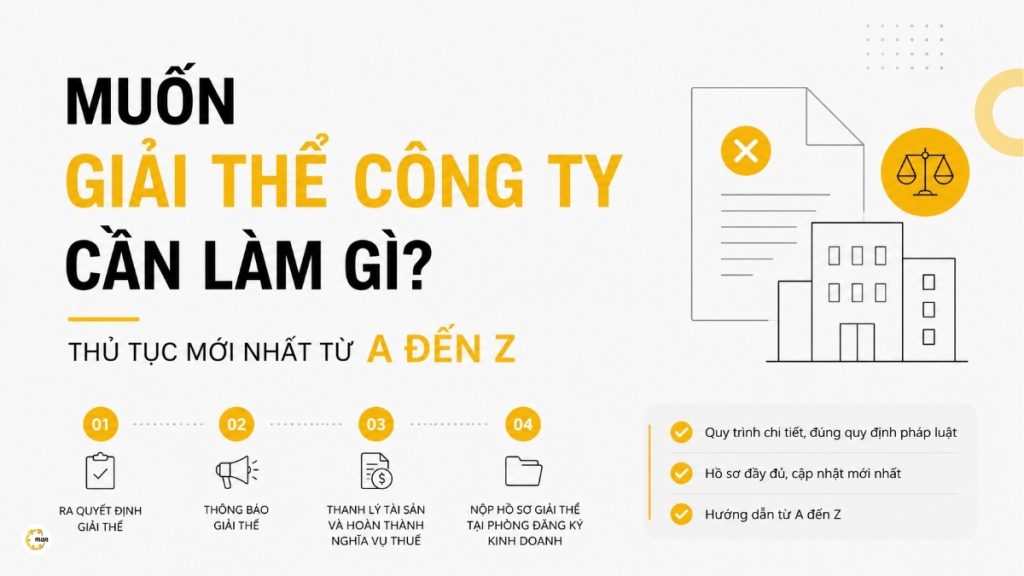
To help you easily visualize and allocate resources effectively, the summary table below outlines the entire business closure process through four core stages.
| Steps to take | Core content | Receiving/Coordinating Agency |
|---|---|---|
| Step 1: Make a decision | Through Resolution/Decision and Minutes of Meeting regarding dissolution | Internal business |
| Step 2: Announce dissolution | Publish information on the National Information Portal, send notifications to creditors and employees. | Business Registration Office (Department of Planning and Investment) |
| Step 3: Liquidation and Taxes | Set up tax settlement, close tax registration number, and pay off debts. | Tax Authority, Customs, Bank |
| Step 4: Submit the completed application. | Submitting documents to terminate the business's existence. | Business Registration Office (Department of Planning and Investment) |
When does a business need to be dissolved?

Business dissolution is the termination of a business entity's existence, as officially recognized by the state authorities. It's not simply a matter of ceasing transactions, but a legal process requiring precision at every step.
Cases of dissolution as prescribed by law.
Based on the provisions of Article 207 Enterprise Law 2020, A business proceeds with dissolution in the following specific circumstances:
- Expiration of operating period: When the term of operation stated in the company's charter has expired and the members or shareholders do not wish to renew it.
- Voluntary decision: According to the decision of the owner of a private enterprise, of the Board of Members for a limited liability company, and of the General Meeting of Shareholders for a joint-stock company.
- Not enough members to meet the minimum requirement: The company no longer has the minimum number of members required by law for a continuous period of 06 months without undergoing the procedure to change its business type.
- Business registration certificate revoked: This is a case of mandatory dissolution when a business violates the law or its business license is forcibly revoked by a state management agency.
What steps are needed to dissolve a company?

When considering ceasing operations, many business owners often make the mistake of submitting further applications to the Department of Planning and Investment. This can lead to repeated rejections of applications because the business has not yet fulfilled its outstanding obligations.
What preparations are needed before dissolving a company?
For a smooth dissolution process, proactively checking and addressing internal issues is crucial. Below is a checklist of core tasks a business needs to complete before officially submitting its dissolution notice to the relevant authorities:
- Check the business's operational status: Ensure the business's tax identification number is not blocked due to abandoning its business address or is not subject to administrative enforcement measures from government agencies.
- Check for outstanding tax obligations: Review all VAT, corporate income tax, and personal income tax returns and settle any late payment penalties to avoid having your tax identification number blocked by the tax authorities.
- Review accounts receivable and payable with customers and partners: Compare and collect all accounts receivable, and settle all accounts payable to clean up the books and avoid civil disputes.
- Fulfilling employee rights: Paying full wages, severance pay, social insurance, health insurance, and completing the social insurance record closing process for employees before terminating their contracts.
- Check unused invoices: Complete the procedure for canceling unused invoice numbers and submit the final invoice usage report to the relevant tax authority.
- Termination of operations of branches, representative offices, and business locations: You are required to complete the procedures for terminating the operations of all these dependent units before proceeding with the dissolution of the parent company.
Conditions for a business to be dissolved
Not every business can immediately close its tax registration and remove its name from the system when needed. Whether dissolved voluntarily or involuntarily, Article 207 of the 2020 Enterprise Law emphasizes that a business can only be dissolved when it ensures that all debts and other financial obligations have been fully paid.
Specifically, you must meet all four of the following prerequisites:
- Pay off all debts: This includes bank debt, supplier debt, personal debt, and financial obligations arising from economic contracts.
- Fulfill your tax obligations: Businesses must receive a notice of completion of tax obligations (decision to close the tax code) from the tax authority directly managing them.
- Addressing workers' rights: Full payment of salary, unemployment benefits, social insurance contributions, and completion of all procedures for terminating the employment contract as required.
- Not currently in dispute resolution: The business must not be involved in any dispute resolution process at any court or commercial arbitration body.
The company dissolution process consists of four detailed steps.
The company dissolution process typically involves the following four main steps. To successfully complete this procedure, businesses need to follow a strict sequence as stipulated in the 2020 Enterprise Law and Decree 01/2021/ND-CP.
Step 1. Make the decision to dissolve.
The first step in the dissolution process is to issue a dissolution decision in accordance with the proper authority.
Who has the authority to decide on dissolution?
This authority rests with the owner of a single-member limited liability company; the Board of Members of a limited liability company with two or more members; the General Meeting of Shareholders of a joint-stock company; and the partners of a partnership company.
What does the dissolution decision include?
The dissolution decision must include the following key contents: name and address of the head office; reason for dissolution; timeframe and procedures for contract liquidation and debt payment; plan for handling employee benefits; full name and signature of the legal representative.
Step 2. Announce the dissolution of the business.
Once the decision is approved, this information needs to be widely publicized to protect the rights of third parties doing business with the company.
Deadline for submitting dissolution notice
Within 7 working days from the date of approval, the dissolution decision and meeting minutes must be sent to the Business Registration Office, the tax authority, and the employees of the enterprise.
Public disclosure of dissolution information as required by regulations.
The dissolution decision must be published on the National Business Registration Portal and publicly displayed at the head office, branches, and representative offices of the enterprise.
Notify creditors and employees.
If a business still has outstanding financial obligations, the dissolution notice, along with a debt settlement plan (clearly stating the amount of debt, deadlines, and payment methods), must be sent directly to creditors and other interested parties.
Step 3. Liquidate assets and fulfill tax obligations.
This is the most complex stage in the business dissolution process, requiring in-depth accounting expertise to finalize accounts and explain data to tax authorities.
The assets of the business, after liquidation, will be prioritized for payment in a strict order as specifically defined below.
| Order of priority | Accounts payable |
|---|---|
| 1 | Salary, severance pay, social insurance, health insurance, unemployment insurance, and other employee benefits as stipulated in the signed contract. |
| 2 | Tax debts and other payments to the state budget. |
| 3 | Other liabilities to partners, suppliers, banks, or credit institutions. |
| 4 | Any remaining assets (if any) are distributed to the business owner, members, or shareholders in proportion to their capital contribution. |
Complete tax settlement upon dissolution.
Businesses must submit tax settlement documents up to the time of dissolution to the supervising tax authority, including corporate income tax settlement, personal income tax settlement, and complete the audit of accounting records at the headquarters.
Close the business tax code.
Once a business has fulfilled all its tax obligations and completed the tax audit, the tax authority will issue a Notice regarding the termination of the taxpayer's tax identification number.
Processing unused invoices
Along with tax settlement, businesses must cancel invoices that are no longer in use and prepare a final invoice usage report to submit to the General Department of Taxation's system.
Terminate the operations of branches and representative offices.
All branches and representative offices affiliated with the company must complete the procedures for ceasing operations and closing their dependent tax identification numbers before the parent company proceeds to close its final tax identification number.
Step 4. Submit the dissolution application to the Business Registration Office.
After fulfilling its tax obligations and receiving confirmation from the tax authorities that its tax identification number has been closed, the business enters the final legal stage to have its name removed from the system.
Procedure for processing dissolution documents
The Business Registration Office receives the application and checks its validity. If there are no objections from the tax authorities or other relevant parties, the business registration office will update the legal status of the business to "Dissolved".
Results after completing the dissolution procedures.
The business will receive a Notice of Dissolution/Termination of Business. From this point onwards, the business officially ceases to be a legal entity.
What documents are required for company dissolution?
In order for the business registration authority to have a legal basis to process the request for cessation of operations, the business needs to prepare a complete and accurate set of documents as prescribed. Decree 01/2021/ND-CP.
Components of a business dissolution application
A complete business dissolution application submitted to the Business Registration Office includes the following core documents:
- Notification of business dissolution: Use the general form specified in Appendix II-22 issued with Circular 01/2021/TT-BKHĐT.
- Dissolution decision: A document expressing the intention of the owner or the highest-ranking authorized person to close down the business.
- Minutes of the dissolution meeting: Minutes recording the process and results of the voting on the dissolution of the Board of Members or the General Meeting of Shareholders.
- List of creditors and debts paid: A commitment to pay all debts, including tax debts and social insurance contributions.
- List of employees and their corresponding benefits: A detailed report on the handling of labor issues and a commitment to ensuring that all their rights have been fully fulfilled.
- Asset liquidation report: A document detailing the plan and results for the distribution and liquidation of all existing assets of the enterprise.
- Business registration certificate: Original Business Registration Certificate or Business and Tax Registration Certificate.
What information should a company dissolution decision form include?
The dissolution decision is the highest-ranking legal document in the file. A standard dissolution decision template should include the following information: business information (Name, Business Registration Number, Address); specific reasons for dissolution; plan for asset liquidation and debt settlement; plan for employee utilization; full name and signature of the legal representative representing the members/shareholders.
Where should the dissolution documents be filed?
Businesses can choose one of the following two flexible application methods:
- Submit directly at the Business Registration Office: Submit paper documents directly at the one-stop service department of the Department of Planning and Investment of the province/city where the enterprise's head office is located.
- Submit online via the National Business Registration Portal: Scan all documents in PDF format, and use your business registration account or public digital signature to submit the application online through the Ministry of Planning and Investment's system.
In what cases is a business not allowed to be dissolved?
Simply filing for dissolution and declaring closure doesn't automatically resolve all legal responsibilities. The law stipulates certain circumstances under which businesses are absolutely not permitted to dissolve, in order to protect the rights of all stakeholders.
| Case | Can it be dissolved? | Important notes |
|---|---|---|
| The company still owes taxes. | Are not | The tax authorities will not approve the closure of a tax identification number if the business has not paid all outstanding taxes or late payment penalties. |
| Failure to fulfill obligations to employees. | Are not | Unresolved labor disputes or complaints regarding wages, benefits, or social insurance will block the dissolution process. |
| There is a dispute currently underway in court or arbitration. | Are not | The dissolution proceedings will be suspended until a final, legally binding judgment is issued. |
| Not all debts have been paid off. | Are not | If a creditor submits a written objection accompanied by evidence of unpaid debts, the dissolution process will be temporarily suspended. |
| Currently under tax enforcement | Are not | Businesses whose accounts are frozen or whose invoices are suspended due to tax enforcement cannot proceed with the next steps. |
How long does it take and how much does it cost to dissolve a company?
Time and cost are always the two biggest questions for business owners when considering ceasing operations. In reality, this process takes significantly more time and effort than the initial business establishment process.
How long does it take to dissolve a company?
The total time required to dissolve a typical business ranges from 3 to 6 months, and can even extend to 1 to 2 years for large businesses with many branches or complex accounting systems with numerous errors.
- Timeframe for each stage: The process of notifying the Department of Planning and Investment about the dissolution only takes 5 to 7 working days. However, the tax settlement phase at the directly managing tax authority takes the majority of the time, usually lasting from several months to six months. The final stage of submitting the documents to remove the company's name from the registration office takes approximately 5 working days.
- Factors affecting the dissolution process: This progress is heavily influenced by the transparency and accuracy of the company's accounting records over the years, the speed of debt collection, and the resolution of employment contract termination agreements.
What are the costs involved in dissolving a company?
Regarding state fees payable at the Business Registration Office, this procedure is completely free. However, businesses will need to budget for a range of expenses. business dissolution costs Other issues may arise:
- Tax settlement costs.
- Costs of closing a branch.
- Costs of company dissolution services.
- Late payment penalties (if any).
What are the differences in the procedures for dissolving a limited liability company (LLC) and a joint-stock company?
Depending on the legal form of the business, the decision-making structure and the required dissolution documents will differ in specific ways, as stipulated in the Enterprise Law.
Dissolution of a limited liability company
For limited liability companies, the decision to dissolve rests entirely with the board of members (for companies with two or more members) or the owner (for single-member companies). This procedure is generally simpler due to the smaller number of contributing members and the streamlined management structure.
Dissolution of a joint-stock company
The process of a joint-stock company requires approval from the general meeting of shareholders through a resolution. The complex shareholder structure and large number of shareholders often prolong the process of reaching consensus and liquidating assets.
Dissolution of a private enterprise
This type of business has the simplest dissolution procedure, as the sole proprietor decides the dissolution themselves and bears unlimited liability for the business's debts using all of their personal assets.
| Criteria | One-Member Limited Liability Company | Limited Liability Company with 2 or more TVs | Joint Stock Company | Private Enterprise |
|---|---|---|---|---|
| Decision-making authority | Company owner | Board of Members | General Shareholders' Meeting | Private business owner |
| Internal document | Decision to dissolve | Decision + Minutes of the Board of Members Meeting | Resolution + Minutes of the Shareholders' General Meeting | Decision to dissolve the business by the business owner. |
| Level of procedural complexity | Short | Medium | High | Very low |
| Property liability | Limited within the scope of registered capital. | Limited by the amount of capital contributed. | Limited to the extent of share ownership. | Unlimited, equal to all personal assets. |
Some important points to note when wanting to dissolve a company.
To avoid potentially damaging legal consequences even after the business has completed the dissolution process on paper, business owners should keep the following points in mind:
- You should not stop filing your tax return before the process is complete. Until the tax authorities officially issue a notice closing your business's tax identification number, you are still obligated to submit all tax returns by the deadline. Sudden cessation of filing will result in the application of progressive late filing penalties, which can amount to a large sum.
- Businesses that have ceased operations for years should not be left unattended: Arbitrarily closing an office or abandoning a business address without notification will result in the business having its tax identification number locked due to the abandonment of the business address. Dealing with the consequences to restore the tax identification number for future dissolution will be complicated and costly in terms of administrative penalties.
- Accounting records need to be preserved after dissolution: According to accounting law, accounting documents and records related to a business's operations must be stored for a minimum of 10 years in a secure location to facilitate unannounced inspections and audits by relevant authorities when necessary.
- Complete all obligations to employees before submitting your application: Any disputes regarding employee rights that are not resolved before the final dissolution application is submitted may result in the application being rejected, prolonging the processing time.
Should you hire a company dissolution service?
When faced with the decision to dissolve a business, many owners often hesitate between two options: doing it themselves to save costs, or entrusting the entire process to a professional external service provider.
Cases where the business can do it itself.
Businesses can absolutely handle the dissolution process themselves if they are small in scale, have a short operating history, generate few invoices and supporting documents, have a clear and coherent accounting system, and have no outstanding tax debts or debts to partners. At the same time, the company's internal accounting staff must have strong professional competence and a deep understanding of the tax settlement process to directly explain the documentation.
When should you use a full-service company dissolution service?
Conversely, you should consider seeking professional services if your business falls into the following categories:
- Businesses that have been operating for many years have a large volume of invoices and documents, and their accounting records from different periods may be lost or contain many errors and inconsistencies in the data.
- The company has numerous branches and representative offices located in various provinces and cities.
- The management team is busy with new business projects and doesn't have time to travel and work directly with government agencies to resolve emerging issues.
- The internal accounting staff has left, and there is no one familiar with the old accounting system to provide explanations when the tax authorities conduct a final audit.
Criteria for selecting a reputable consulting firm
A reputable dissolution consulting firm must be a legally registered entity with a team of licensed and experienced lawyers, tax experts, and chief accountants. The firm should offer a clear work plan, commit to maximum confidentiality, and provide a transparent, all-inclusive price list with no hidden costs throughout the process.
If handling accounting records or preparing tax returns is too complex, businesses can seek assistance from MAN – Master Accountant Network. With the package company dissolution services professional, especially Reputable company dissolution services in Ho Chi Minh City, MAN will handle the entire process on behalf of the business, from cleaning up accounting records and closing tax codes to removing the name from the system. This gives business owners complete peace of mind and saves them maximum time to focus on new business plans.
Conclude
Business dissolution is a complex legal process consisting of four steps: making a dissolution decision, notifying the dissolution, liquidating assets – fulfilling tax obligations, and submitting the application for delisting to the Business Registration Office. Of these, settling taxes and fulfilling outstanding financial obligations to the state is always the biggest challenge that businesses must overcome. If a business encounters difficulties in the tax settlement process or handling dissolution documents, using professional consulting services from MAN – Master Accountant Network will help save time and minimize potential risks.
Contact information for services at MAN – Master Accountant Network
- Address: No. 19A, Street 43, Tan Thuan Ward, Ho Chi Minh City
- Mobile/Zalo: 0903 963 163 – 0903 428 622
- E-mail: man@man.net.vn
- Google Business Profile: View MAN – Master Accountant Network's Google Business Profile
- LinkedIn Founder: View expert Le Hoang Tuyen's LinkedIn profile.
Responsible for production and professional content review by: Mr. Le Hoang Tuyen – Founder & CEO of MAN – Master Accountant Network, CPA Vietnam with over 30 years of experience in accounting, auditing, taxation, and corporate financial consulting.
MAN – Master Accountant Network is committed to providing transparent, up-to-date professional information in accordance with current legal regulations and adhering to professional standards in the fields of accounting, auditing, and taxation.
Frequently Asked Questions When Wanting to Dissolve a Company
Below is a compilation of some of the most common questions from business owners during the process of consulting on business closure procedures.