



Regulations on corporate restructuring Nowadays, legal documents are not merely a collection of legal texts but have become a strategic tool for organizations to reinvent themselves, overcome crises, or achieve breakthroughs in scale. In the context of a fiercely competitive digital economy, mastering regulations on business restructuring is a prerequisite for managers to safely carry out mergers, splits, or model transformations, avoiding unnecessary legal risks.
Legal basis for regulations on corporate restructuring
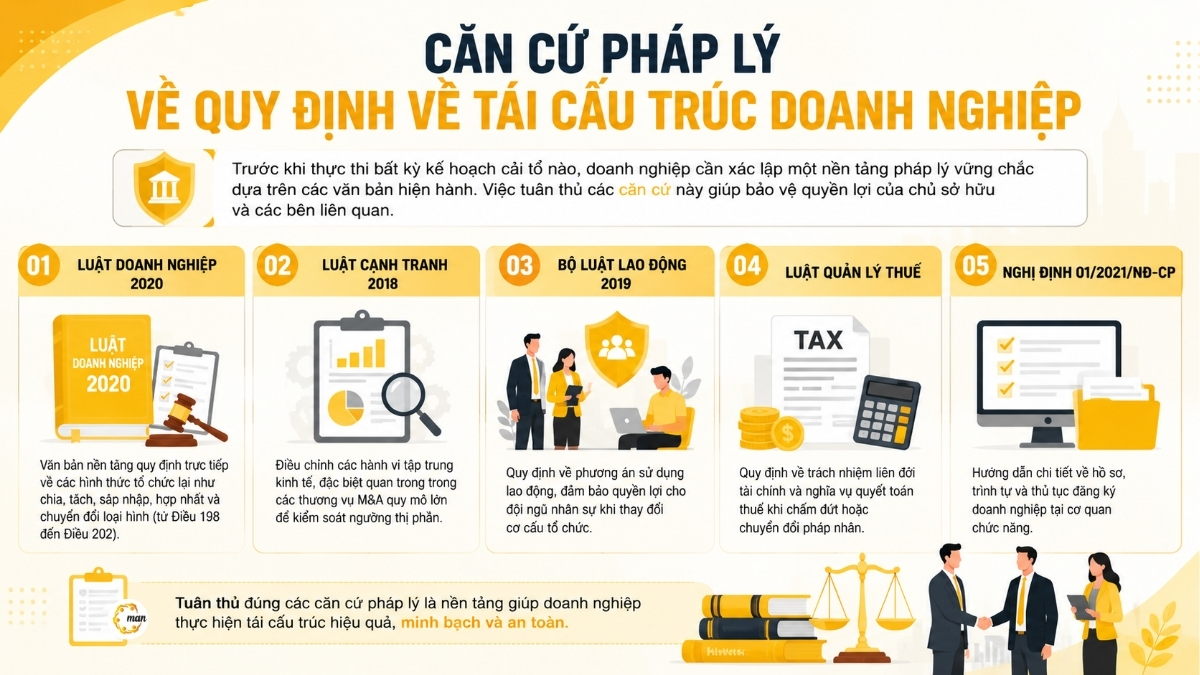
Before implementing any restructuring plan, businesses need to establish a solid legal foundation based on existing regulations. Adherence to these regulations helps protect the rights of owners and stakeholders.
- Enterprise Law 2020: The foundational text directly regulates forms of reorganization such as division, separation, merger, consolidation, and conversion of legal form (from Article 198 to Article 202).
- Competition Law 2018: Regulating economic concentration behaviors is particularly important in large-scale M&A transactions to control market share thresholds.
- Labor Code 2019: Regulations regarding workforce utilization plans, ensuring the rights of personnel when organizational structure changes.
- Tax Administration Law: Regulations on joint financial liability and obligations tax settlement when a legal entity is terminated or transformed.
- Decree 01/2021/ND-CP: Detailed guidance on the documents, procedures, and steps for registering a business with the relevant authorities.
What is business restructuring?
Corporate restructuring is the process of systematically reorganizing a company's capital structure, operating model, or legal form. The core objective of this process is to restore operational efficiency, optimize wasted resources, or rescue the entity from severe financial imbalances.
Unlike dissolution, restructuring is a solution to maintain the survival and create new value for a business entity by "cleaning up" the balance sheet and streamlining the management structure.
What forms of business restructuring are included under the Enterprise Law?
According to the regulations on corporate restructuring In Vietnam, the concept of "reorganization" is focused on five main forms of legal entity change. Each form has its own specific characteristics regarding responsibilities and inherited rights.
Division of enterprises (Article 198)
This applies to both limited liability companies and joint-stock companies. The business being divided will cease to exist, and all assets and liabilities will be transferred to the newly established companies. This is often the solution when shareholders disagree on the direction of development.
Separation of enterprises (Article 199)
A company that is split up does not cease to exist but only transfers a portion of its assets, rights, and obligations to establish one or more new legal entities. This form helps maintain the core brand while still developing specialized business segments.
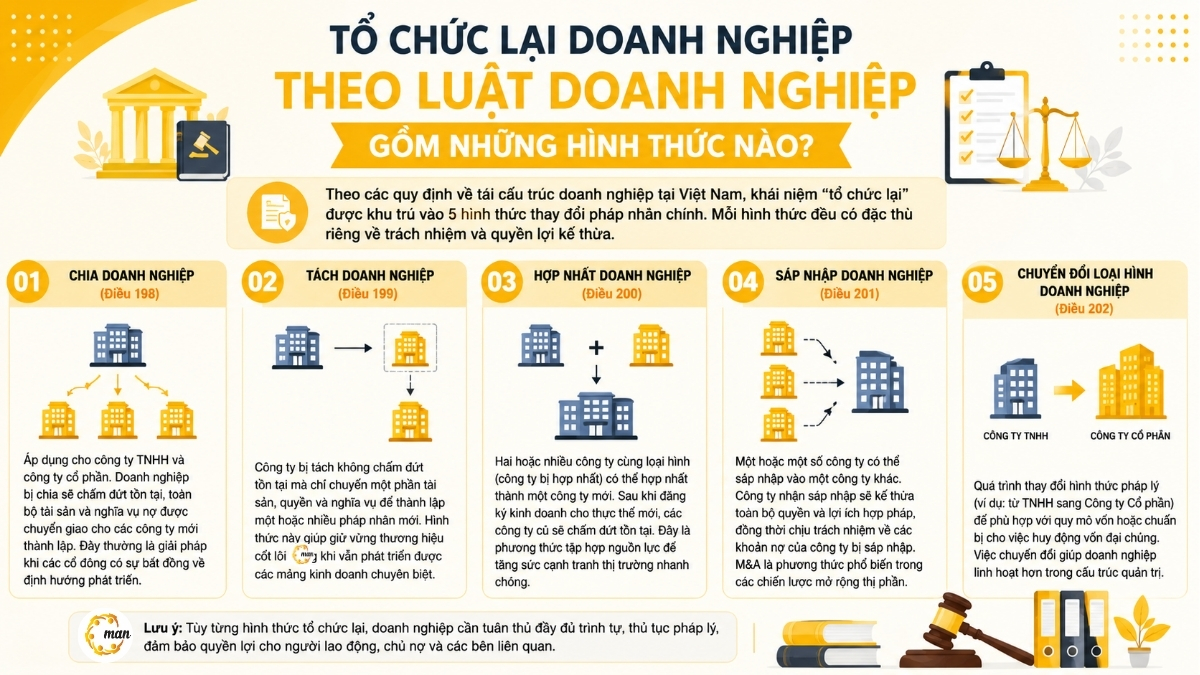
Business merger (Article 200)
Two or more companies of the same type (companies being merged) can merge into a new company. After the new entity is registered, the old companies cease to exist. This is a method of pooling resources to quickly increase market competitiveness.
Business mergers (Article 201)
One or more companies may merge into another. The acquiring company will inherit all legal rights and interests, and will be responsible for the debts of the merged company. M&A is a common method in market share expansion strategies.
Conversion of business type (Article 202)
The process of changing the legal form (e.g., from Limited Liability Company to Joint Stock Company) to suit the capital size or to prepare for public fundraising. This conversion gives businesses more flexibility in their governance structure.
Analyze the differences between financial and operational restructuring.
To optimize the regulations on corporate restructuring, Managers need to clearly distinguish between two pillars: finance (debt management) and operations (performance). The table below compares the technical characteristics of these two methods:
| Criteria | Financial restructuring | Operational restructuring |
|---|---|---|
| Core objectives | Improve the balance sheet, manage debt and cash flow. | Increase productivity, streamline processes, and digitize the organization. |
| Target | Owners, banks, bondholders, creditors. | Middle management, employees, workflows. |
| Specific actions | Debt restructuring, share issuance, and divestment of weak business segments. | Change the organizational structure and apply AI/ERP technology. |
| Expected results | Good liquidity ratios reduce debt pressure. | Reduce operating expenses (OPEX), increase competitive advantage. |
From the table above, it can be seen that while financing is an urgent solution to avoid bankruptcy, operations are a long-term strategy for sustainable development.
A professional and systematic business restructuring process.
Implementation needs to follow a scientifically sound roadmap to minimize the risk of operational disruption. This is evident in expert networks such as... MAN – Master Accountant Network, The process is typically advised based on a combination of legal and governance practices:
- Survey and assess the current situation: Identify financial "black spots" or resource surpluses. Suppliers Accounting services Professionals will help review tax data to ensure there are no hidden debts.
- Develop and approve the plan: Develop a detailed plan regarding personnel and finances. The plan must be officially approved by the highest authority (Board of Members or General Meeting of Shareholders).
- Executing legal procedures: Proceed with submitting the business registration change application to the Department of Planning and Investment and fulfill obligations regarding the company seal and tax notification.
- Reorganize the structure: Rearrange personnel according to the new organizational structure and stabilize team morale to avoid "brain drain".
- Monitoring and calibration: Monitor post-restructuring KPIs to make adjustments that align with operational realities.
Documents and legal procedures required for business restructuring.
To ensure compliance with the regulations on corporate restructuring, The registration file submitted to the relevant authorities must include the following documents:
| No. | Document type | Technical requirements |
|---|---|---|
| 1 | Business registration application form | According to the form prescribed in Decree 01/2021. |
| 2 | Resolutions and decisions on restructuring | The signature of the representative and the seal are required. |
| 3 | Merger/Consolidation Agreement | The regulations clearly define the responsibilities for inheriting debt obligations. |
| 4 | Labor utilization plan | Comply strictly with the 2019 Labor Code. |
| 5 | List of members/shareholders | Updated according to the latest capital structure. |
The processing time for business registration applications is usually 3-5 working days. However, the tax settlement preparation and creditor notification phase can take from several weeks to several months.
Legal risks to consider when restructuring a business.
Apply the regulations on corporate restructuring A lack of caution can lead to serious legal consequences:
- Joint liability: In the event of a division or separation, the new legal entities remain jointly liable for the old debts unless there is a clear agreement with the creditors.
- Labor disputes: The failure to properly notify and pay severance pay for redundant staff is a leading cause of lawsuits.
- Tax risks: Experts at MAN – Master Accountant Network Warnings have been issued that mergers or dissolutions leading to consolidation require thorough tax settlements, where past violations are likely to result in back taxes and heavy penalties.
- Intellectual property rights: It is necessary to carry out procedures for transferring or re-registering ownership of patents and trademarks to avoid losing protection rights after a change of legal entity.
Frequently Asked Questions about Regulations Regarding Business Restructuring
Is business restructuring different from business dissolution?
How long does it take to complete the restructuring procedures?
What costs are included in restructuring expenses?
Conclude
Mastering and applying these skills flexibly regulations on corporate restructuring This is key to realizing the strategic goals of managers. It is a complex process, requiring close coordination between legal expertise, sharp financial acumen, and humane human resource management skills.
Whether choosing mergers, splits, or operational restructuring, businesses need a transparent roadmap and the support of experts with in-depth practical knowledge. Thorough preparation today is the foundation for businesses to grow stronger. Businesses can refer to additional resources. business restructuring services For in-depth support regarding the roadmap and procedures.
Contact information for MAN – Master Accountant Network
- Address: 19A, 43rd Street, Tan Thuan Ward, Ho Chi Minh City
- Mobile/Zalo: 0903 963 163 – 0903 428 622
- Email: man@man.net.vn
Content production is overseen by: Mr. Le Hoang Tuyen – Founder & CEO of MAN – Master Accountant Network, CPA Vietnam auditors with over 30 years of experience in accounting, auditing, and financial consulting.