


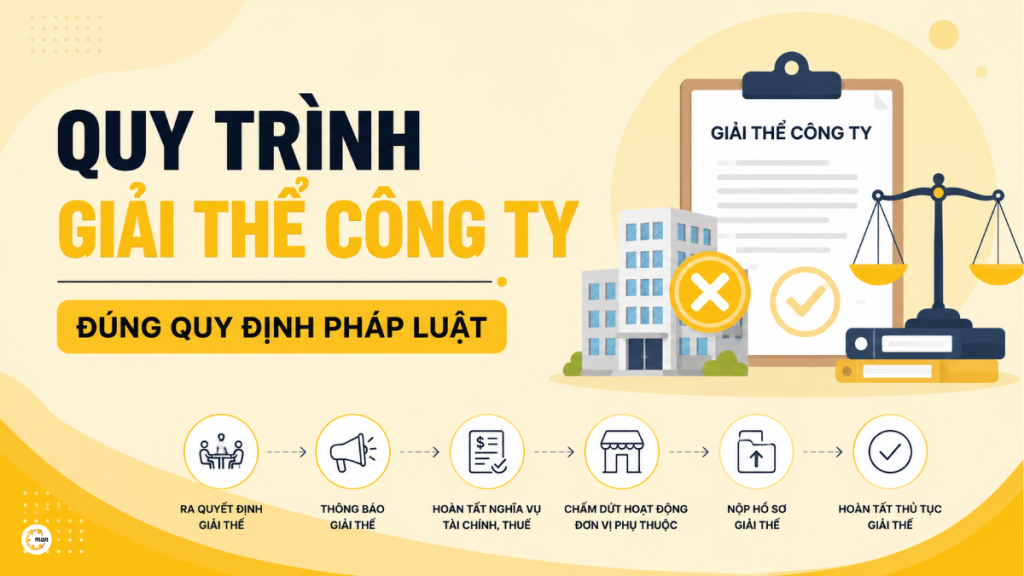
Conditions for a business to be dissolved
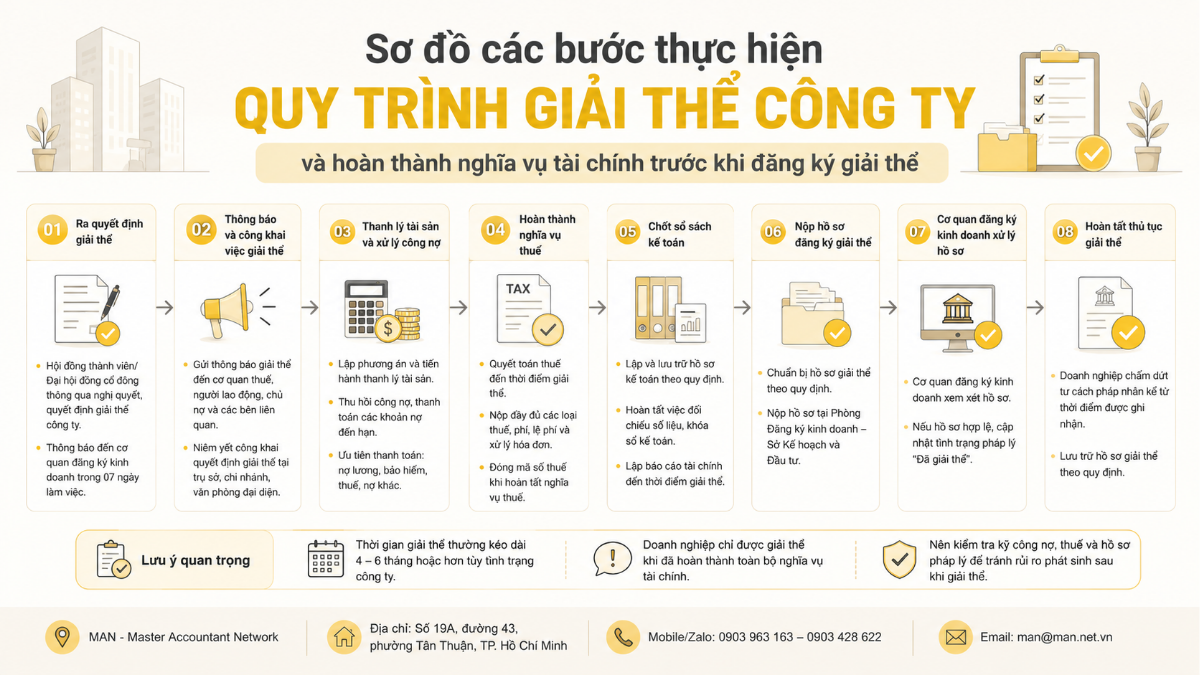
According to Clause 2, Article 207 of the 2020 Enterprise Law, an enterprise is only allowed to carry out dissolution procedures when it fully meets two conditions. conditions for dissolving a business The following are mandatory:
- Complete fulfillment of all financial obligations: The business has fully settled all outstanding salary debts, social insurance debts, tax obligations, and debts to business partners and creditors.
- No legal disputes: The business is not currently involved in any disputes in court or arbitration proceedings.
In cases where a business becomes insolvent (total assets are insufficient to cover total debts), it cannot proceed with voluntary dissolution but must instead go through bankruptcy proceedings as stipulated in the 2014 Bankruptcy Law.
Cases of business dissolution
According to Article 207 of the 2020 Enterprise Law, enterprises can be dissolved in the following four specific cases:
- Expiration of operating period: The business's operating period as stated in the company's charter has expired without a decision to extend it.
- Voluntary dissolution: A business is dissolved by an internal decision of the owner of a private enterprise, the Board of Members (for limited liability companies), or the General Meeting of Shareholders (for joint-stock companies).
- Insufficient minimum number of members: The company no longer has the minimum number of members required by law for a continuous period of 06 months without carrying out the procedure to change its business type.
- Compulsory dissolution: The business has its business registration certificate revoked or is dissolved by a court order.
What are the steps involved in the company dissolution process?
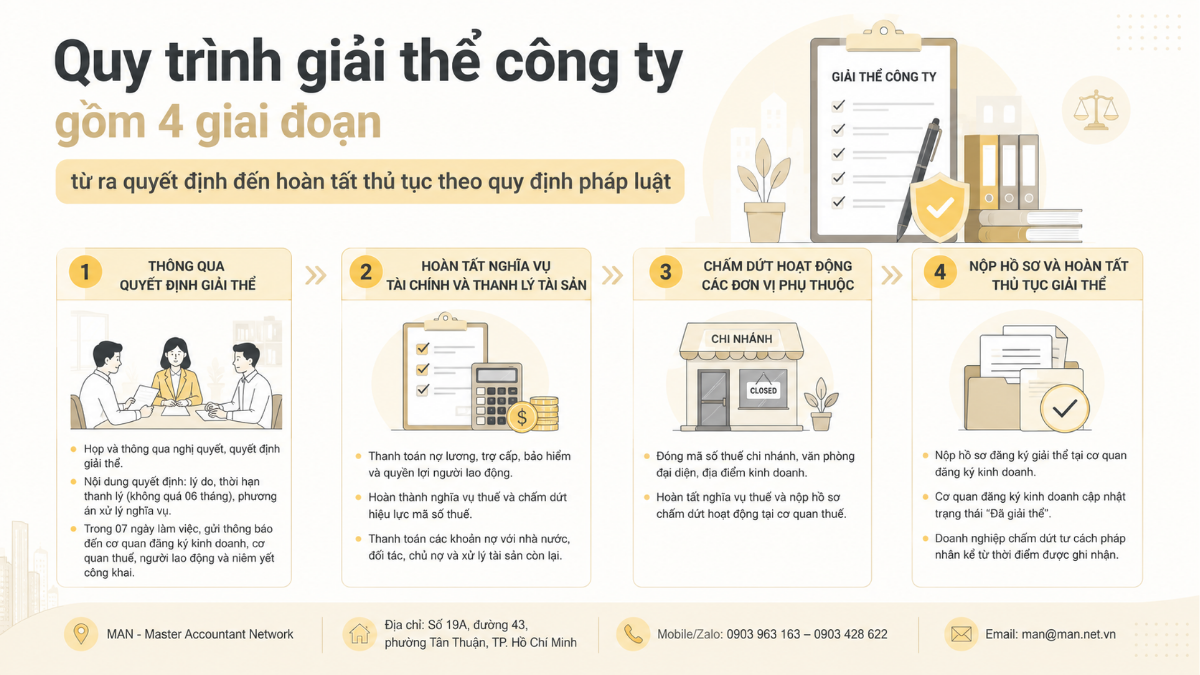
According to the provisions of the 2020 Enterprise Law, the company dissolution process includes four main stages to terminate its legal existence. For detailed implementation guidelines for each case, businesses can refer to the following information. Instructions for dissolving a business Overall assessment compiled by legal experts.
The actual implementation sequence is carried out through the following specific work steps:
- Step 1: Pass an internal dissolution decision.
- Step 2: Announce dissolution and make the announcement public.
- Step 3: Complete financial obligations and settle tax obligations.
- Step 4: Terminate the operations of the subsidiary unit (if any).
- Step 5: Submit the dissolution registration application to the Business Registration Authority.
- Step 6: Update the legal status to "Business Dissolved".
Step 1. Pass the dissolution decision.
Businesses must hold a meeting of the Board of Members or the General Meeting of Shareholders to pass a resolution or decision on dissolution. Within 7 working days from the date of approval, the business must send a notice of dissolution along with the decision to the Business Registration Authority, the tax authority, employees, and publicly post it at its headquarters.
The authority to issue dissolution decisions is determined according to the specific type of business:
- Single-member limited liability company: Decisions rest with the company owner.
- Limited Liability Company with two or more members: Approved by the Board of Members according to the voting ratio stipulated in the Articles of Association.
- Joint-stock company: Approved by the General Meeting of Shareholders during the meeting or through written consultation.
- Private enterprises: The decision rests entirely with the private enterprise owner.
Regarding the content of the document, the resolution or decision on dissolution must include important information such as: the name and registered address of the enterprise, the reason for dissolution, the timeframe and procedures for liquidating contracts, the deadline for paying debts (not exceeding 6 months from the date of approval), and the plan for handling obligations arising from labor contracts.
Step 2. Complete financial obligations and liquidate assets.
Before filing for formal dissolution, a business is required to complete the liquidation of all assets and settle all debts in the order of priority stipulated by law.
According to Article 208 of the 2020 Enterprise Law, the payment of financial obligations is prioritized as follows:
- Paying outstanding wages, severance pay, social insurance, health insurance, unemployment insurance, and other employee benefits as stipulated in employment contracts and collective bargaining agreements.
- Pay off tax debts and other financial obligations arising from the state budget.
- Pay off outstanding debts to creditors, suppliers, partners, and financial obligations arising from civil and commercial contracts.
Payment of employee benefits
The top priority during the dissolution process is ensuring the financial rights of the workforce. Businesses need to proactively review and settle all outstanding salaries, severance pay, social insurance, health insurance, and unemployment insurance contributions, and finalize insurance records for employees in accordance with their signed employment contracts.
Fulfill tax obligations.
The business's tax identification number needs to be terminated by submitting a written request to the directly managing tax authority. At this point, the tax authority will review the application and determine whether the business has fulfilled its tax obligations as required. Businesses need to be aware of this. Tax obligations when dissolving a business To settle any outstanding taxes, late payment penalties, or fines (if any) before receiving the notice of termination of the tax identification number.
Pay off debts and other financial obligations.
After fulfilling its commitments to personnel and the state budget, the enterprise proceeds to repay debts to partners, suppliers, and other creditors according to the debt list. If there are surplus assets remaining after fulfilling all financial obligations, this value will be distributed to members, shareholders, or owners of the company in proportion to their initial capital contributions.
Step 3. Terminate the operations of branches, representative offices, and business locations.
Businesses operating subsidiaries are required to finalize the procedures for terminating the operations of all branches, representative offices, or business locations before proceeding with the dissolution application for the parent company.
The process for handling dependent units is carried out in a two-step sequence:
- Termination of dependent tax identification number: Submit an application to terminate the tax identification number of the branch or representative office to the tax authority directly managing that unit.
- Deleting the name of a subsidiary unit: Submit an application to terminate the subsidiary unit's operations to the Business Registration Authority where the branch or representative office is located.
If a business skips this procedure, the Business Registration Authority will issue a notice requesting additional information or refuse to accept the parent company's dissolution application.
Step 4. Submit the dissolution registration documents.
Within 05 working days from the date of full payment of all debts, the legal representative of the enterprise shall submit the dissolution registration dossier to the Business Registration Department of the Business Registration Authority where the enterprise's head office is located.
After receiving all valid documents, the Business Registration Authority updates the legal status of the enterprise. National portal for business registration Change the status to "Dissolved" and issue a notice regarding the dissolution of the business.
What documents are required for company dissolution?
Ingredient business dissolution documents As stipulated in Decree 168/2025/ND-CP, these include the following specific groups of documents:
- Notice of business dissolution: Signed directly by the legal representative.
- Asset liquidation report: Includes a list of creditors, amounts paid, confirmation of fulfillment of tax obligations, and full payment of social insurance, health insurance, and unemployment insurance contributions for employees.
- Internal approval documents: Resolutions, decisions, and meeting minutes of the Board of Members (for limited liability companies with 2 or more members), the General Meeting of Shareholders (for joint-stock companies), or decisions of the owner (for single-member limited liability companies).
- Documents related to the seal: The seal and the certificate of registration of the seal design (if the business uses a seal issued by the police).
- Confirmation of tax obligation fulfillment: Official notification of termination of tax identification number issued by the tax authority.
Time required for the company dissolution process.
According to legal regulations, the process of dissolving a business at the Business Registration Office only takes 3 to 5 working days from the date of receiving all valid documents. In reality, the entire process usually takes 1 to 3 months, depending on the tax situation, outstanding debts, and the completeness of the business's documentation.
The actual time required to complete the procedure is usually divided into timeframes corresponding to each specific stage of the work:
- Phase 1 (Notification of Dissolution): To be completed within 7 working days from the date the dissolution decision is approved.
- Phase 2 (Tax and Social Insurance Settlement): This typically takes around 30 to 60 days, depending on the speed at which the tax authorities review the records and accounting data.
- Phase 3 (Cessation of subsidiary unit operations): This phase takes 15 to 30 days for businesses with branches or representative offices.
- Phase 4 (Registration of dissolution at the Business Registration Office): Processing takes 3 to 5 working days after the agency receives a complete and valid set of documents.
Factors affecting dissolution time
The actual dissolution process has been delayed primarily due to the following six factors:
- Tax obligations: Businesses must wait for the tax authorities to verify their accounting records. If there are discrepancies in the declared data, the settlement process can take several months.
- Unprocessed invoices: Businesses that still have electronic invoices that have not been canceled or have not submitted a report on invoice usage up to the time of cessation of operations.
- Social insurance: Failure to finalize the social insurance record for employees or outstanding social insurance contributions will result in the social insurance agency not certifying the fulfillment of obligations.
- Branches not yet closed: The company forgot to complete the procedures for terminating the operations of its subsidiary units before submitting the parent company's registration documents.
- Complex debt: Negotiating asset liquidation, debt recovery, and repayment to related parties is time-consuming.
- Incomplete application: Applications submitted to the Business Registration Authority contain inaccurate information or lack confirmation from the tax authority, resulting in rejection.
Important considerations when carrying out the company dissolution process.
Common errors that cause applications to be returned
During their work assisting businesses, the team of experts at MAN – Master Accountant Network has compiled a list of common mistakes that lead to dissolution applications being rejected by authorities:
- Filing while the branch is still operating: The business files for the dissolution of the parent company while the branch's tax identification number and procedures at the Business Registration Authority have not yet been terminated.
- The company's tax identification number has not yet expired: Submit dissolution documents to the Business Registration Authority before receiving a Notice of Termination of Tax Identification Number from the tax authority.
- Financial statement imbalances at liquidation: Financial statements at the time of liquidation still record outstanding liabilities or receivables that have not been fully settled.
- Discrepancies in member or shareholder information: The signatures on the meeting minutes and dissolution decision do not match the list of members or shareholders kept at the Business Registration Authority.
Common misconceptions about the dissolution process.
In reality, many businesses encounter legal problems due to a misunderstanding of dissolution procedures:
- Misconceptions about the processing agency: Many business owners believe that simply submitting the application to the Business Registration Authority is sufficient for dissolution. However, the Business Registration Authority only updates the status after the tax authority has issued a notice confirming that the business has fulfilled its tax obligations as required.
- Misconceptions about tax debt: Some managers believe that a company can still dissolve and pay off its tax debts later even if it still owes taxes. In reality, the tax authorities will not issue a notice terminating the tax identification number if there are outstanding tax or penalty payments, causing the dissolution process to stall.
- Misconceptions about business suspension: Many people believe that a prolonged business suspension will automatically lead to dissolution. Business suspension is only a temporary state; failure to pay taxes or file tax returns will result in the termination of the tax identification number, enforcement action, and administrative penalties, but it does not equate to legal dissolution.
Expert opinion from MAN
The biggest workload in a dissolution process doesn't lie in filing documents with the Business Registration Authority, but rather in the tax settlement and accounting cleanup phases.
Based on practical experience from MAN – Master Accountant Network, to optimize time and costs during dissolution, businesses should follow these recommendations:
- Review accounting records 3 to 6 months in advance: Before issuing a dissolution decision, the accounting department needs to check all input and output invoices, loans, and inventory to proactively address tax risk areas.
- Complete settlement of labor and social insurance obligations: Ensure that all employees have had their social insurance records finalized and have received all applicable benefits before submitting the dissolution application.
- Follow the correct legal order: close down business locations and branches first; then settle the parent company's taxes; and finally, file the dissolution application.
Understanding the regulations and preparing the necessary documentation from the outset is key to helping business owners close down their operations safely, legally, and avoid future legal complications.
Conclude
The company dissolution process requires strict adherence to both legal procedures and financial obligations to the state, employees, and partners. Understanding each step, from preparing documents to handling tax obligations and procedures at regulatory agencies, will help business owners and accounting departments save time and minimize the risk of administrative penalties or unnecessary delays in the process.
Frequently Asked Questions about the Company Dissolution Process
How long does the company dissolution process take?
The processing time at the Business Registration Authority is 3-5 working days. However, the entire process usually takes 1 to 3 months due to tax settlement, social insurance record closing, and asset liquidation.
Can a company that owes taxes be dissolved?
No. According to the 2020 Enterprise Law and the 2019 Tax Administration Law, businesses are required to fulfill all tax obligations and receive a Notice of Termination of Tax Identification Number before they are eligible to register for dissolution.
Is it necessary to settle taxes before dissolution?
Yes. The tax authorities will conduct an inspection, verify the records, and determine the tax obligations of the business applying for dissolution to ensure that all obligations are collected correctly and fully before issuing a notice terminating the tax identification number.
Applicable legal basis:
-
Enterprise Law 2020 (Law No. 59/2020/QH14).
-
Decree 168/2025/ND-CP on business registration.
-
Law on Tax Administration 2019 (Law No. 38/2019/QH14).