



The business dissolution process is a legal procedure aimed at terminating the legal entity status of a business after it has fulfilled all financial obligations and paid all debts as required. Enterprise Law 2020, This process consists of six steps, from approving the dissolution decision and handling tax obligations to updating the status to "Dissolved" in the National Business Registration Database.
Following the correct procedures not only helps businesses shorten processing time but also minimizes legal risks arising during the dissolution process. This article will provide detailed guidance on the documents, conditions, steps, processing time, and important considerations when dissolving a business according to current regulations.
How many steps are involved in the business dissolution process?
To complete the process of terminating a legal entity's operations, a business must follow the legally mandated steps sequentially to ensure the rights of all parties involved are protected. This process includes the following steps:
| Step | Content of implementation |
|---|---|
| Step 1 | Through the decision to dissolve |
| Step 2 | Public announcement |
| Step 3 | Liquidate assets, pay off debts. |
| Step 4 | Close the tax identification number. |
| Step 5 | Submit dissolution documents. |
| Step 6 | Update status: Dissolved |
Following the correct procedure not only helps businesses comply with the law but also minimizes the risk of problems or rejected applications due to incorrect processing order.
Summary of the business dissolution process
The table below summarizes the basic parameters of the procedure implementation process, helping managers easily visualize the overall roadmap:
| Content | Information |
|---|---|
| Number of steps | 6 steps |
| Conditions for dissolution | Fulfill financial obligations. |
| Processing agency | Tax authorities and Business Registration Office |
| Application submission method | In person or online |
| Processing time | 30-60 days |
| Legal basis | Enterprise Law 2020 |
Before proceeding with the dissolution process, businesses must meet the conditions stipulated in the 2020 Enterprise Law. If tax obligations have not been fulfilled or there is an ongoing dispute in court, the dissolution application will not be approved.
Conditions for a business to be dissolved
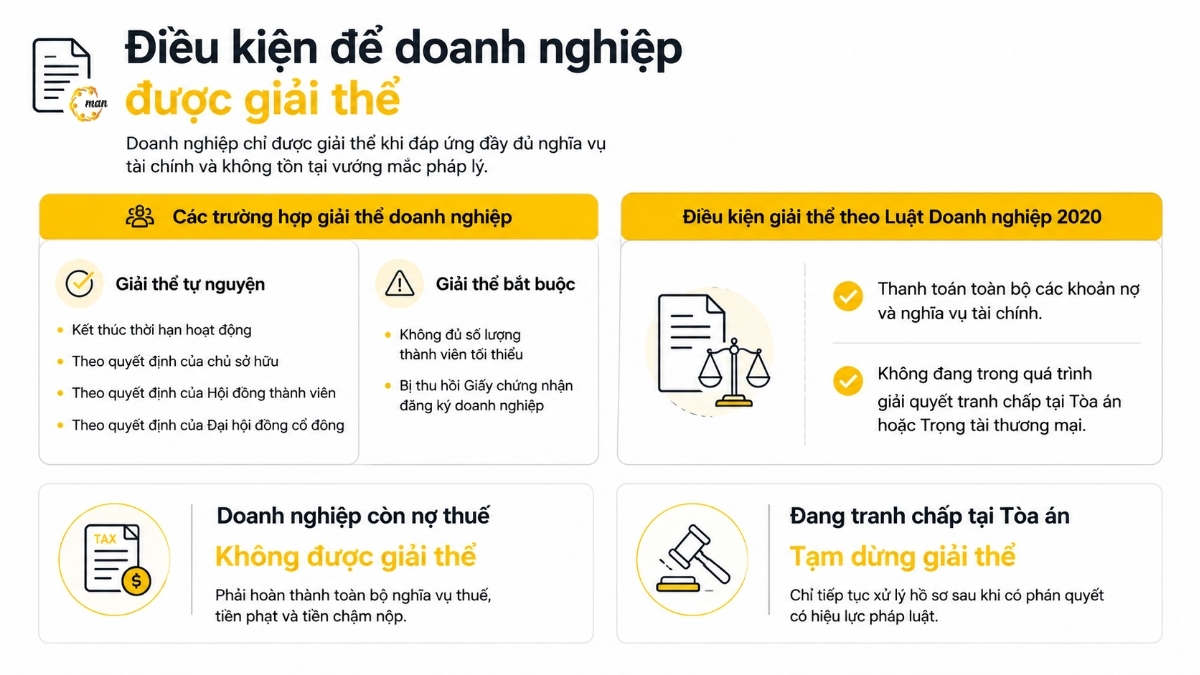
To proceed legally, businesses are required to meet conditions regarding financial obligations as well as the current legal status of the entity.
Cases of business dissolution
Depending on the specific circumstances, dissolution will fall into one of two main categories:
Voluntary dissolution:
- The operating period has ended.
- By decision of the owner.
- According to the decision of the Board of Members.
- According to the decision of the General Meeting of Shareholders.
Mandatory dissolution:
- The minimum number of members is not met.
- The business registration certificate has been revoked.
Conditions for dissolution under the 2020 Enterprise Law
Clause 2 of Article 207 of the 2020 Enterprise Law clearly stipulates that an enterprise may only be dissolved when it ensures the payment of all debts and other financial obligations and is not in the process of resolving disputes in court or commercial arbitration.
Can a business that owes taxes be dissolved?
Businesses with outstanding tax debts cannot proceed with dissolution. The tax authorities will only issue a notice terminating the tax identification number after the business has fulfilled all tax obligations, including late payment penalties, fines, and outstanding tax returns.
Can a business that is in dispute with the court be dissolved?
When a business is involved in a dispute in court or arbitration, the dissolution application will be temporarily suspended by the business registration authority until a legally binding judgment is issued and all enforcement obligations are fulfilled.
Documents required for business dissolution
Preparing complete documentation from the outset will help businesses minimize the need for multiple revisions and additions when dealing with the tax authorities and the Business Registration Office. The necessary documents are included in the set. business dissolution documents include:
| File | Purpose |
|---|---|
| Decision to dissolve | Grounds for termination of operations |
| Meeting minutes | Through dissolution |
| Announcement of dissolution | Submit to the business registration authority |
| List of creditors | Confirmation of financial obligations |
| List of workers | Ensuring workers' rights |
| Tax Identification Number (TIN) Closure Confirmation Certificate | Complete your tax obligations. |
Detailed step-by-step process for dissolving a business.
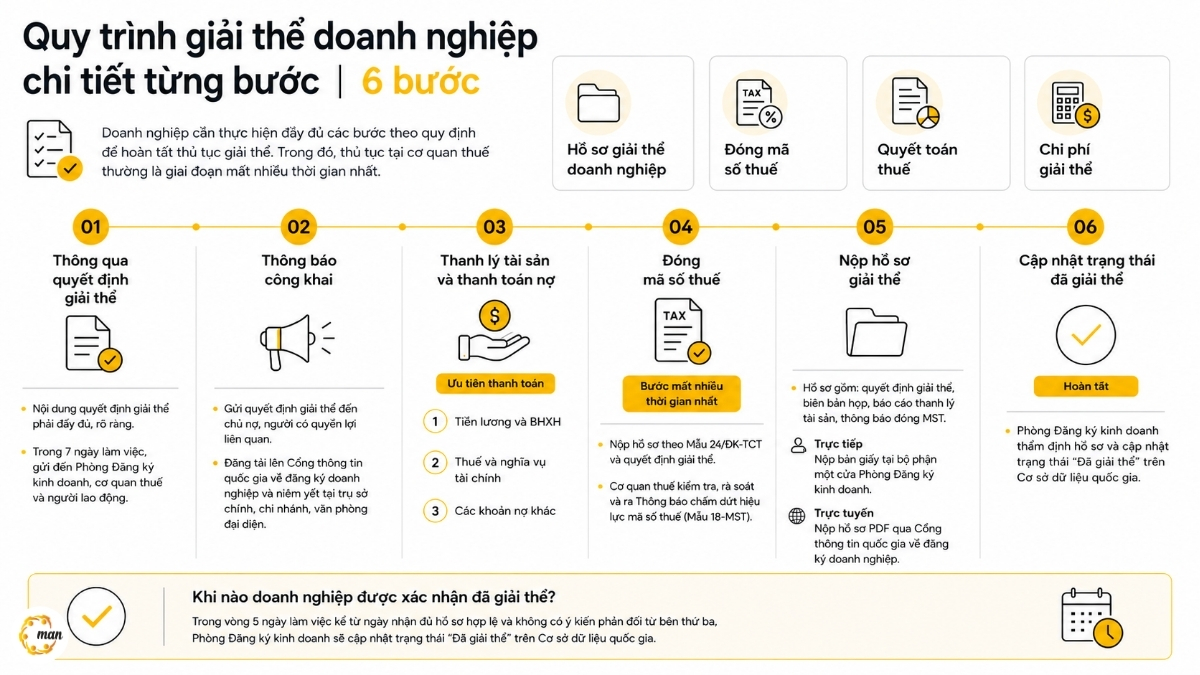
After meeting all the requirements and preparing the necessary documents, the business will proceed with the dissolution process according to legal procedures. In practice, the procedures at the tax authorities are often the most time-consuming stage and are also the reason why many cases are delayed.
To proactively monitor and implement, businesses can quickly refer to the directly related content below:
- Documents required for business dissolution
- Close the tax identification number when dissolving a business.
- Tax settlement upon business dissolution
- What are the costs of dissolving a business?
Step 1. Pass the decision to dissolve the business.
All procedures begin with a formal decision within the company.
Contents of the dissolution decision
The decision must clearly state the following basic information: Name and address of the head office; reason for dissolution; timeframe and procedures for liquidating contracts and settling debts; and plan for handling obligations arising from employment contracts.
Deadline for notifying the dissolution decision.
Within 7 working days from the date of approval, the dissolution decision must be sent to the Business Registration Office, the directly managing tax authority, and the employees of the enterprise.
Step 2. Publicly announce the dissolution.
Businesses must publicly list information regarding the cessation of operations so that relevant parties can protect their legitimate rights.
The individuals who need to be notified
The dissolution decision must be sent directly to creditors and other parties with relevant rights, obligations, and interests, along with a specific settlement plan.
Forms of public disclosure of dissolution information
Businesses are obligated to publish the dissolution decision on the National Business Registration Portal and publicly display it at their head office, branches, and representative offices.
Step 3. Liquidate assets and pay off debts.
This phase requires absolute financial transparency and strict adherence to the payment priorities as stipulated by law.
Order of payment of debts upon dissolution
| Order of priority | The debt |
|---|---|
| 1 | Salary, social insurance, severance pay |
| 2 | Taxes and financial obligations to the State |
| 3 | Other debts |
Wages and benefits for workers
Businesses must pay employees their full salaries, social insurance, health insurance, and severance pay before fulfilling other regular debt obligations.
Tax obligations to the State
Businesses must submit financial statements and tax return forms up to the time of dissolution and fulfill all outstanding tax obligations to the state budget.
Other debts
Debts arising from economic contracts with suppliers, banks, or individual lenders will be repaid after all obligations to employees and the State have been fulfilled.
Handling the remaining assets of the business.
After all debts and dissolution costs have been paid, the remaining assets will belong to the private business owner, contributing members, or shareholders in proportion to their respective ownership stakes.
Step 4. Complete the procedure for terminating the tax identification number.
The tax authority's procedures are usually the longest stage because the tax authority needs to conduct an on-site tax audit at the business.
Tax identification number closing file
Businesses submit a written request to terminate the validity of their tax identification number as follows: Form No. 24/DK-TCT The decision to dissolve the company must be submitted to the tax authority directly responsible for its management.
The tax authorities process the application.
The tax authorities conduct a review of the data system, check accounting documents, and issue a Notice of Termination of Tax Identification Number (Form 18-MST) when the business has fulfilled all tax obligations.
Step 5. Submit the dissolution application to the Business Registration Office.
After completing tax procedures, the business proceeds to submit an application to remove the legal entity's name from the business registration system.
Documents to be submitted
The documents submitted to the Department of Planning and Investment include the dissolution decision, meeting minutes, asset liquidation report, and the tax code closure notice issued by the tax authority.
How to submit your application in person
The legal representative or authorized person submits the paper application at the one-stop service counter of the Business Registration Office.
How to submit your application online
Scan the documents in PDF format and submit them through the National Business Registration Portal using your business registration account or digital signature.
Step 6. Update the legal status to dissolved.
The Business Registration Office receives and assesses the validity of the application.
When is a business considered dissolved?
Within 5 working days from the date of receiving all valid documents and without any objections from third parties, the Business Registration Office will update the business status to "Dissolved" in the National Database.
How long does it take to dissolve a business?
The actual progress depends heavily on the accounting records of each business.
| Job | Estimated time |
|---|---|
| Processing at the tax office | 15–45 days |
| Processing at the Business Registration Office | 3-5 days |
| The business has no activity. | 20-30 days |
| Complex case | A few months |
The processing time at the tax authorities can be lengthy if the business has delayed tax settlements for many years or has a complex accounting system requiring in-depth inspection.
Factors affecting dissolution time
- Tax debt status.
- Number of years for which accounts remain unsettled.
- The documents were lost.
- Social insurance obligations to employees.
- The situation is one of legal dispute.
What are the costs of dissolving a business?
In reality, there is no single fixed cost that applies to all businesses. Costs of dissolving a business This depends on the accounting records, tax obligations, and service needs of each business.
| Expenses | Note |
|---|---|
| State fees | Free of charge |
| Taxes owed | If any |
| Penalty for late payment | If any |
| Clean up the accounting books. | Depending on the circumstances |
| Dissolution services | According to the price quote |
Thorough accounting preparation helps minimize unexpected tax penalties.
Where do I file for business dissolution?
Businesses submit their applications directly to two main regulatory agencies:
- The tax authority directly responsible for managing the tax identification number is the District/County Tax Office or the Provincial/City Tax Department where the head office is located.
- Business Registration Office: Under the Department of Planning and Investment of the province or city where the business is registered, responsible for removing the legal entity's name.
- Carry out the business dissolution procedure online: Through the National Business Registration Portal and the General Department of Taxation's Public Service Portal.
Cases where a business cannot be dissolved
Regulatory authorities will refuse to accept dissolution applications in the following cases:
- The company has not yet fully paid off its debts to partners, credit institutions, or individuals.
- The business is in the process of resolving a legal dispute in court or commercial arbitration.
- The company has not fulfilled its obligations to its employees, owing wages or social insurance contributions.
- Businesses are subject to enforcement measures to implement administrative tax decisions or other legal violations.
Dissolution procedures vary by business type.
The biggest difference in dissolution procedures between different types of businesses lies in the authority to issue the dissolution decision and the internal voting ratio.
| Type of business | Decision-making authority | The percentage of votes in favor. | Special files |
|---|---|---|---|
| One-Member Limited Liability Company | Company owner (Individual/Organization) | No request required (Unilateral decision) | Owner's decision |
| Limited Liability Company with 2 or more TVs | Board of Members | At least 65 percent of the total capital contributed by the attending members. | Minutes of the Board of Members Meeting |
| Joint Stock Company | General Shareholders' Meeting | A minimum of 65 percent of the total voting shares of shareholders present at the meeting are required. | Minutes of the Shareholders' General Meeting |
| Private enterprise | Private business owner | No request required (Unilateral decision) | Business owner's decision |
Comprehensive business dissolution services
When faced with a complex volume of paperwork, using a professional dissolution service is the optimal solution for many managers.
When should a business use a business dissolution service?
- Tax returns have not been finalized for many years.
- Lost invoices and receipts.
- There is no internal accounting department.
- We want to shorten the dissolution process.
- To minimize the risk of tax penalties.
Costs of business dissolution services
The fee is calculated flexibly based on the actual operating status of the business, the number of years of operation without tax settlement, and the completeness of the current documentation system.
The service provider's implementation process
Reputable consulting firms like MAN – Master Accountant Network will represent businesses in handling all aspects of the process: reviewing accounting documents, optimizing tax risks, drafting all dissolution documents, directly working with and explaining settlement figures to the tax authorities, and submitting the delisting application to the Department of Planning and Investment.
Benefits of using business dissolution services
| Benefit | Describe |
|---|---|
| Save time | Reduce the number of rejected applications. |
| Reduce tax risk. | Supported with explanations |
| Cost optimization | Minimize the occurrence of penalties. |
Some things to note when carrying out the business dissolution procedure.
Is it possible to dissolve a business before its tax identification number is closed?
Absolutely not. Businesses are required to complete the tax registration closure process at the tax authority before submitting dissolution documents to the Business Registration Office.
Does a business that generates no revenue have to file a tax return when it is dissolved?
Tax settlement is still required. Even if no revenue or expenses are incurred, businesses must still submit blank tax returns and financial reports up to the time of dissolution for tax authorities to review and close their tax identification number.
Is it possible to handle the business dissolution procedure independently?
It is entirely possible if the business has highly qualified accounting staff. Conversely, doing it yourself without experience in tax reporting can easily lead to heavy penalties due to accounting discrepancies accumulated over many years.
Does the legal representative still have responsibilities after the business is dissolved?
Yes. Founding members, shareholders, and legal representatives remain jointly liable for the truthfulness and accuracy of dissolution documents, as well as for outstanding financial obligations, if there was prior fraudulent activity.
Conclude
Do it right business dissolution process This involves numerous procedures related to tax authorities and business registration agencies. Thorough preparation of documentation, fulfillment of financial obligations, and adherence to proper procedures will help businesses shorten processing times and minimize potential legal risks.
In cases where a business has outstanding tax issues, debts, or unresolved accounting records from years past, it should consult with experts to mitigate legal risks and shorten the processing time. Utilizing a business dissolution service will make the process faster and more efficient.
Contact information for services at MAN – Master Accountant Network
- Address: No. 19A, Street 43, Tan Thuan Ward, Ho Chi Minh City
- Mobile/Zalo: 0903 963 163 – 0903 428 622
- E-mail: man@man.net.vn
- Google Business Profile: View MAN – Master Accountant Network's Google Business Profile
- LinkedIn Founder: View expert Le Hoang Tuyen's LinkedIn profile.
Responsible for production and professional content review by: Mr. Le Hoang Tuyen – Founder & CEO of MAN – Master Accountant Network, CPA Vietnam with over 30 years of experience in accounting, auditing, taxation, and corporate financial consulting.
MAN – Master Accountant Network is committed to providing transparent, up-to-date professional information in accordance with current legal regulations and adhering to professional standards in the fields of accounting, auditing, and taxation.