


Professional license: CPA Vietnam Auditors
Experience: Over 30 years of experience in Accounting, Auditing, and Financial Consulting.
Capital restructuring is a financial management solution that helps businesses adjust their capital structure to suit development needs and cash flow capabilities at each stage of operation. When the debt structure is no longer suitable for generating cash flow from business operations, proactively re-establishing a balance between debt and equity helps reduce short-term financial pressure. Understanding the financial nature, adjustment options, and accompanying legal and tax consequences will help management proactively build a safe and sound financial foundation.
Applicable legal basis: Consolidated text 67/VBHN-VPQH consolidates the Law on Enterprises. (August 15, 2025); Law No. 76/2025/QH15 (effective from July 1, 2025); Decree 168/2025/ND-CP was amended and supplemented by Decree 296/2026/ND-CP. Regarding business registration; Clause 3, Article 16 Decree 255/2026/ND-CP Regarding tax management for enterprises with related-party transactions; Corporate Income Tax Law 67/2025/QH15; Article 24 of Tax Administration Law 108/2025/QH15.
What is capital restructuring?
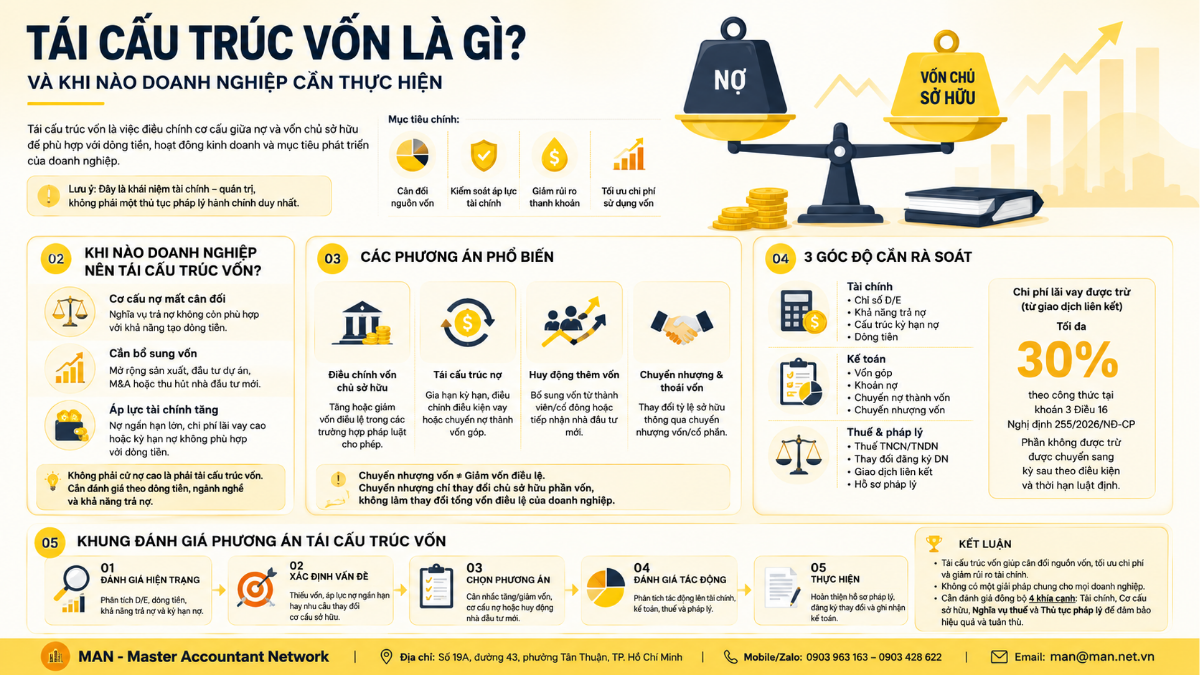
Capital restructuring is the process of rearranging and adjusting the ratio between debt and equity in a company's capital structure. The main goal is to optimize the average cost of capital, control liquidity risk, and balance cash flow. This is a financial and management concept, not the name of a single administrative legal procedure.
A company's capital structure essentially consists of two main components: equity (initial capital contributions, retained earnings, funds) and liabilities (bank loans, accounts payable, bonds). The relationship between these two components determines the financial leverage and risk resilience of the organization. When the debt ratio is too high, the cost of capital can increase due to credit risk pushing interest rates up; conversely, if the company relies entirely on equity, it may miss out on the benefits of interest expense within the deductible limits under tax regulations and the opportunity cost of capital.
Therefore, capital restructuring focuses on readjusting this ratio to best suit the business model, operating cycle, and actual cash flow generation capacity.
Capital restructuring is different from financial restructuring and corporate restructuring.
In management practice, these three restructuring concepts are often used interchangeably, leading to misidentification of objectives and the application of incorrect legal solutions. To apply the correct measures, businesses need to distinguish between the following three areas of activity:
- Capital Restructuring: Focusing directly on the Liabilities side of the balance sheet, this activity adjusts the ratio between debt and equity through transactions such as increasing/decreasing charter capital, converting debt into equity, issuing additional shares, or restructuring debt terms.
- Financial Restructuring: Financial restructuring has a broader scope, encompassing the entire balance sheet and cash flow. Beyond adjusting the capital structure, it also includes asset disposal (selling non-performing assets, recovering outstanding debts), reducing operating costs, managing inventory, and optimizing short-term cash flow.
- Corporate Restructuring: This is the broadest concept, impacting the entire operational model of an organization. This process can include restructuring the management structure, mergers, splits, dissolution of branches, changes in core business direction, in addition to adjustments in finance and capital sources.
Objectives and indicators requiring capital restructuring.
The main objective of capital restructuring is to adjust the debt-to-equity ratio, control the cost of capital, and minimize liquidity risk. Businesses need to undertake this when their current capital structure no longer meets operating cash flow needs, financial leverage is too high, or they need to expand their scale.
The debt-to-equity structure is no longer appropriate.
An inappropriate capital structure is evident in the imbalance between debt obligations and asset profitability. Increased financial leverage exceeding industry safety limits creates pressure to repay principal and interest that exceeds net cash flow from operating activities.
It's important to note that a high debt ratio doesn't automatically mean a company is forced to restructure its capital immediately. For industries with steady cash flow, such as infrastructure or energy, maintaining a high debt ratio can help increase return on equity (ROE). However, for industries with significant revenue fluctuations, an unusually high debt-to-equity (D/E) ratio puts the company at risk of insolvency. When the ability to meet financial obligations declines and internal credit ratings are affected, the company is forced to restructure its debt to ensure financial stability.
Businesses need additional capital.
The need for capital restructuring arises when a business enters a new growth phase or undertakes long-term investment projects. In these situations, existing capital is insufficient to finance the expansion of the business, as evidenced by the specific needs outlined below:
- Expand production lines or enter new business markets.
- Supplementing the long-term working capital that is currently lacking.
- Conduct mergers and acquisitions (M&A) projects.
- Attracting additional investors, strategic shareholders, or investment funds aims to enhance financial capacity and commercial reputation.
Businesses need to reduce financial pressure.
Financial pressure often arises when the maturity structure of debt does not match the cash flow recovery cycle from assets. Using too much short-term debt to finance long-term assets exposes businesses to continuous liquidity risk and a heavy burden of high interest expenses.
The goal of capital restructuring in this case is to negotiate an extension of the debt term, convert short-term loans into long-term loans, or convert a portion of debt into equity to lower fixed financing costs and bring the capital structure back to a state that aligns with actual cash flows.
Common capital restructuring options
Common capital restructuring options include adjusting equity capital, restructuring debt, raising capital from new members/shareholders, and divesting or transferring shares. Depending on the nature of the transaction, the business must carry out the corresponding legal, accounting, and tax obligations.
Adjusting equity capital
Adjusting equity directly changes the size or proportion of owners' capital on the balance sheet. This adjustment is typically done through the following main methods:
- Increase charter capital: Existing members/shareholders contribute additional capital, or the company issues additional shares, converting undistributed after-tax profits into charter capital.
- Reduce charter capital: Businesses may reduce their charter capital in cases permitted by business law (such as returning a portion of capital contributions, or repurchasing capital contributions/shares as stipulated).
It is important to emphasize that capital restructuring is not entirely synonymous with increasing or decreasing charter capital, as businesses can restructure through changes in the structure of debts or changes in ownership without altering the total registered charter capital.
Debt restructuring
This approach focuses on changing the nature, maturity, and cost of the debt obligations that the business is currently undertaking, including the following specific technical solutions:
- Extending the loan term: Negotiate with creditors to convert short-term debts that are due into medium- and long-term debts.
- Changes to loan conditions: Adjusting interest rates, principal grace periods, or other financial terms and conditions associated with a loan agreement.
- Debt-to-Equity Swap: The parties agree to convert part or all of the debt obligation into equity/shares under suitable conditions and schemes, helping the enterprise reduce its principal and interest repayment obligations arising from that debt.
Raising additional capital
To increase the scale of long-term capital without increasing immediate debt repayment pressure, businesses can apply the following common forms of capital raising:
- Additional capital contributions from existing members/shareholders in proportion to their ownership stake.
- Accepting new members (for limited liability companies) or offering shares privately/publicly to new investors (for joint-stock companies). In cases where the investor is a foreign individual or organization contributing capital, the business needs to take note of the following procedures. Procedures for foreign investors to contribute capital and purchase shares. In accordance with current investment regulations.
- Issuing convertible bonds or bonds with warrants combines the advantages of both debt and equity financing.
Divestment and capital transfer
Divestment and capital transfer are transactions that change the identity and ownership ratios of entities involved in a business, including the following main forms:
- Transfer of capital contributions/shares: An existing member or shareholder transfers all or part of their ownership rights to another individual or organization. This transaction changes the ownership ratio but does not alter the total registered capital of the business.
- Divestment by members/shareholders: Members or shareholders withdraw capital from a business by transferring capital to another entity or requesting the company to repurchase/repay capital in accordance with the law. This does not automatically lead to a capital reduction procedure if another investor takes over that portion of capital.
Capital restructuring by business type
The method of capital restructuring is directly regulated by the legal framework applicable to each type of enterprise. Regulations on increasing and decreasing charter capital and transferring ownership are applied according to Consolidated Document 67/VBHN-VPQH, which consolidates the Enterprise Law and Law No. 76/2025/QH15.
Limited Liability Company
The legal framework regulating the forms of capital increase and decrease and adjustment of ownership structure for single-member limited liability companies and limited liability companies with two or more members is specifically illustrated in the comparison table below:
| Comparison criteria | One-member limited liability company | Limited Liability Company with 2 or more members |
|---|---|---|
| Forms of capital increase | • The owner invests additional capital.
• Raising capital contributions from others (requires procedures for changing the business type). |
• Increase the capital contributions of existing members proportionally.
• Accepting additional capital contributions from new members. |
| Capital reduction | • Partial return of capital contributions to the owners.
• Capital reduction due to owners failing to contribute sufficient capital on time. |
• Partial return of capital contributions to members in proportion to their contributions.
• The company repurchases the capital contribution at the request of the member. • Capital reduction due to members failing to contribute their full amount on time. |
| Conditions for partial repayment of capital contributions | The business must have been operating continuously for more than two years since the date of business registration and must ensure full payment of all debts after repayment. | The business must have been operating continuously for more than two years since the date of business registration and must ensure full payment of all debts after repayment. |
According to Consolidated Document 67/VBHN-VPQH, which consolidates the Enterprise Law and Law No. 76/2025/QH15, when a limited liability company repays a portion of its capital contribution to a member/owner, it must ensure that it has been operating continuously for at least two years since the date of business registration, and also ensure that all debts and other financial obligations are fully paid after the repayment.
Joint Stock Company
The adjustment of capital sources of a joint-stock company is carried out through the basic mechanisms stipulated in the Enterprise Law as follows:
- Offering shares for sale: Offerings can be made to existing shareholders, through private placements, or to the public. Private placements by joint-stock companies that are not public companies must meet the conditions of a General Meeting of Shareholders' resolution and be registered/notified of changes as prescribed by regulations.
- Share transfer: Shareholders have the right to freely transfer their shares to others, except as stipulated in Clause 3, Article 120 of the Enterprise Law regarding common shares of founding shareholders within 3 years from the date of establishment, or when the company's charter stipulates restrictions on transfer.
- Share buyback: The company has the right to repurchase sold shares at the discretion of the General Meeting of Shareholders or the Board of Directors within the scope of authority and conditions prescribed by law, resulting in a corresponding reduction in charter capital.
Accounting, tax, and legal considerations when restructuring capital.
Capital restructuring simultaneously entails obligations related to business registration, accounting record keeping, and tax liability determination. Businesses need to carefully assess corporate income tax, personal income tax on capital transfers, and reasonable interest expenses to avoid potential legal risks.
Changes in capital and business registration
Depending on the specific changes and the type of business, adjustments to capital or ownership structure may require registration of changes or notification of changes to business registration details in accordance with Decree 168/2025/ND-CP (amended and supplemented by Decree 296/2026/ND-CP). In the case of FDI enterprises adjusting their registered investment capital, the entity must simultaneously carry out these procedures. Investment license amendment service To ensure legal consistency.
The legal department should take note of the following key points:
- Processing time: In cases where the law requires registration or notification of changes to business registration, the business is responsible for doing so within the corresponding timeframe as prescribed by law.
- Legal risks: Delays in registration or notification may result in administrative penalties and may lead to disputes between owners due to the incomplete establishment of legal validity against third parties.
Accounting entries when there is a change in funding sources.
The accounting department must clearly distinguish the nature of each transaction in order to accurately reflect it in the accounting system and financial statements, specifically in the following cases:
- Capital contribution: An increase in equity capital should only be recognized when the contributed funds or assets have actually been legally transferred to the business.
- Converting debt into equity: Write off the corresponding liability and record an increase in working capital at the value of the legally agreed conversion.
- Capital transfer: Essentially, it's a transaction between investors. The company only adjusts its member/shareholder register and does not record any revenue or expenses in its accounting books.
Tax issues to consider on a transaction-by-transaction basis.
Tax obligations arising from capital restructuring depend entirely on the nature of each specific transaction. Businesses should be aware of the following important tax policies:
Tax on the transfer of capital/shares:
- For individuals: Personal Income Tax (PIT) arises from the transfer of capital or securities according to current regulations.
- For organizations: Income from the transfer of capital contributions/shares is included in other income for the purpose of declaring Corporate Income Tax (CIT) at the standard tax rate.
- Determine the transaction price: According to Article 24 of the Tax Administration Law 108/2025/QH15, if the transfer price in the contract does not conform to the market price or shows signs of inaccurate declaration, the tax authority has the right to determine the taxable price in accordance with regulations.
Interest expense: According to Clause 3, Article 16 of Decree 255/2026/ND-CP on tax management for enterprises with related-party transactions, the total deductible interest expense after deducting interest on deposits and loans incurred during the period shall not exceed 30% of the total net profit from business operations plus interest expense (after deducting interest on deposits and loans) plus depreciation expense during the period (EBITDA). The portion of interest expense that is not deductible will be carried forward to the next tax period under the prescribed conditions.
Real-life examples and common misunderstandings
In reality, even with the same financial pressure, each business may choose a different capital restructuring option depending on its cash flow and agreements with owners. Misunderstanding the nature of transactions such as capital reduction, capital transfer, or debt restructuring can easily lead to tax and legal errors.
Scenario 1: The business is under debt pressure but continues to operate.
Company A, a manufacturing joint-stock company, is burdened with a short-term bank debt of 50 billion VND at a high interest rate, while declining revenue means that cash flow from business operations is insufficient to cover interest payments. The company continues to operate normally and has long-term orders.
- Target: Reduce fixed financial burdens immediately to maintain operations.
- Restructuring plan: The company is negotiating with creditors to implement a debt-to-equity swap, while restructuring the remaining short-term debt into medium- to long-term loans.
- Result: The company immediately lowered its debt-to-equity ratio, eliminating the interest payment pressure on the convertible debt and gaining more time to recover its cash flow without having to dissolve.
Scenario 2: The business needs additional capital for expansion.
Company B, a limited liability company with two contributing members, wants to invest in a new production line, but the existing members do not want to borrow more from the bank.
- Restructuring plan: The company has accepted Member C, who has contributed additional capital.
- Consequences: The company proceeded with the procedures to increase its charter capital, granted capital contributions to Member C, and registered the changes to the business registration. The total charter capital increased, diluting the ownership percentages of the two former members, but the company now has sufficient long-term capital, eliminating the pressure of interest expenses.
Scenario 3: A member or shareholder wants to change their ownership percentage.
Member X in a two-member limited liability company C wants to withdraw all of his capital contribution from the company. Depending on the chosen mechanism, the legal and financial consequences will differ in the following two ways:
- Case 1 (Capital Transfer): Member X transfers their capital contribution to another member or a new person. The charter capital of Company C remains unchanged.
- Case 2 (Reduction in charter capital): Company C will return the corresponding cash capital contribution to Member X (upon meeting the operating conditions of over 2 years and ensuring full payment of all debts). The charter capital of Company C will decrease accordingly.
MAN's expert perspective
Confusing "capital transfer" with "reduction of charter capital" is one of the most common misunderstandings when businesses undergo changes in ownership structure. Many managers believe that when a shareholder withdraws capital, the company's charter capital will automatically decrease.
Misidentifying the nature of this transaction leads to incorrect business registration procedures, misdeclaration of personal income tax/corporate income tax obligations, and creates legal risks regarding capital ownership later on. Therefore, a review of the legal structure should be conducted before signing any capital change agreements.
Common misunderstandings to avoid
To avoid making wrong decisions during operations, business managers need to be aware of and clarify the following four common misconceptions:
- Capital restructuring does not mean reducing charter capital: Capital restructuring can involve increasing capital, changing the debt structure, or adjusting ownership ratios while keeping the registered capital completely unchanged.
- Capital restructuring does not mean debt reduction: Some businesses restructure their capital by increasing long-term debt to finance assets or replacing high-cost short-term debt.
- Capital transfers do not change the registered capital of the enterprise. The transfer transaction only changes the ownership of that portion of the capital; the total registered capital of the legal entity remains unchanged.
- Capital restructuring does not necessarily mean a business is becoming insolvent: This is a proactive financial management tool implemented even as a business grows, aimed at preparing resources for strategic moves.
Framework for evaluating capital restructuring options
The capital restructuring assessment framework is a management tool that helps businesses identify their current capital situation, determine core objectives, compare financial, tax, and legal impacts, and outline an implementation roadmap. A thorough assessment helps optimize resources and minimize operational risks.
The process of evaluating capital restructuring options from a governance perspective can be implemented according to the five basic governance steps in the table below:
| Steps to take | Key job content | The desired output |
|---|---|---|
| Step 1: Assess the current structure | Analyze the debt-to-equity ratio, debt repayment capacity, cost of capital, and debt maturity structure. | Report on the current state of liquidity risk and financial burden. |
| Step 2: Identify the core problem | Clarify whether the business is experiencing a shortage of working capital, a burden of short-term debt, or a need for a change in ownership structure. | Specific restructuring objectives (lowering cost of capital, increasing charter capital, or extending debt maturity). |
| Step 3: Choose an option | Consider increasing/decreasing charter capital, converting debt into equity, or attracting new investors. | The financial plan was approved internally. |
| Step 4: Assess the multidimensional impact | Calculating personal/corporate income tax obligations, risk of ownership dilution, and foreclosure clauses. | Complete financial, accounting, and tax plan. |
| Step 5: Determine the procedure to be implemented. | Drafting resolutions, transfer/loan agreements, and business registration documents. | Complete the legal registration and record the entries in the accounting books. |
In implementing this assessment framework, businesses collect data from the Balance Sheet and Cash Flow Statement to clarify the causes of liquidity risk. After selecting the optimal solution, the management team conducts a comprehensive impact analysis on financial ratios (D/E), personal income tax/corporate income tax obligations (including interest expense ceilings), and legal risks under existing contracts before the specialized department finalizes the business registration application.
Conclude
To ensure that the capital restructuring process is safe and effective, businesses need to keep the following three key conclusions in mind:
- Capital restructuring involves adjusting the balance between debt and equity to optimize financial costs, control liquidity risks, and meet the company's development goals at each stage.
- There is no single fixed capital restructuring solution for every business. The choice of increasing/decreasing capital, restructuring debt, or transferring ownership depends on cash flow, business type, and the objectives of the parties involved.
- Capital restructuring must be assessed comprehensively across four aspects: finance, ownership structure, tax obligations, and corporate legal procedures, to ensure legality and effective implementation.
If your business is struggling with capital allocation, facing liquidity risks, or needs advice on restructuring options that comply with current legal regulations, please contact us. MAN – Master Accountant Network To receive expert advice from our team of financial, accounting, and corporate legal consultants.
Frequently Asked Questions
Does capital restructuring mean reducing the registered capital?
No. Capital restructuring is the process of adjusting the ratio between debt and equity. Reducing charter capital is just one of the adjustment options. Businesses can restructure capital by increasing charter capital, restructuring debts, issuing bonds, or converting debt into equity without reducing charter capital.
Does capital restructuring include debt restructuring?
Yes. Debt restructuring is an important component of capital restructuring. Adjusting debt terms, interest rates, loan conditions, or converting debt into equity (Debt-to-Equity Swap) all directly impact and change the debt-to-equity ratio on the balance sheet.
Does capital restructuring affect taxes?
Yes. Capital restructuring may give rise to personal income tax or corporate income tax obligations if there are capital transfer transactions generating income. In addition, adjusting the debt structure also directly affects deductible interest expenses when calculating corporate income tax (especially the regulation limiting the ceiling on interest expenses under Clause 3, Article 16 of Decree 255/2026/ND-CP for enterprises with related-party transactions).