



Mergers and acquisitions (M&A) consulting is a strategic solution that helps many businesses overcome challenges. financial crisis Instead of choosing the path of dissolution or declaring bankruptcy, when facing insolvency, the complete cessation of a legal entity's existence often comes with heavy losses in terms of brand, assets, and legal obligations to related parties. In this context, mergers and acquisitions for struggling businesses offer a lifeline, allowing for the transfer of part or all of the capital to restructure cash flow and maximize the preservation of business value.
How do M&A advisory services support businesses?
During times of crisis, M&A advisory services act as a professional lifeline, helping businesses reposition their value. More than simply brokering transfers, these consulting firms assist businesses in reviewing all assets and liabilities, restructuring cash flow, and designing the safest transaction plan.
The involvement of consulting experts helps break the deadlock between former owners and new investors. Thanks to a scientific valuation process and a wide network of partners, this professional service supports the transformation of distressed assets or unfinished projects into tangible cash flow, helping businesses make a spectacular escape without facing harsh liquidation rulings from the courts.
The choice is between dissolution/bankruptcy or restructuring through M&A transactions.
The global economic downturn and persistent inflationary pressures have pushed many businesses into serious cash flow crises. Facing the risk of insolvency, management often faces immense pressure to decide whether to continue operations or close permanently.
Many business owners immediately consider dissolving or filing for bankruptcy as a way to end their debt burden. However, each of these options is bound by extremely strict legal frameworks and does not always yield the best results for the founders.
From a legal standpoint, the dissolution of a business under the current Enterprise Law is a voluntary or mandatory procedure aimed at terminating the existence of a legal entity. The key point is that a business is only permitted to dissolve when it ensures the full payment of all debts and other financial obligations.
At the same time, the business must not be involved in any ongoing disputes in court or arbitration. This means that if the business is genuinely in financial distress and has outstanding bank loans or supplier debts that it cannot pay, dissolution is completely impractical.
Meanwhile, corporate bankruptcy is a complex judicial procedure governed by the Bankruptcy Law. This procedure applies when a business becomes insolvent, specifically when it fails to fulfill its payment obligations within three months of the creditor's request.
The process of court handling, asset liquidation, and bankruptcy declaration often takes many years. This severely erodes the value of remaining assets due to high liquidation management costs and assets being sold off at rock-bottom prices. Furthermore, the personal reputation of board members is also heavily damaged after a protracted bankruptcy case.
To avoid the negative consequences of both of the above options, restructuring through mergers and acquisitions is becoming a smart alternative. Instead of letting the business go into a state of collapse, proactively seeking timely business transfer solutions will help transfer part or all of the capital contribution to investors with stronger financial capabilities.
This is a humane and highly economical solution, helping the former owner recover a portion of their initial investment. At the same time, the business can legally transfer its debt obligations and open up opportunities for continued revival under the management of a new owner.
Comparing dissolution/bankruptcy and M&A/restructuring solutions.
To help business owners gain a comprehensive understanding and make the most informed management decisions during a crisis, it is essential to compare these three options. Below is a detailed summary of the core criteria for each solution, from legal and financial perspectives to practical operational aspects.
| Comparison criteria | Business dissolution | Business bankruptcy | M&A restructuring |
|---|---|---|---|
| Legal conditions | All debts and financial obligations must be paid off. | Inability to pay debts due within 3 months. | There is an agreement between the buyer and the seller based on the remaining core value. |
| Procedure | Performed at the Business Registration Office | This is carried out through legal proceedings at the People's Court. | This is done through a voluntary commercial transfer contract. |
| Brand retention | The brand was completely wiped out from the market. | The brand was terminated following a court decision. | The brand continues to be maintained, inherited, and developed by the new owner. |
| Return on investment | Recovery will only take place after all debt obligations have been fully settled. | The recovery rate is extremely low due to assets being forcibly liquidated at low prices. | Business owners have the opportunity to recover a significant portion of their capital through valuation. |
| Outstanding debt obligations | The business owner is solely responsible for paying off all debts. | The assets will be distributed according to the order prescribed by law. | The agreement is transferred or processed under the new transaction structure. |
The comparison table above shows that restructuring through mergers and acquisitions is far superior to the two traditional closure options, both economically and legally.
While dissolution and bankruptcy put businesses in a passive position and force them to accept the complete loss of their brand and accumulated assets, a merger opens up a flexible negotiation space to best protect the interests of all stakeholders.
When should businesses seek M&A advisory services?
The decision to shift from closing the company to seeking an acquisition partner requires management to be astute in evaluating their remaining strategic assets. Even a heavily indebted business can become a sought-after target if it possesses attractive core values.
Here are some signs that indicate a business should consider seeking a transfer of ownership instead of filing for dissolution or bankruptcy:
- The brand still holds a reputable position in the market or possesses a loyal customer base and a wide distribution channel system that competitors would take many years to build.
- They hold highly scarce tangible and intangible assets such as clean project land, modern factories meeting international standards, or valuable specialized licenses.
- The company's core business model remains highly profitable, but it is temporarily experiencing short-term liquidity issues due to supply chain disruptions or excessive bank debt burdens.
- The management proactively sought to divest safely in order to preserve a portion of their accumulated assets, rather than continuing to bear the burden of personal loans incurred from the business.
If one of the above criteria is met, proactively seeking restructuring services through mergers and acquisitions will offer a much greater chance of revival than accepting closure.
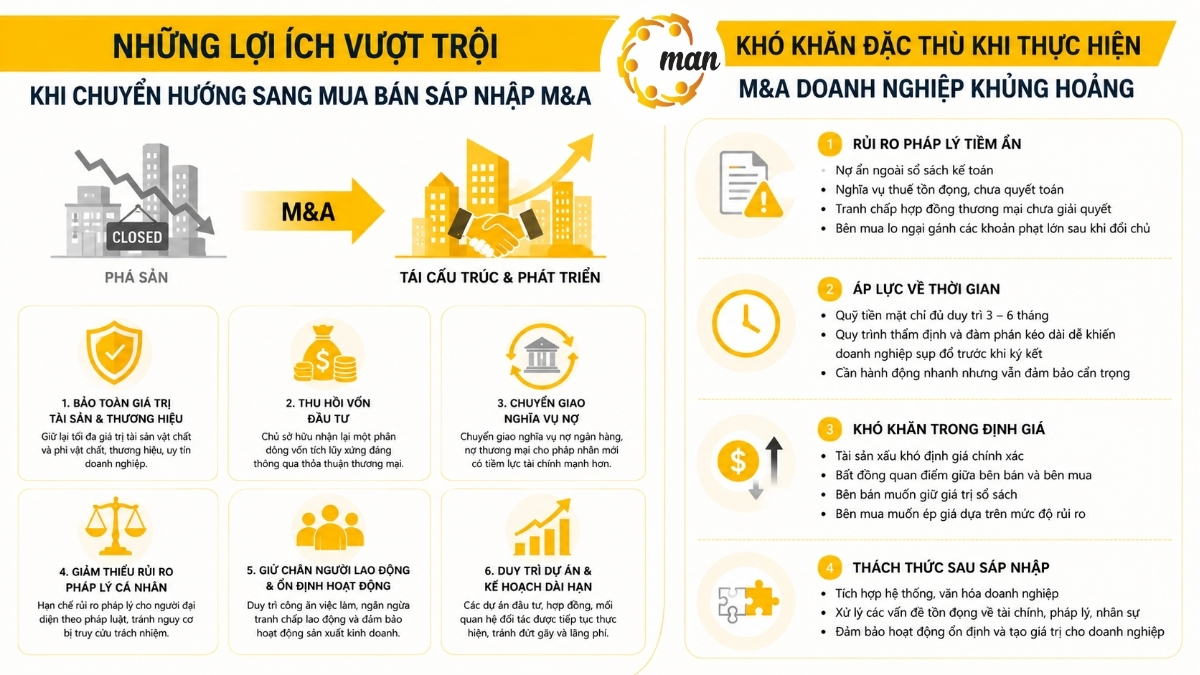
The outstanding benefits of shifting towards mergers and acquisitions (M&A).
The biggest advantage when a business chooses to transfer capital instead of declaring bankruptcy is the ability to maximize the preservation of both tangible and intangible assets that have been painstakingly built up.
In bankruptcy cases, a company's assets are often seized and auctioned off at extremely low prices to prioritize the payment of tax debts and wage arrears.
Conversely, through voluntary commercial merger negotiations, owners have complete freedom to negotiate a sale price based on the long-term potential of the asset and receive a fair share of accumulated capital to prepare for future personal plans.
The deal not only solved the financial problems for the previous owner, business acquisition It also serves as a golden key to transferring bank and commercial debt obligations to new legal entities with stronger financial capabilities.
This helps minimize personal legal risks for the legal representative of the former business, avoiding the risk of criminal or civil liability related to debt evasion or insolvency.
At the same time, the continued normal operation of the business under the new owner will help maintain jobs for the workforce, effectively prevent collective labor disputes, and ensure that large investment projects are not disrupted midway, thus avoiding a waste of social resources.

Specific challenges when carrying out M&A of businesses in crisis.
Despite offering numerous significant benefits, mergers and acquisitions for financially struggling entities often involve complex obstacles. Without the guidance of experienced professionals, such deals can easily fall apart.
The primary challenge is the potential legal risk arising from hidden debts not recorded in the official books, outstanding tax obligations that have not been settled over several financial years, and unresolved commercial contract disputes with former partners. The buyer always fears incurring unforeseen and substantial financial penalties after the ownership transfer is complete.
Besides legal risks, the immense time pressure is also a significant challenge for both parties in the transaction. Typically, the cash reserves of businesses on the verge of bankruptcy are only sufficient to sustain minimal operations for a minimum of three to six months.
If the business due diligence and negotiation process drags on too long due to disagreements over valuation between the buyer and seller, the target business may collapse completely before the official contract is signed. Valuing distressed assets is always a tense battle of wits, with the seller trying to maintain book value while the buyer wants to drive down the price based on the level of risk they face.
Standard M&A advisory process for restructuring businesses.
To overcome specific barriers and bring a deal to fruition business restructuring Reaching the shores of success requires applying one professional and systematic process. The initial phase is always the pre-M&A preparation stage, where experts conduct a comprehensive assessment of the company's actual financial health, review and categorize debt groups to develop the most optimal offering plan.
At this time, collaborating with a reputable network of experts like MAN – Master Accountant Network is crucial to preparing a transparent offering document that accurately reflects the value of the core assets and potential growth opportunities, thereby building initial trust with international investors.
Moving on to the next stage, the consulting firm will screen and approach the most suitable target investor groups, including investment funds specializing in acquiring debt assets or strategic partners in the same industry looking to rapidly expand their market share. Once interested partners are found, business appraisal process In-depth legal, financial, and tax investigations will be aggressively pursued to uncover all potential risks.
Finally, the two parties will enter the transaction structure negotiation phase, where complex terms regarding debt repayment, asset disposal, and confidentiality commitments will be specified in the share purchase agreement before proceeding with the legal procedures for ownership transfer at the relevant government agency.
Which type of consulting firm do businesses need in M&A transactions?
A successful merger and acquisition deal is never the result of a single individual's actions, but rather the coordinated efforts of a consortium of highly specialized professional consulting firms in specific fields.
Professional law firm
The role of law firms in mergers and acquisitions is irreplaceable, as they are directly responsible for providing absolute legal protection for their clients.
Specialized lawyers will conduct a thorough review of the legal status of all assets, verify the validity of core business licenses, and directly negotiate and resolve complex debt disputes with former creditors.
Their most important task is to draft strict confidentiality clauses, prerequisites, and compensation mechanisms in share purchase agreements to completely eliminate disputes arising after the transaction.
Auditing and financial consulting firm
Beyond legal aspects, the transparency and accuracy of financial data are crucial factors in determining the success of a transaction valuation. Leading auditing and financial consulting firms help bring transparency and high credibility to the target company's accounting reports.
They analyze the actual cash flows, review potential liabilities, and propose smart transaction structuring options to optimize corporate income tax obligations and other taxes arising from capital transfer activities for the parties involved in the transaction.
Reputable securities company
For large-scale transactions or those involving publicly traded companies, the role of reputable securities firms like SSI Securities or BSC Securities is extremely important.
These organizations possess an extremely extensive network of connections with major domestic and international financial institutions and investment funds, enabling businesses to quickly access high-quality acquisition capital.
Additionally, they assist in designing complex financial structures for transactions, valuing shares using modern market methods, and providing detailed advice on options for private placements or share swaps to legally merge businesses.
A specialized boutique M&A advisory firm.
For small and medium-sized enterprises (SMEs), hiring multinational consulting firms is sometimes unsuitable in terms of cost and operational flexibility. In this case, specialized boutique M&A consulting firms are the best option due to their ability to provide tailored solutions for each client.
These specialized units will work closely with business owners from the initial stages of preparing the offering documents, directly searching for the most suitable investors, to directly participating in negotiations to ensure the deal is successfully closed at the best possible price for the struggling business.
Practical experience helps businesses choose the right consulting model.
To optimize costs and achieve transaction goals as quickly as possible, management needs to accurately assess the size of its liabilities and existing asset structure before deciding to hire advisory services.
If a business has a highly complex financial structure with numerous creditors, including banks and suppliers, choosing a comprehensive consulting solution that combines both financial experts and specialized law firms will help ensure a smooth and efficient debt resolution process.
This combination helps avoid situations where consulting firms blame each other when unexpected legal issues arise. Collaborating with firms that have comprehensive networks of experts such as... MAN – Master Accountant Network This will help to quickly connect the tax, finance, and legal aspects into a single, unified processing path.
In addition, clearly defining the position and role of the business as either the buyer or the seller also determines the negotiation scenario that the consulting firm will develop.
For sellers facing a crisis, the most valuable practical lesson is to proactively seek help from merger and acquisition consultants early on, absolutely avoiding a situation where the company's operating cash flow is completely depleted before starting to look for a partner to acquire the equity stake.
Approaching investors in a hasty and passive manner will strip away all negotiating advantages, making it easy for businesses to be forced to accept prices that are too low or to accept extremely unfavorable contract terms.
Early restructuring advice is crucial for preserving maximum business value.
Most businesses only proactively seek M&A advisory services when their operating cash flow has almost dried up and debt pressures are weighing heavily on all daily operations.
However, consulting with experts and undertaking business restructuring early on will help businesses proactively improve their negotiating position with investors. This optimizes the value of assets being transferred and minimizes complex legal risks compared to dissolution or bankruptcy.
Proactively contacting professional organizations early on will help management promptly identify governance gaps, clean up accounting records, and establish a safe and effective capital transfer roadmap to retain the most valuable core assets of the business in a volatile commercial market.
Frequently Asked Questions about Corporate Restructuring and M&A
Can companies with high levels of debt still pursue M&A?
What is the difference between dissolution and bankruptcy?
When should you sell your business instead of filing for bankruptcy?
What does due diligence in M&A involve?
Does M&A help transfer debt obligations?
Conclude
Facing the dilemma of whether to continue restructuring efforts or accept business closure is always the most daunting challenge for any manager.
Clearly, instead of choosing dissolution or bankruptcy, which entail significant financial losses and prolonged legal risks, mergers and acquisitions offer a promising path to revival for financially struggling businesses.
Through the support of reputable M&A consulting firms, businesses can not only maximize the value of their assets and brands but also thoroughly resolve their debt problems in a legal and humane manner, contributing to the stability of the overall economy.
Contact information for MAN – Master Accountant Network
- Address: 19A, 43rd Street, Tan Thuan Ward, Ho Chi Minh City
- Mobile/Zalo: 0903 963 163 – 0903 428 622
- Email: man@man.net.vn
Content production is overseen by: Mr. Le Hoang Tuyen – Founder & CEO of MAN – Master Accountant Network, CPA Vietnam auditors with over 30 years of experience in accounting, auditing, and financial consulting.