


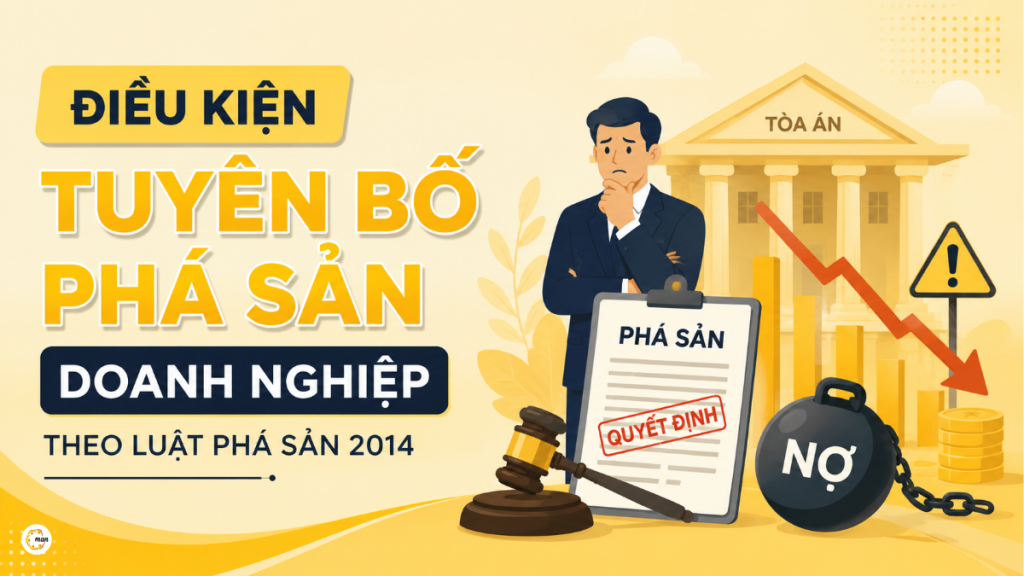
Understanding the conditions for declaring a business bankrupt is a crucial first step in helping business owners and accounting departments accurately assess the legal status of their organization when facing a financial crisis. When a business is burdened with prolonged debt, a thorough understanding of the legal basis not only ensures proper procedures but also minimizes legal risks related to tax obligations and the financial liability of managers.
Legal basis: The content of this article is compiled based on: Bankruptcy Law 2014 (Law No. 51/2014/QH13) Issued by the National Assembly on June 19, 2014 (see reference) Text schema on legal documents or Government Electronic Portal) and the implementing guidelines that are still in effect.
Conditions under which a business may be considered for bankruptcy by the court.
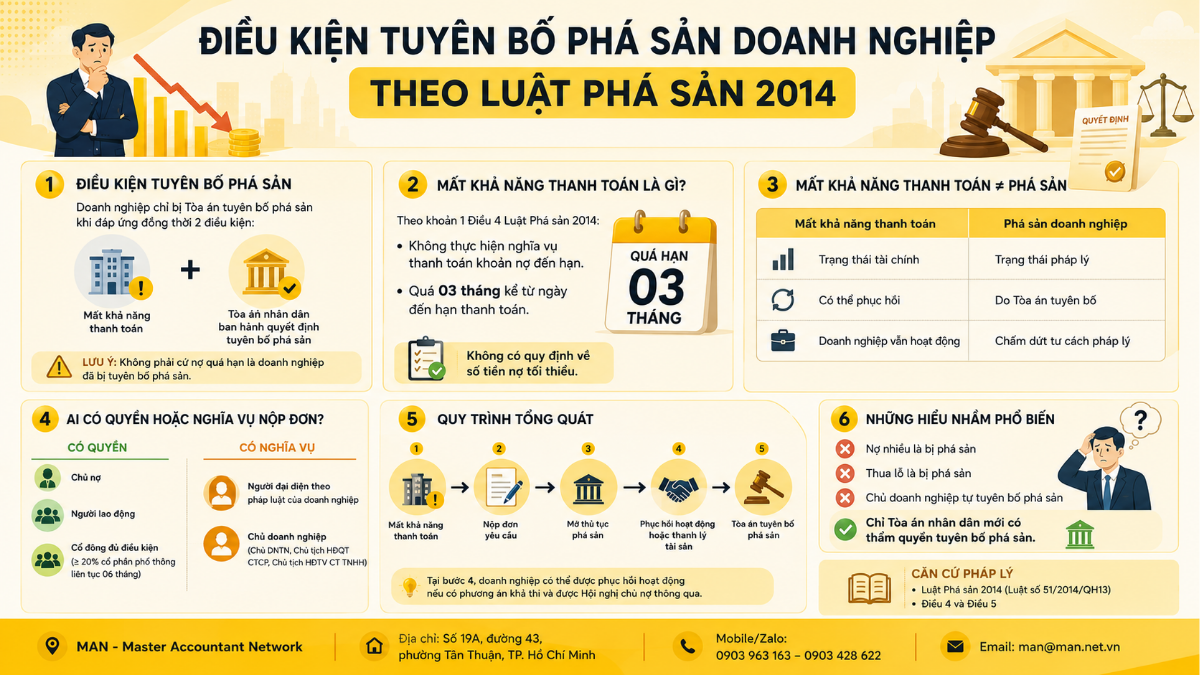
According to Clause 2, Article 4 of the 2014 Bankruptcy Law, the conditions for a business to be declared bankrupt by the Court include two mandatory constituent elements: the business is in a state of insolvency and the People's Court issues a decision declaring bankruptcy. The occurrence of overdue debts exceeding 3 months is only grounds for initiating bankruptcy proceedings; only the decision declaring bankruptcy from the Court officially terminates the legal status of the organization.
The concept of insolvency under the Bankruptcy Law 2014
According to Clause 1, Article 4 of the 2014 Bankruptcy Law, an insolvent enterprise is one that fails to fulfill its debt payment obligations within 3 months from the due date. This regulation applies consistently to all organizational models, from Limited Liability Companies, Joint Stock Companies, Private Enterprises to Partnerships.
Current legislation does not specify a debt-to-total-assets ratio as a criterion for determining insolvency. Therefore, even if an organization owns fixed assets or real estate worth significantly more than its total debt, the inability to convert these assets into cash flow to cover due debts within three months still results in legal bankruptcy.
Basis for determining due debt obligations and the 3-month term.
The three-month period is calculated from the day following the payment deadline agreed upon in the economic contract, commitment letter, debt reconciliation statement, or decision of a competent state agency. According to Articles 4 and 5 of the 2014 Bankruptcy Law, the debt due that gives rise to this obligation includes both unsecured and partially secured debts.
In practice and court proceedings, if a debt is subject to a dispute regarding its value or legal basis in court or commercial arbitration, the obligation to pay that debt is not considered a clear basis for calculating the three-month overdue period until a legally binding judgment or ruling is issued.
The role of bankruptcy declaration decisions from the Court
The state of insolvency is essentially just a factual financial indicator and a prerequisite for competent authorities to file a petition for bankruptcy proceedings. A business only becomes legally bankrupt when the judge assigned to the case issues a bankruptcy declaration.
After issuing a decision to initiate bankruptcy proceedings, the court will appoint a receiver or asset management and liquidation company to oversee transactions, inventory all assets, compile a list of creditors, and distribute assets according to the legally prescribed order of priority for payment.
Distinguishing between insolvency and business bankruptcy
Confusing the concepts of "insolvency" and "bankruptcy" often leads to erroneous financial management decisions and legal responses from executives. The core difference lies in their financial nature, the authority to certify them, and the resulting legal consequences.
The detailed comparison table below clarifies the differences between these two legal and financial statuses:
| Distinguishing criteria | Insolvency | Business bankruptcy |
|---|---|---|
| Nature | Financial status: Unable to repay debts overdue for 3 months. | The legal status that completely terminates the existence of the business. |
| Certification body | The assessment is based on accounting reports, contracts, and actual cash flow. | A legally binding bankruptcy declaration is issued by the People's Court. |
| Legal personality | The business retains its legal status and continues to operate normally. | The business officially ceased to be a legal entity and was removed from the business registration. |
| Solution | Recovery is possible through restructuring, debt write-off, or negotiation. | Liquidate assets, recover debts, and distribute proceeds to creditors in the order prescribed by law. |
| Legal intervention | There has been no direct intervention from the judge or the receiver. | There is direct supervision and guidance from the Judge and the Receiver. |
Please refer to the article for details. Comparison of business dissolution and bankruptcy To better understand the differences between the various forms of business termination.
Clearly distinguishing between these two states helps management accurately determine the course of action, proactively negotiating dissolution or business recovery instead of passively waiting for a court decision.
Who has the right and obligation to file a petition for bankruptcy proceedings?
According to Article 5 of the 2014 Bankruptcy Law, the right to file a petition for bankruptcy proceedings belongs to unsecured creditors, partially secured creditors, employees, and shareholders owning 201 or more common shares for a continuous period of at least 6 months. Meanwhile, the legal representative of the enterprise, the owner of a private enterprise, the Chairman of the Board of Directors of a joint-stock company, or the Chairman of the Board of Members of a limited liability company is obligated to file a petition when the enterprise becomes insolvent.
Clearly defining the rights and obligations of filing an application is crucial in protecting assets and determining the individual responsibility of the manager:
- The entity with the mandatory obligation: When a business is found to be insolvent, the legal representative, owner, or manager of the business must proactively file a bankruptcy petition. According to Article 161 of the 2014 Bankruptcy Law, if the obligated party intentionally fails to file the petition or delays doing so, causing damage to the assets of the business and creditors, they may be held liable for personal damages as stipulated by law.
- Eligible applicants: Unsecured or partially secured creditors have the right to file a claim after a three-month period if the debt remains unpaid. Employees or union representatives have the right to file a claim when the employer owes wages and benefits for more than three months.
The process for handling a situation after a business is eligible for bankruptcy.
The bankruptcy proceedings are carried out through several stages: accepting the application, issuing a decision to open bankruptcy proceedings, convening a creditors' meeting, implementing a rehabilitation plan (if any), and issuing a decision declaring bankruptcy. Throughout this process, the bankruptcy administrator will coordinate with the court and tax authorities to inventory assets and accurately determine financial obligations.
The asset liquidation phase requires businesses to strictly adhere to the priority order of payment as stipulated in Article 54 of the 2014 Bankruptcy Law:
- Bankruptcy costs (including court fees, newspaper advertising fees, advance payments for the bankruptcy administrator, and asset valuation).
- Wages, severance pay, social insurance, and health insurance contributions owed to employees.
- Tax debts and other financial obligations to the State budget.
- Unsecured debts are being repaid to creditors on the verified list.
The accounting department plays a crucial role in finalizing accounts payable figures, preparing invoices and supporting documents, and fulfilling tax settlement obligations with the relevant authorities before asset distribution.
For detailed instructions on the process, please refer to the in-depth article. business dissolution and bankruptcy procedures Contact MAN to familiarize yourself with the list of litigation documents.
Situations where businesses should not choose bankruptcy as a solution.
Many business owners hastily choose to file for bankruptcy when faced with immediate financial difficulties. However, from a management and legal advisory perspective, bankruptcy is not always the optimal solution.
Businesses should consider alternative options in the following situations:
- The business is only experiencing a temporary cash flow imbalance: The total value of fixed assets, real estate, or accounts receivable is greater than the total debt, but is facing difficulties due to the short-term decline in market liquidity.
- There is still room for negotiation regarding restructuring: Major creditors, such as banks or strategic suppliers, agree to extend repayment periods, freeze debt, or convert debt into equity.
- There is a viable business plan: Businesses have a pool of potential customers, new orders, or partners willing to invest capital to generate positive cash flow in the near future.
- The risk of personal liability for managers is high: In cases where accounting records are unclear, with expenses lacking valid invoices or incomplete tax obligations, initiating bankruptcy proceedings will lead to in-depth scrutiny by the bankruptcy administrator and inspectors, increasing the risk of personal legal liability for the business owner.
Options include temporarily suspending business operations, negotiating debt restructuring, or initiating legal procedures. business dissolution Voluntary action in these situations will help businesses protect their assets and avoid unnecessary legal consequences.
Common misconceptions about the conditions for business bankruptcy
Some common misunderstandings lead managers and accountants to make inaccurate decisions:
- Misconception 1: Business losses or debts exceeding assets automatically lead to bankruptcy. Reality: Operating at a loss is a state of operation, while debt exceeding assets is an imbalance on the balance sheet. A business is only considered bankrupt if it fails to meet its debt obligations for three months and receives an official declaration from the Court.
- Misconception 2: Filing for bankruptcy will wipe out all debt and tax obligations. Reality: Bankruptcy is the process of seizing assets to pay obligations in the order of legal priority. Tax obligations and employee wages are given priority. In cases of intentional violations or asset concealment, the managing individual is still liable for damages.
- Misconception 3: The board of directors is free to issue decisions declaring bankruptcy. Reality: The manager only has the right or obligation to file an application for bankruptcy proceedings. The sole authority to issue a decision declaring a business bankrupt rests with the People's Court.
Conclude
Accurately assessing the conditions for declaring a business bankrupt helps management and the accounting department proactively prevent legal risks, maximize asset protection, and comply with current regulations. When signs of cash flow imbalances appear, comparing recovery options, debt restructuring negotiations, dissolution, or bankruptcy is a mandatory management step.
Comprehensive support services from MAN – Master Accountant Network
The team of legal, accounting, and auditing experts at MAN – Master Accountant Network We are ready to support businesses in reviewing accounts receivable, assessing financial health, settling tax obligations, and advising on the most optimal legal solutions for each specific case.
Frequently Asked Questions about the Conditions for Declaring Bankruptcy
What are the conditions for declaring a business bankrupt?
The conditions for declaring bankruptcy include two mandatory elements: the business fails to fulfill its debt payment obligations within 3 months from the due date, and the People's Court issues a decision declaring bankruptcy as stipulated in Article 4 of the 2014 Bankruptcy Law.
If a debt is not repaid for more than 3 months, will the individual be declared bankrupt immediately?
No. Failure to repay debts for more than three months only establishes a state of insolvency and serves as grounds for filing for bankruptcy. A business is only officially declared bankrupt after the court accepts the case, initiates proceedings, and issues a bankruptcy declaration.
Who has the right to file a petition for bankruptcy proceedings?
Pursuant to Article 5 of the 2014 Bankruptcy Law, unsecured creditors, partially secured creditors, employees (or union representatives), and shareholders/groups of shareholders owning 20% or more common shares have the right to file a petition for bankruptcy proceedings.