



When deciding to cease business operations, many business owners and accountants often have questions. What steps are needed to dissolve a company? First and foremost, to ensure compliance with legal procedures and avoid potential risks, understanding the steps from decision approval and tax settlement to filing dissolution documents with the Business Registration Authority will significantly save businesses time and costs. This article guides you through all the legal procedures and financial obligations that need to be completed according to current regulations.
What steps are needed to dissolve a company?
To dissolve a company in accordance with the law, the business needs to follow this sequence: pass a dissolution decision, notify the relevant authorities and employees, liquidate assets, settle all debts, fulfill tax obligations with the tax authorities, and then submit the dissolution documents to the Business Registration Authority to update the dissolved status on the National Business Registration Portal.
Before initiating formal legal proceedings, business owners and accounting departments should proactively conduct an internal review including:
- Reconcile and cancel unused electronic invoices.
- Check the status of tax returns, outstanding tax payments, and bank account management for the business.
- Review current social insurance obligations and employment contracts.
- Conduct an inventory of fixed assets and review the legal status of branches, representative offices, or affiliated business locations.
Conditions for a business to be dissolved
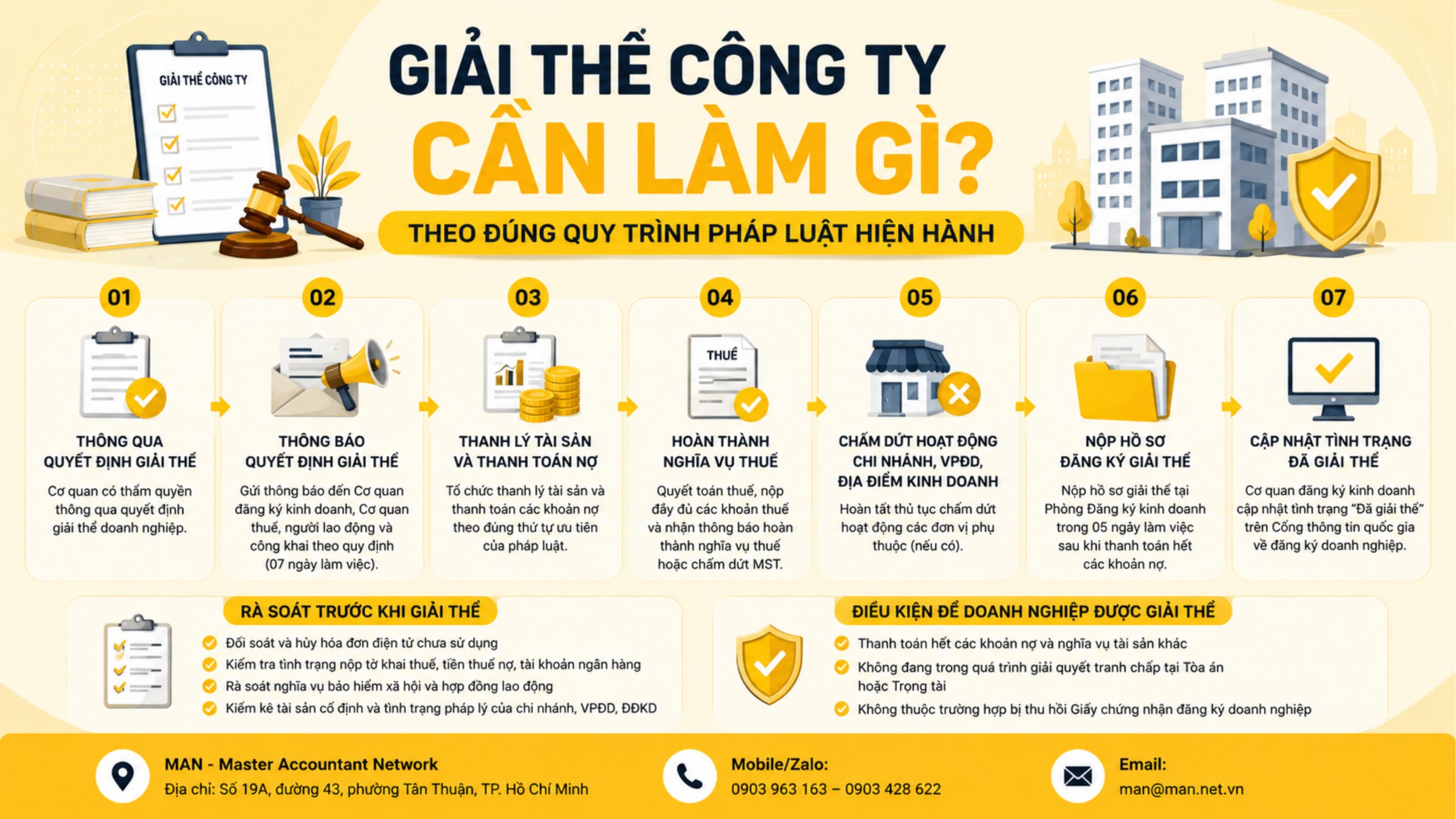
A business can only be dissolved when it ensures that all debts and other financial obligations are paid in full, and it is not in the process of resolving disputes in court or arbitration as stipulated in Article 207. Enterprise Law 2020. If a business is no longer able to pay its debts, the processing procedure must be transferred to the standard procedure. business bankruptcy According to the Bankruptcy Law, if a business does not meet these conditions, it cannot complete the dissolution process and may have to undergo bankruptcy proceedings as prescribed by law.
The mandatory financial obligations that must be settled in order of priority before completing the dissolution registration process include:
- Wage arrears, severance pay, social insurance, health insurance, unemployment insurance, and other employee benefits as stipulated in signed employment contracts and collective bargaining agreements.
- Tax debts and other financial obligations to the State Budget.
- Remaining debts to creditors, business partners, or banks.
After all debts have been paid off and business dissolution costs, The remaining asset value is then distributed to the company owners, contributing members, or shareholders in proportion to their respective ownership shares.
Step-by-step company dissolution process
The actual business dissolution process goes through two core stages: settling tax obligations at the directly managing tax authority and completing legal procedures at the Business Registration Authority under the Department of Planning and Investment.
Step 1. Pass the dissolution decision.
The dissolution of a business must be approved by the highest decision-making authority within the company. Depending on the type of business, the authority to make dissolution decisions is regulated as follows:
- One-member limited liability companyDecision of the company owner.
- For limited liability companies with two or more members: Resolutions and minutes of meetings of the Board of Members.
- Joint Stock Company: Resolutions and minutes of the General Meeting of Shareholders.
- Private enterprise: Decisions of the private enterprise owner.
The dissolution decision must clearly state the name and registration number of the enterprise, the reason for dissolution, the deadline and procedures for liquidating contracts, settling debts (the deadline for debt payment must not exceed 6 months from the date of the decision), and the plan for handling obligations arising from labor contracts.
Step 2. Announce the dissolution decision.
Within 7 working days from the date of approval, the dissolution decision must be sent to the Business Registration Authority, the directly managing Tax Authority, and the employees of the enterprise as prescribed. Decree 168/2025/ND-CP Regarding business registration.
Simultaneously, the dissolution decision must be publicly posted at the head office and branches of the enterprise, and published on the National Portal for Business Registration. If the enterprise still has outstanding financial obligations, the dissolution decision must be accompanied by a debt settlement plan sent to creditors and other parties with relevant rights and obligations.
Step 3. Liquidate assets and pay off debts.
Businesses shall liquidate assets in accordance with the Law on Enterprises and the company's charter; the liquidation may be carried out by the owner, the Board of Members, the Board of Directors, or a department/organization directly assigned to do so. All proceeds from the liquidation of assets will be prioritized for the payment of debts in the order prescribed by law.
During this process, businesses need to prepare a detailed list of all assets, accounts receivable, accounts payable, and asset liquidation records with confirmation from all relevant parties to serve as a basis for explanation to regulatory authorities when requested.
Step 4. Fulfill your tax obligations.
Fulfilling tax obligations is the most complex and time-consuming step in the entire dissolution process. According to regulations... Tax Administration Law 2019, Businesses must submit a written request to terminate their tax identification number to the directly managing tax authority.
The tasks that the accounting department needs to perform at the tax office include:
- Prepare and submit complete corporate income tax and personal income tax settlement documents, along with financial statements up to the date of the dissolution decision.
- Follow the correct procedures for notifying the cancellation of unused electronic invoices.
- Actively cooperate with tax authorities during tax audits and settlements at the company's premises (if an audit is required).
- Complete payment of any outstanding taxes, fines, or late payment penalties (if applicable).
- Hand over documents and receive a Notice of Completion of Tax Obligations or a Notice of Termination of Tax Identification Number from the Tax Authority.

Step 5. Terminate the operations of any branch or representative office.
Before filing for company dissolution with the Business Registration Authority, businesses are required to complete the procedures for terminating the operations of all branches, representative offices, and business locations under their jurisdiction.
The application for the termination of a subsidiary's operations must be submitted to the Business Registration Office where the branch, representative office, or business location is situated. Skipping this step may result in the parent company's dissolution application being rejected or requiring additional information, disrupting the entire processing timeline.
Step 6. Submit the dissolution registration application.
Within 05 working days from the date of full payment of all business debts, the legal representative of the business shall submit the dissolution registration dossier to the Business Registration Authority where the business is headquartered.
Currently, dissolution registration applications are submitted online through the National Business Registration Portal. The business registration authority will check the validity of the application and verify the fulfillment of tax obligations on the data system linked with the Ministry of Finance.
Step 7. Update the dissolved status.
After receiving all valid documents and confirmation from the Tax Authority that the business has fulfilled its tax obligations, the Business Registration Authority issues a notice regarding the dissolution of the business.
Simultaneously, the Business Registration Authority updates the legal status of the enterprise to "Dissolved" on the National Business Registration Portal and revokes the Business Registration Certificate.
What documents are required for company dissolution?
The company dissolution documents submitted to the Business Registration Authority include the Notice of Business Dissolution, the Report on Liquidation of Business Assets, the List of Creditors and the Amounts of Debts Paid, and the Decision and Minutes of the Meeting of the competent authority regarding the dissolution.
| Document components | Detailed description | Note the facts |
|---|---|---|
| Announcement of dissolution | According to the form prescribed in Decree 168/2025/ND-CP | Signed by the legal representative. |
| Decision/Resolution on dissolution | Approved by the Owner, Board of Directors, or General Meeting of Shareholders. | The plan for handling debt and labor must be clearly outlined. |
| Meeting minutes | Applicable to Limited Liability Companies with 2 or more members, and Joint Stock Companies. | All attending members/shareholders must sign the document. |
| Asset liquidation report | Provide a detailed breakdown of the asset liquidation and debt repayment process. | A commitment must be made to have all debts paid off. |
| List of creditors | A list of creditors and the amount of debt paid. | This includes both tax debts and social insurance debts. |
How is a company dissolved if it has not yet generated any revenue?
Even if a company has not generated revenue or issued invoices, it must still complete the full dissolution process as prescribed by law, including submitting tax settlement documents, canceling invoices (if registered), and submitting documents to close the tax code before submitting the dissolution application to the Business Registration Authority.
Many newly established businesses mistakenly believe that they don't need to file tax returns if they haven't started any business operations. However, legally, the tax authorities still manage periodic tax declaration obligations (VAT, personal income tax, corporate income tax, and business license tax returns) from the time of business registration. Therefore, businesses must still submit all missing tax returns, fulfill their business license tax obligations, and apply for confirmation of tax code closure according to the usual procedures.
Common mistakes when dissolving a company
In practice, the process of dissolving a business is often prolonged due to technical errors in the paperwork or unresolved outstanding financial obligations.
Tax obligations not yet fulfilled
This is the most common reason for delays in dissolution applications. Many businesses still owe penalties for late filing of tax returns, business license taxes from previous years, or have not yet submitted their final annual financial statements. The tax authorities will not issue a certificate of tax compliance if any outstanding debts remain in the system.
Electronic invoices not yet processed
Before requesting the termination of a tax identification number, businesses must notify the tax authorities of the cancellation of unused electronic invoices. Skipping this procedure or canceling them incorrectly results in invoices remaining in an active state, causing bottlenecks in the automatic data reconciliation process between the tax authorities and the business registration authority.
The branch or business location has not yet been closed.
A common technical error is that businesses directly file dissolution documents for the parent company while its subsidiaries, such as branches, representative offices, and business locations, are still operational. According to regulations, all these entities must complete the procedures for ceasing operations and closing their dependent tax identification numbers first.
The records are inconsistent.
There is a discrepancy between the financial statements submitted to the tax authorities and the asset liquidation report submitted to the Business Registration Authority. This inconsistency in figures regarding liabilities, capital contributions, or the value of liquidated assets will lead the Business Registration Department to issue a rejection notice and request further explanations and corrections multiple times.
When should you use company dissolution services?
Businesses should consider using professional dissolution services when their accounting records are incomplete, they have complex tax debts, a network of branches and business locations in many provinces and cities, or when the legal representative does not have time to directly work with regulatory agencies.
Self-dissolution procedures typically require businesses to have a thorough understanding of the working procedures of each tax office, the skills to prepare financial statements for dissolution settlement, and the ability to handle arising legal issues. Without a dedicated accounting and legal department, hiring a reputable consulting firm can save businesses time, optimize unnecessary costs, and minimize the risk of tax arrears and penalties.
Expert opinion from MAN
Experts at MAN – Master Accountant Network share practical experiences to help businesses optimize the dissolution process, ensuring it is quick and legally secure.
Expert quote from MAN – Master Accountant Network:
“"Based on the practical experience of MAN's team of experts in advising and assisting businesses with dissolution procedures, most of the bottlenecks occur in the tax settlement phase, not at the Business Registration Authority.".
To optimize the process and significantly shorten the dissolution time, businesses need to pay attention to three key points:
- Review your electronic tax account (eTax): Review all outstanding tax obligations, late payment penalties, and missing tax returns from the time of establishment before submitting the dissolution notice.
- Lock your bank account at the right time: Only close the company's bank account after all final tax obligations have been paid to the State Budget.
- Prepare a comprehensive asset liquidation file: Ensure that the figures in the Asset Liquidation Report (100%) accurately match the tax settlement financial statements at the time of dissolution.”
Conclude
Clearly understand What steps are needed to dissolve a company? This helps business owners proactively coordinate work and adhere to legal procedures from decision-making, asset liquidation, tax settlement, to submitting documents for business registration closure. Accurate execution of each step not only protects the rights of employees and creditors but also helps legal representatives avoid future legal risks related to tax collection.
If your business is struggling with tax settlements, accounting issues, or needs a quick and safe dissolution plan, please consider our services. business dissolution services Become a professional at MAN – Master Accountant Network to receive the best possible support.
Frequently Asked Questions
What steps should be taken before dissolving a company?
Businesses need to hold a meeting to approve the dissolution decision, and then within 7 working days must send notification of this decision to the Business Registration Authority, the directly managing Tax Authority, and the employees.
How long does it take to dissolve a company?
The time it takes to dissolve a company depends on the status of its accounting records, the progress in fulfilling tax obligations, and the tax audit conducted by the directly supervising tax authority. The process will be faster if the business prepares transparent documentation and has no outstanding financial debts.
Is it necessary to settle taxes before dissolution?
Yes. Businesses are required to complete corporate income tax and personal income tax settlements, cancel invoices, and pay all outstanding taxes before the Tax Authority issues a document confirming the closure of their tax identification number, allowing them to proceed with dissolution procedures at the Business Registration Authority.
Can a company that has not yet generated revenue be dissolved?
Yes. A company that has not yet generated revenue can still be dissolved normally, but it must still complete all procedures to submit any missing tax returns, cancel invoices (if any), and submit documents to close its tax identification number in accordance with the law.