



The procedure for dissolving a single-member limited liability company is a mandatory legal process when the owner no longer wishes to continue the business or the company falls under the cases of mandatory dissolution as stipulated by law. This process requires thorough preparation of documentation and the settlement of all financial obligations with tax authorities, employees, and partners. Understanding the procedure helps owners save time and avoid unnecessary administrative penalties during the termination process.
What is the procedure for dissolving a single-member limited liability company?
Understanding the legal nature of dissolution helps business owners be more proactive in their business decisions and fulfill their legal responsibilities.
The concept of business dissolution
Business dissolution is the process of terminating the existence of a legal entity as recognized by the state management agency. Legally, this is the procedure for terminating the rights and obligations of the business towards related parties. Unlike bankruptcy, which is a procedure applied when a business is unable to pay its debts and must be resolved through the courts, business dissolution This is a proactive (or legally mandated, passive) process, but the prerequisite is that the business must ensure that all debts and other financial obligations are paid off.
This applies to single-member limited liability companies.
According to the regulations at Enterprise Law 2020, A limited liability company with a single member may be dissolved in the following specific cases:
- Voluntary dissolution: The company owner decides to cease operations due to unsatisfactory business performance, a change in investment direction, or the lack of suitable management.
- Expiration of operating period: The business's operating period, as stated in its Articles of Association, has expired, and the owner has not decided to renew it.
- Business registration certificate revoked: This is a case of mandatory dissolution when a business violates the law to the extent that the regulatory authority revokes its operating license.
- The minimum number of members is no longer required: This applies if the sole owner, an individual, dies without a legal heir or if the heir refuses to accept the property.
Conditions for carrying out the procedure for dissolving a single-member limited liability company.
In order to begin submitting applications to the relevant authorities, businesses must ensure they meet all the stringent legal standards as follows: conditions for dissolving a business.
Cases of dissolution according to regulations
Businesses are only permitted to dissolve when they fall under one of the cases stipulated in Clause 1, Article 207 of the 2020 Enterprise Law. These cases include the voluntary decision of the owner, the expiration of the operating period stated in the charter without renewal, or the revocation of the Business Registration Certificate by a competent state agency.
Conditions that must be met before dissolution
Clause 2 of Article 207 of the 2020 Enterprise Law clearly states that an enterprise can only be dissolved when it ensures the full payment of all debts and other financial obligations. This means that before submitting the official documents, the enterprise must complete the following:
- The total tax liability includes value-added tax, corporate income tax, business license tax, and other applicable taxes.
- Pay employees their full salaries, severance pay, social insurance, health insurance, and unemployment insurance contributions in accordance with their contracts and legal regulations.
- Set aside all principal and interest payments to credit institutions, banks, business partners, and other creditors.
- Thoroughly resolve all economic contracts that are in the process of being executed or are undergoing legal contract liquidation.
Cases where dissolution is not permitted
The business registration authority and tax authority will refuse to accept or process the application if they discover that the business falls under any of the restricted dissolution cases, including:
- The business is currently under tax audit, has its accounting records inspected, or has an enforcement order against an administrative tax decision.
- The business is currently a defendant or a related party in civil, economic, or labor cases being handled by the court.
- The company is in the process of resolving a contract dispute with a customer or partner, and has not yet received a final ruling from a competent authority.
Documents and procedures for dissolving a single-member limited liability company.
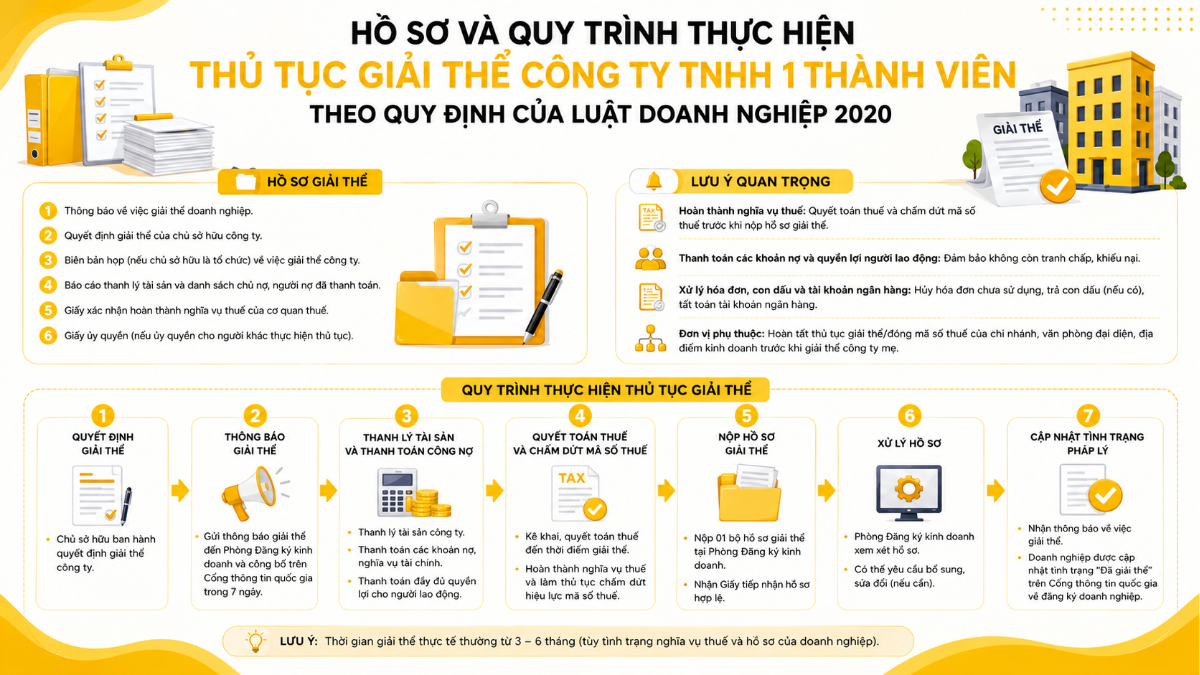
Preparation Dissolution documents for a single-member limited liability company. Completeness and accuracy in accordance with the prescribed forms of the Ministry of Planning and Investment and the Ministry of Finance are decisive factors in the processing speed of the management agency.
Required documents
The documents to be submitted to the Business Registration Office to record the termination of a single-member limited liability company include the following:
- Notification of business dissolution (according to the form prescribed in Decree 01/2021/ND-CP).
- The decision to dissolve the business is made by the company owner.
- The company's asset liquidation report clearly states the list of creditors and the amount of debt paid, as well as tax debts and outstanding social insurance, health insurance, and unemployment insurance contributions for employees after dissolution.
- The list of employees and their entitlements have been settled.
- A certificate from the tax authority confirming that tax obligations have been fulfilled (business tax code has been closed).
- Original business registration certificate.
- Authorization letter for the person submitting the application (if not the legal representative directly submitting the application).
Documents required for businesses with branches, representative offices, or business locations.
If the company has subsidiaries, the process becomes more complex. Before filing for the dissolution of the parent company, the owner must complete the procedure to terminate the operations of all branches, representative offices, and business locations at the Business Registration Office where the subsidiary is located.
The accompanying documents must now include decisions to terminate the operations of each subsidiary unit and confirmation notices from the business registration authority.
| Stage | Receiving agency | Main components of the application file |
|---|---|---|
| Close the tax identification number. | Tax Authority | Documents required for termination of tax identification number (Form 24/ĐK-TCT); Dissolution decision; Settlement documents. |
| Register for dissolution | Business Registration Office | Notice of dissolution; Decision on dissolution; Liquidation report; Confirmation of completion of tax obligations (Notice 10-MST). |
Businesses need to carefully review the legal validity of each document to avoid having their applications rejected due to formal errors or missing signatures from the owner.
Procedure for dissolving a single-member limited liability company.
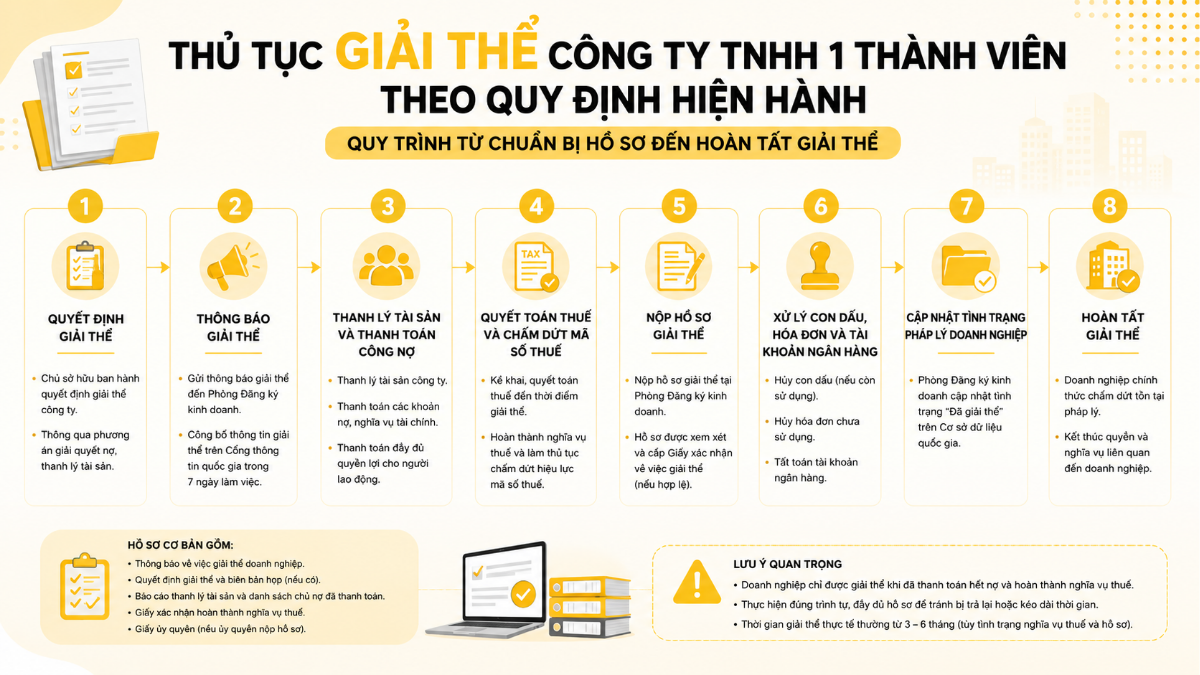
When finding out What steps are needed to dissolve a company?, The owner must strictly adhere to a six-step process involving coordination between internal departments and relevant authorities.
Step 1. Issue the dissolution decision.
The owner of a single-member limited liability company issues a dissolution decision. The decision must clearly state the reasons, the timeframe for asset liquidation, and the plan for handling obligations arising from employment contracts.
Step 2. Announce the dissolution decision.
Within 7 working days, send the decision to the Business Registration Office, the tax authority, and the employee. Simultaneously, publicly post it at the company headquarters and on the National Business Registration Portal.
Step 3. Liquidate assets and settle obligations with creditors and employees.
The owner directly liquidates the assets. The priority order for payment is: wages, severance pay, social insurance, health insurance, and unemployment insurance for employees, followed by obligations to banks and partners.
Step 4. Fulfill tax obligations and terminate the tax identification number.
Businesses submit a written request to terminate their tax identification number (Form 24/ĐK-TCT) to the tax authority along with their tax return documents. After confirmation of completion, the tax authority will issue a Notice Form 10-MST.
Step 5. Submit the dissolution registration application to the Business Registration Office.
Within 5 working days after the debt is fully paid, submit the documents to the Business Registration Department via the Public Service Portal or in person.
Step 6. Update the legal status of the business.
After verification, the Business Registration Office updates the status to "Dissolved" in the national database of business registrations.
| Step | Processing agency | Result |
|---|---|---|
| Steps 1, 2, 3 | Internal & Disclosure Information | Public information |
| Step 4 | Tax Authority | Notification Form 10-MST |
| Steps 5, 6 | Business Registration Office | Status: "Disbanded"“ |
Reference timeline: Week 1 (Issuance and notification of dissolution decision), Weeks 2–4 (Asset liquidation, debt settlement), Weeks 5–12 (Tax settlement and termination of tax identification number), Week 13 (Completion of dissolution procedures).
Time and cost involved in the dissolution process of a single-member limited liability company.
Processing time
The processing time at the registration office is 5 working days. However, the tax settlement phase at the tax office can take from one to several months depending on the accounting records.
Expenses to prepare for
Although the government waives fees for dissolution procedures, businesses still need to balance their finances. company dissolution costs including: publication fees, dissolution costs for tax arrears, late payment penalties (if any), and accounting consulting fees.
Factors affecting the dissolution time
Progress largely depends on transparency in accounting records, the number of dependent entities requiring tax code closure beforehand, and the complexity of debt disputes.