



The process of closing a company is essentially the procedure for dissolving a business to terminate its operations and legal status. A business cannot simply cease operations or stop issuing invoices and be automatically considered closed. According to current regulations, a business must meet dissolution conditions, pass a resolution or decision, handle assets and liabilities, fulfill related obligations, terminate the operations of any dependent units, and submit the dissolution registration application within the deadline. The following process is updated according to Law No. 76/2025/QH15, Decree 168/2025/ND-CP, and Decree 296/2026/ND-CP.
Is closing a company the same as dissolving a business?
“"Closing down a company" is a common term in practice, but it's not a separate legal term. If the goal is to completely cease the existence of the business, the term to use is "business dissolution." Dissolution differs from temporary suspension of business in that temporary suspension only interrupts operations while the business continues to exist, while dissolution results in the business being updated to its legal status as dissolved after fulfilling all legal conditions and procedures.
Distinguishing between company closure, temporary suspension of business, and dissolution.
Before choosing a procedure, business owners need to determine whether their goal is to temporarily cease operations or terminate the legal entity. The three states below are fundamentally different:
| Criteria | Closed/Dissolved | Temporarily suspending business operations. | Bankrupt |
| Purpose | Terminate the existence of the business. | Temporarily suspending business operations but maintaining the business itself. | Resolving insolvency through bankruptcy proceedings. |
| Legal status | The process ends when the updated business has been dissolved. | The business still exists. | Follow the legal procedures for bankruptcy. |
| The possibility of returning to operation. | Do not return to a dissolved legal entity. | It is possible to resume operations under regulations. | Depends on the outcome of the bankruptcy proceedings. |
| Financial conditions | All debts and financial obligations must be settled and not be subject to any disputes in court or arbitration. | It is not necessary to pay off the entire debt to be eligible for a temporary suspension. | This applies when a business becomes insolvent under bankruptcy law. |
If a business only needs to cease operations for a period but still wants to retain its legal entity, temporary suspension of operations may be more appropriate. If the business has decided to cease operations completely, it needs to prepare according to the dissolution process instead of just notifying the cessation of operations. MAN also analyzes the differences between these options separately in the article “Comparing business dissolution and bankruptcy today“".
Conditions for a company to be dissolved
A business can only complete its dissolution when it simultaneously meets the conditions regarding the reason for dissolution, financial obligations, and the status of any disputes. According to the Enterprise Law, businesses can be dissolved in legally defined cases, but the core condition remains that all debts and other financial obligations must be paid off, and the business must not be involved in any ongoing disputes in court or arbitration.
Cases of business dissolution
According to Article 207 of the Enterprise Law, the main cases of dissolution include the following situations:
- The operating period stated in the Charter has expired without a decision to extend it.
- According to a resolution or decision of the owner, the Board of Members, or the General Meeting of Shareholders, depending on the type of business.
- Businesses that no longer have the minimum number of members required by law for a continuous period of 06 months without undergoing the procedure to change their legal form.
- The business registration certificate is revoked, except where the tax administration law provides otherwise.
In the case of voluntary dissolution, the resolution or decision to dissolve must be issued by the competent authority and its content should include information about the enterprise, the reason for dissolution, the timeframe and procedures for liquidating contracts, settling debts, the plan for handling obligations to employees, and the signature of the authorized person.
Mandatory conditions before dissolution
Before filing for dissolution, a business needs to review all existing obligations. It shouldn't be assumed that simply ceasing business operations is sufficient grounds for closure. The groups of obligations that need to be checked include:
- Accounts payable to employees, including wages, allowances, and related benefits.
- Tax obligations and other payments due to the state budget.
- Accounts payable to suppliers, banks, partners, and other creditors.
- Assets, inventory, tools and equipment, accounts receivable, and uncompleted contracts.
- Branches, representative offices, business locations, and other dependent units.
- Disputes are being resolved in court or arbitration.
If a business becomes insolvent and unable to settle its debts under the conditions of dissolution, it should evaluate bankruptcy options instead of attempting to complete a dissolution process that does not meet the requirements.
What are the steps involved in the company closure process?
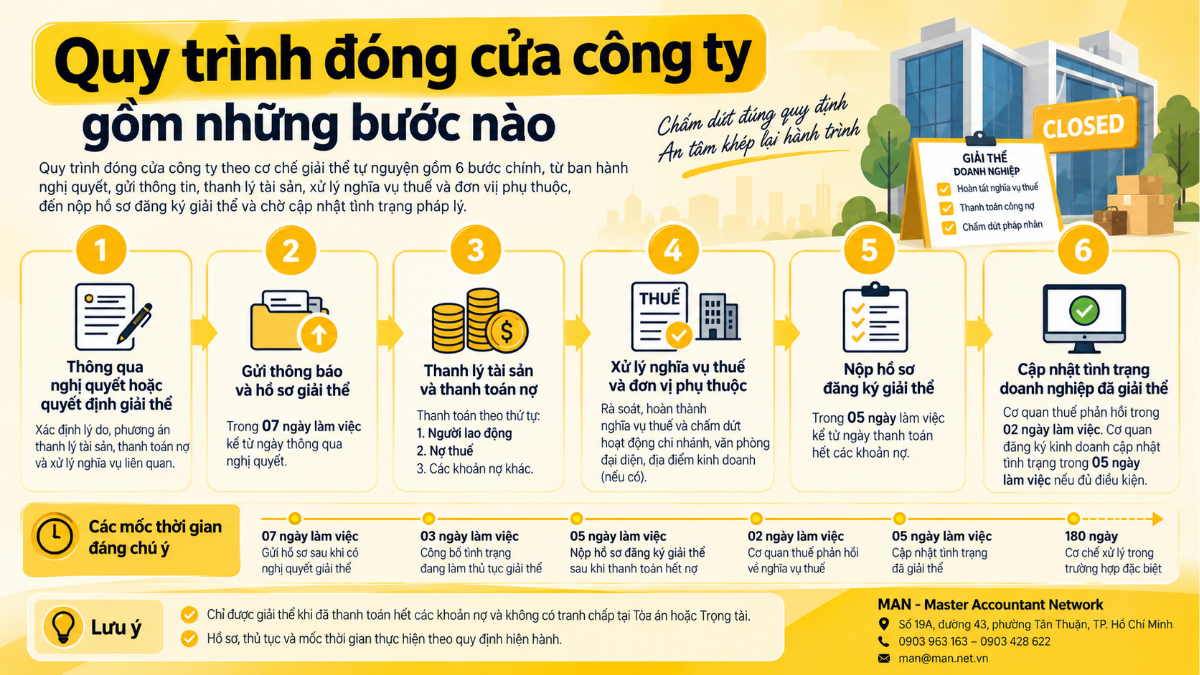
The process of closing a company under a voluntary dissolution mechanism can be visualized as a sequence: issuing a resolution or decision, sending dissolution information, liquidating assets and settling obligations, handling dependent units, submitting dissolution registration documents, and waiting for the business registration authority to update the legal status. Notable timelines in the current process include 7 working days, 3 working days, 5 working days, 2 working days, and a 180-day mechanism in special cases.
Step 1: Pass a resolution or decision to dissolve the organization.
Businesses begin the dissolution process by passing a resolution or decision in accordance with the authority of their type of business. This document must clearly state the reasons for dissolution, the plan and timeframe for liquidating assets, settling debts, handling obligations to employees, and the person responsible for organizing the implementation.
For voluntary dissolution, the business must prepare a resolution or decision according to the corresponding type and meeting minutes if required by law. If there is a debt settlement plan, the business needs to develop a suitable payment plan.
Step 2: Submit the dissolution notice and documents.
Within 7 working days from the date of adoption of the resolution or decision on dissolution, the enterprise shall submit the required documents to the Provincial Business Registration Authority where the enterprise is headquartered. The documents at this stage include the resolution or decision on dissolution, meeting minutes (if required), and a debt settlement plan (if any).
Within 3 working days of receiving the resolution or decision on dissolution, the provincial business registration authority shall publish the status of the enterprise undergoing dissolution procedures on the National Database of Business Registration, and simultaneously send relevant information to the tax authority and the civil enforcement agency as prescribed.
Step 3: Liquidate assets and pay off debts.
After initiating the procedure, the business must organize the liquidation of assets and settle obligations in the order prescribed by law. This part of the work directly affects the ability to complete the application, as the business can only submit the dissolution registration application after all obligations have been settled.
The order of payment should be controlled according to the following groups of obligations:
- Debts related to wages, severance pay, social insurance, health insurance, unemployment insurance, and other employee benefits as agreed upon in the contract.
- Tax debts.
- Other debts.
After settling dissolution costs and debts, the remaining assets are distributed to owners, members, or shareholders according to their ownership ratios as stipulated. Businesses should not distribute assets to owners or members before fulfilling their obligations to employees, the State, and creditors.
Step 4: Handling tax obligations and dependent units
Tax obligations are one of the most crucial aspects of the company closure process. Businesses need to check their tax declarations, invoices, taxes payable, late payment penalties, fines (if any), and other obligations arising up to the point of cessation of operations. The current system involves coordination between the Business Registration Authority and the tax authorities; therefore, it's not advisable to rigidly apply the old procedure where every business must independently complete a separate procedure at the tax office before filing for dissolution.
Decree 168/2025/ND-CP stipulates that after receiving the dissolution registration dossier, the provincial business registration authority sends the information to the tax authority; the tax authority has 2 working days to respond regarding the fulfillment of tax obligations. Businesses must still proactively handle their actual tax obligations, because submitting the dissolution dossier does not cancel any tax obligations already incurred.
Before filing the final dissolution application, the business must also cease operations of any branches, representative offices, and business locations, if any. Omitting a dependent unit is a common reason why the application cannot be finalized as planned.
Step 5: Submit the business dissolution registration documents.
Within 5 working days from the date of full debt settlement, the enterprise must submit the dissolution registration application to the provincial business registration authority. Decree 296/2026/ND-CP has amended the regulations on the required documents at this stage; therefore, it is necessary to use the forms and documents as prescribed in current regulations instead of reusing checklists from old guides.
Essentially, the dissolution registration dossier must include the documents specified in Clause 1, Article 210 of the Enterprise Law. For joint-stock companies that are not listed and not registered for securities trading, Decree 296/2026/ND-CP requires the addition of a copy of the shareholder list to the dissolution notification dossier.
Step 6: Update the dissolved business status.
After receiving the dissolution registration application, the provincial business registration authority will coordinate with the tax authority. If no rejection notice is received from the tax authority or confirmation that the business has fulfilled its tax obligations is received, the business registration authority will update the legal status of the business to "dissolved" and publish the information as prescribed.
According to Decree 168/2025/ND-CP, the business registration authority has 5 working days from the date of receiving the dissolution registration application to update the information if all conditions are met. Therefore, this 5-day period is the administrative processing time after the application has reached its final stage, not the total time for the entire company closure process to be completed.
Failure to submit dissolution registration documents within 180 days.
The law also stipulates a mechanism for handling situations where a business, having been registered as undergoing dissolution procedures, fails to complete the necessary paperwork. If, after 180 days from the date the provincial business registration authority receives the resolution or decision on dissolution, it does not receive the dissolution registration documents, documents for the cessation of operations of its subsidiaries, or a valid objection from the tax authority and relevant parties, the business registration authority may update the legal status of the business according to the legally prescribed mechanism and publish the information within 3 working days after the 180-day period expires.
The 180-day mechanism should not be interpreted as a default timeframe for business dissolution. If a business has settled all its debts and obligations, filing the final documents on time remains a more proactive and safer approach.
Documents required for company closure
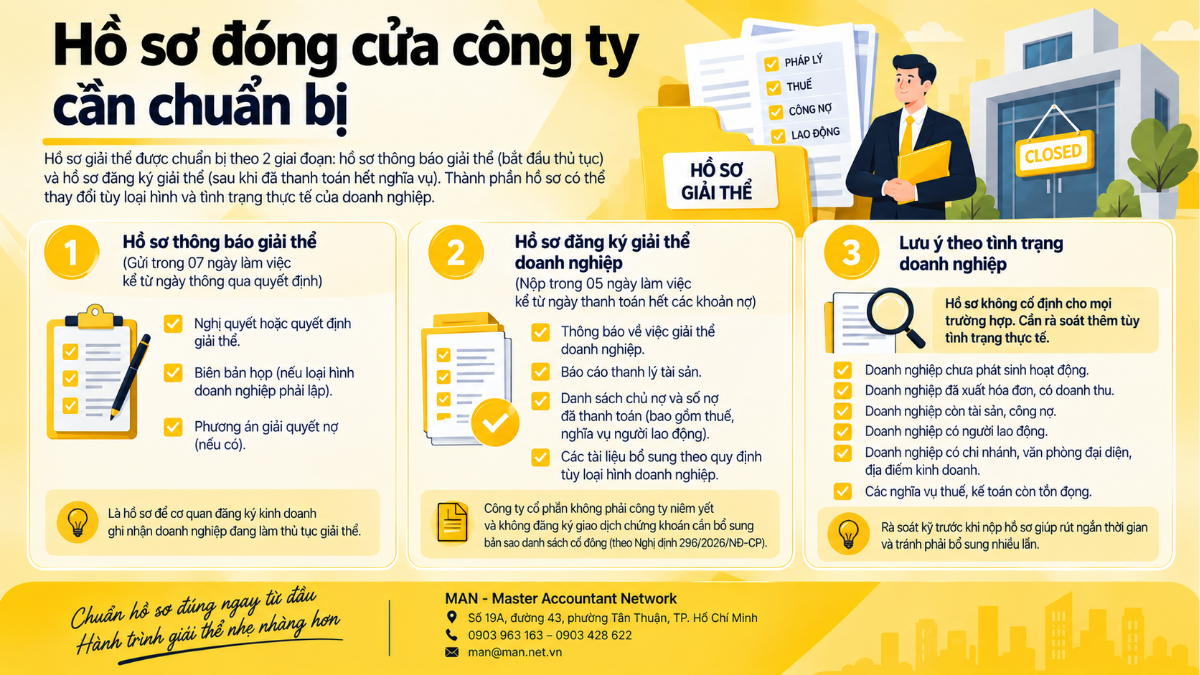
The required documents vary depending on the stage of the procedure and the type of business. Businesses should prepare documents in two groups: documents at the beginning of the dissolution process and documents for registration of dissolution after all obligations have been settled.
Dissolution notification file
During the startup phase, businesses need to prepare the required documents, focusing on the following:
- Resolution or decision to dissolve.
- Minutes of meetings of the competent authority for this type of business must be recorded.
- A debt resolution plan is required if the business has developed one.
The content of the resolution or decision must be sufficient grounds for the business registration authority to record that the enterprise is undergoing dissolution procedures and for the relevant parties to be aware of the plan for handling their obligations.
Business dissolution registration documents
After settling all obligations, the business needs to prepare a dissolution registration dossier in accordance with current regulations, which includes the following main documents:
- Notice of business dissolution.
- Report on the liquidation of the company's assets.
- A list of creditors and the amount of debt paid, including tax debts and obligations to employees as required by law.
- Additional documents apply depending on the specific case and type of business.
For joint-stock companies that are not listed and not registered for securities trading, it is important to note the requirement to supplement the shareholder list with a copy as stipulated in Decree 296/2026/ND-CP.
Dissolution documents vary depending on the company's status.
A single set of documentation should not be used for all businesses. Companies that have not yet commenced operations, those that have issued invoices, those with assets, those with employees, or those with subsidiaries will require different levels of review. In particular, outstanding tax debts, accounts payable, and accounting documents may generate additional work before the final documentation is ready for submission.
Notes on closing a company based on its current situation.
Although it's a dissolution procedure, the level of processing varies significantly depending on the company's history. Businesses should categorize their documents before planning to avoid misjudging the time and workload.
The company has not generated any revenue or invoices.
Companies that have not yet generated revenue or issued invoices typically have simpler documentation, but this does not mean they can be exempt from tax and accounting obligations. Businesses still need to check their tax registration status, submitted tax returns, outstanding obligations, electronic invoice status, and other payables, if any.
Before proceeding, it's advisable to cross-reference the actual records instead of assuming that "not yet operational" means "no obligations." MAN has specific guidelines regarding dissolution procedures and tax obligations for businesses to review on a case-by-case basis.
The company has generated revenue and invoices.
For businesses that have already generated revenue, use invoices, or have an accounting system, the task is usually more complex. It requires checking revenue, expenses, accounts receivable and payable, inventory, fixed assets, salaries, insurance, and tax obligations.
In particular, you shouldn't focus solely on filing documents with the Business Registration Authority while neglecting accounting and tax reconciliation. A complete legal file but with outstanding financial obligations can still prolong the closure process.
The company has branches, representative offices, or business locations.
If a business has subsidiaries, it needs to compile a complete list of all existing branches, representative offices, and business locations in its system. Before submitting the final dissolution application, the business must complete the procedures for terminating the operations of these units as required by law.
The audit of dependent units should be conducted from the outset rather than waiting until the final stage. This helps avoid a situation where the parent company has almost completed the process but a branch or business location remains unresolved.
How long does it take for the company to close down?
There is no fixed number for the entire duration of a company closure, as the actual timeframe depends on tax status, liabilities, assets, employees, subsidiaries, and the completeness of documentation. Key legal deadlines that help businesses plan include:
| Mold | Duration | Meaning |
| Following the resolution/decision to dissolve | 7 working days | Submit the resolution/decision and required documents to the Provincial Business Registration Authority. |
| The business registration authority receives the application. | 3 working days | Announce the status of ongoing dissolution procedures and send relevant information. |
| After paying off all debts | 05 working days | Submit dissolution registration documents. |
| Tax authorities respond | 2 working days | Feedback on tax compliance status after receiving information from the business registration authority. |
| The business registration authority handles the final processing of the application. | 05 working days | Update the status to dissolved if eligible. |
| Special case | 180 days | The mechanism for handling cases where the application is not completed and no valid objections are raised as per regulations. |
The milestones above are legal deadlines for each stage, not a guarantee that every business will complete everything within the total number of days. Time spent on tax processing, asset liquidation, debt collection, or dispute resolution can significantly determine the actual time required.
Common mistakes that prolong the dissolution process.
In reality, the dissolution process is often prolonged not only because of the filing of documents but also because the business fails to fulfill a pre-existing obligation. Common mistakes include:
- Tax obligations and declaration status were not reviewed before the dissolution decision was made.
- There are still outstanding debts to employees, government agencies, banks, suppliers, or partners.
- Omitting branches, representative offices, or business locations.
- No reconciliation of assets, inventory, accounts receivable, and accounts payable before liquidation.
- Use outdated forms or guidelines, especially documents that still use the old way of referring to the business registration authority.
- Confusing temporary business suspension with dissolution leads to choosing the wrong procedure from the start.
It is worth noting that Decree 168/2025/ND-CP has changed the framework for business registration procedures, and Decree 296/2026/ND-CP further amends some of its contents. Therefore, checklists taken from documents prior to July 2025 may no longer be suitable for the current process.
Tax obligations were not reviewed before dissolution.
Businesses should check the status of tax returns, tax obligations, invoices, and payments due before submitting final documents. The goal is to clearly identify any outstanding obligations, necessary documentation, and payments. Early review helps prevent situations where submitted legal documents are pending due to outstanding tax obligations.
Unresolved debts or financial obligations
Dissolution is not a debt forgiveness mechanism. If a business still has debts, the creditors, the value of the debts, the order of payment, and the source of assets to pay them must be identified. In cases where the business is truly insolvent, a bankruptcy process assessment is necessary instead of attempting voluntary dissolution.
Omitting branches, representative offices, or business locations.
The list of dependent entities needs to be cross-referenced with business registration data and internal records. A business location that is no longer operating in reality but still exists in registration must be processed before the business is fully dissolved.
Use the old records or guidelines.
This is a particularly noteworthy error in 2026. Decree 168/2025/ND-CP takes effect from July 1, 2025, and Decree 296/2026/ND-CP, which further amends Decree 168, takes effect from July 23, 2026. Therefore, businesses should directly refer to the current regulations instead of relying solely on guidance written before these dates.
Confusing temporary suspension of business with dissolution.
Suspension is a solution to keep a business legally in existence so that it can resume operations, while dissolution is the option to terminate the business. If the business owner is unsure about terminating the legal entity, they need to assess their business objectives before making a choice.
Professional considerations when dissolving a business.
From an accounting and risk management perspective, dissolution should be viewed as a project to close the case rather than merely an administrative procedure. A good plan should simultaneously identify those responsible, a list of obligations, assets to be liquidated, debts to be recovered, debts to be paid, and the status of each subsidiary.
MAN – Master Accountant Network recommends that businesses review their records in the following order: corporate legal, accounting, tax, labor, accounts payable, and subsidiaries. This approach helps identify bottlenecks early, before the records are submitted, rather than addressing each issue only after government agencies respond.
Businesses also need to be aware of the responsibilities of managers and legal representatives. According to the Enterprise Law, if dissolution documents are inaccurate or there is any concealment of obligations, those responsible may be held liable for outstanding debts and obligations to the extent stipulated by law.
Conclude
The company closure process needs to be carried out by simultaneously addressing three groups of tasks: terminating business registration, fulfilling tax and financial obligations, and fully settling debts, employees, and subsidiaries. The milestones of 7 working days, 3 working days, 5 working days, 2 working days, and the 180-day mechanism are points that require special attention when planning.
Businesses should utilize the regulations in force at the time of implementation, particularly Decree 168/2025/ND-CP and Decree 296/2026/ND-CP, instead of relying on outdated guidelines. If the application includes outstanding tax debts, incomplete accounting records, years of unresolved tax issues, unliquidated assets, or dependent entities, a professional review before submission will significantly reduce potential risks.
MAN – Master Accountant Network can assist businesses in reviewing their legal, accounting, tax, and debt status to determine a suitable dissolution plan based on their specific circumstances. Businesses can refer to the website for more information. business dissolution services Contact MAN to see the scope of support and handling options.
Legal basis
- Law No. 76/2025/QH15, effective from July 1, 2025: Text from the Government's Electronic Information Portal.
- Decree 168/2025/ND-CP on business registration: Text from the Government's Electronic Information Portal.
- Decree 296/2026/ND-CP amends Decree 168/2025/ND-CP: Text from the Government's Electronic Information Portal.
- Circular 86/2024/TT-BTC on tax registration: Text from the Government's Electronic Information Portal.
Professional license: CPA Vietnam Auditors
Experience: Over 30 years of experience in Accounting, Auditing, and Financial Consulting.
Frequently Asked Questions about the Company Closure Process
When a company closes down, is it necessary to go through the dissolution process?
If "closing down" is understood as the complete termination of a business, the answer is yes. The business must follow the prescribed dissolution procedures instead of merely ceasing operations in practice. If the business only wishes to temporarily suspend operations for a period, it can consider the temporary business suspension procedure.
Can a company that owes taxes be dissolved?
Businesses must settle their asset obligations and debts according to the dissolution conditions. Tax debts do not automatically disappear when a business files for dissolution. The business registration authority and the tax authority cooperate to verify the status of tax obligations during the process of completing the dissolution application.
How long after paying off all debts do I have to file for dissolution?
Within 05 working days from the date of full payment of all debts, the enterprise must submit the dissolution registration dossier in accordance with current regulations.
Does a company that has not yet generated revenue have to fulfill its tax obligations?
It should not be assumed that the absence of revenue means there are no tax obligations. Businesses need to check their tax registration status, declarations, invoices, and actual obligations incurred up to the time of dissolution. The level of processing depends on the operating history and records of each business.
Does dissolving a company mean closing down its branches and business locations?
Yes. Before filing the final dissolution application, the business must complete the termination of operations of its branches, representative offices, and business locations, if any.
How long does it take for a business to be updated to the dissolved status?
If the final application is complete and there are no tax obligation issues, the provincial business registration authority will update the legal status within 05 working days from the date of receiving the dissolution application as prescribed. This is the processing time for the final stage, not the total time for the entire process.