

Law No. 142/2025/QH15 also known as Bankruptcy and Recovery Law 2025 It will officially take effect from March 1, 2026, replacing the 2014 Bankruptcy Law. This is considered a significant shift in legal policy, as it is the first time that business recovery is prioritized instead of focusing solely on liquidation and cessation of operations.
In the context of many businesses facing pressure regarding cash flow, debt, and solvency, understanding the new regulations will help managers proactively develop risk management plans while protecting the rights of creditors, employees, and stakeholders.
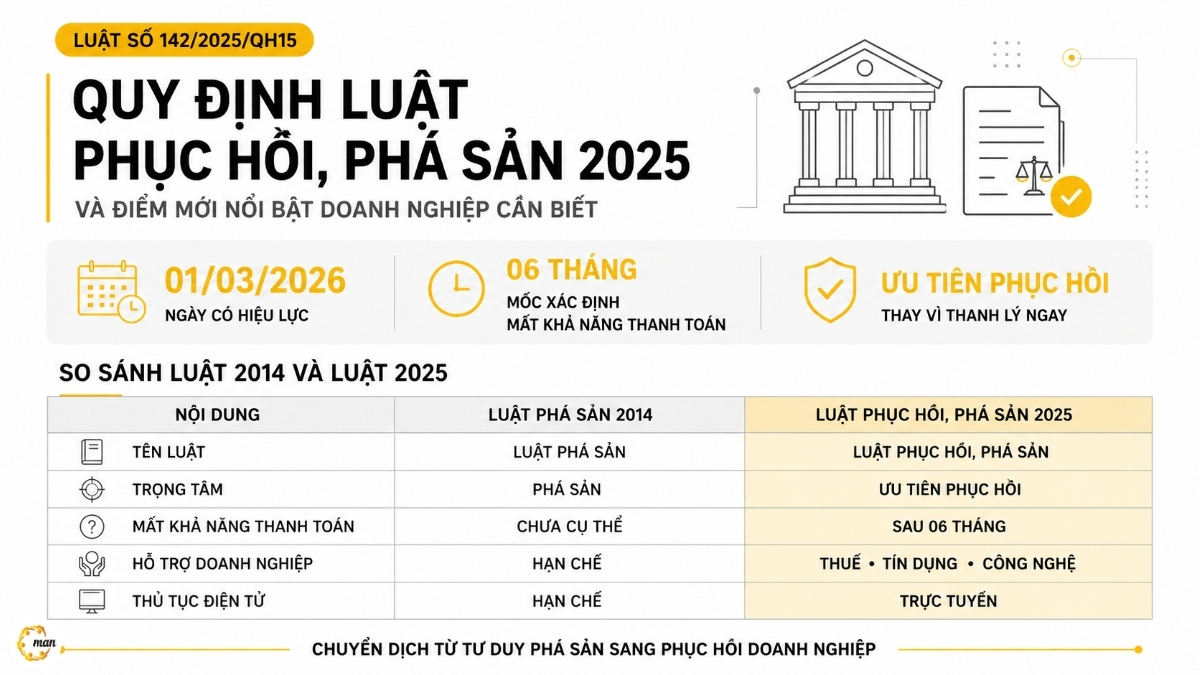
Key new features of the 2025 Bankruptcy and Recovery Law compared to the 2014 Bankruptcy Law.
The new law includes several notable changes aimed at creating opportunities. restructuring for businesses before they go into complete bankruptcy.
| Content | Bankruptcy Law 2014 | Bankruptcy and Recovery Law 2025 |
|---|---|---|
| Name of the law | Bankruptcy Law | Bankruptcy and Recovery Law |
| Focus of processing | Bankrupt | Prioritize recovery |
| The concept of insolvency risk | Not yet clearly defined | Specific regulations |
| Defining insolvency | Not specific yet | After 6 months |
| Business support policies | Limit | Tax, credit, and technology support. |
| Tax debt write-off | No regulations | There is a support mechanism. |
| Temporarily suspend contributions to the pension and death benefit fund. | No regulations | Applicable |
| Electronic procedures | Limit | Allow online execution. |
Clearly, the new law not only changes the name but also completely alters the approach to businesses facing financial difficulties.
A new definition of a company's solvency.
One of the most significant changes is found in Article 5, where the law for the first time clearly defines the boundary between “risk of insolvency” and “insolvency.”.
The business is at risk of insolvency. This is the case:
- Failure to pay the debt due within 06 months; or
- There are debts that are due but not more than 6 months overdue.
The business is insolvent. This refers to a situation where a business fails to fulfill its debt payment obligations within six months of the due date.
This regulation helps stakeholders identify financial risks early and provides an opportunity to implement recovery measures before a business goes bankrupt.
Practical example
Suppose Company A has a debt due on April 1, 2026.
- From April 1, 2026 to September 30, 2026, businesses are considered to be at risk of insolvency.
- If the payment obligations are not fulfilled by October 1, 2026, the company may be deemed insolvent under the provisions of the Bankruptcy and Recovery Law 2025.
Prioritize business recovery over declaring bankruptcy.
According to Article 3, the overarching principle of the new law is to prioritize the application of recovery procedures to enterprises and cooperatives. Instead of quickly moving to the bankruptcy stage, the State encourages enterprises to restructure, seek new sources of capital, reorganize production and business operations, and develop feasible debt repayment plans.
Policies to support businesses during the recovery phase
To help businesses overcome difficulties, the law allows for the application of various support mechanisms such as:
- Write off outstanding tax debts in accordance with tax management laws.
- Temporarily suspend contributions to the pension and death benefit fund as stipulated by social insurance laws.
- Support in accessing credit.
- Technology support and digital transformation.
- Support business restructuring.
These are mechanisms that were not clearly defined in the 2014 Bankruptcy Law.
Who is eligible to file a request for reinstatement?
According to Article 24, the entities entitled to apply for the application of the rehabilitation procedure include:
- The legal representative of the business.
- Board of directors of a joint-stock company.
- Board of members of a limited liability company or partnership.
- General meeting of cooperative members.
- Private business owner.
- Owner of a single-member limited liability company.
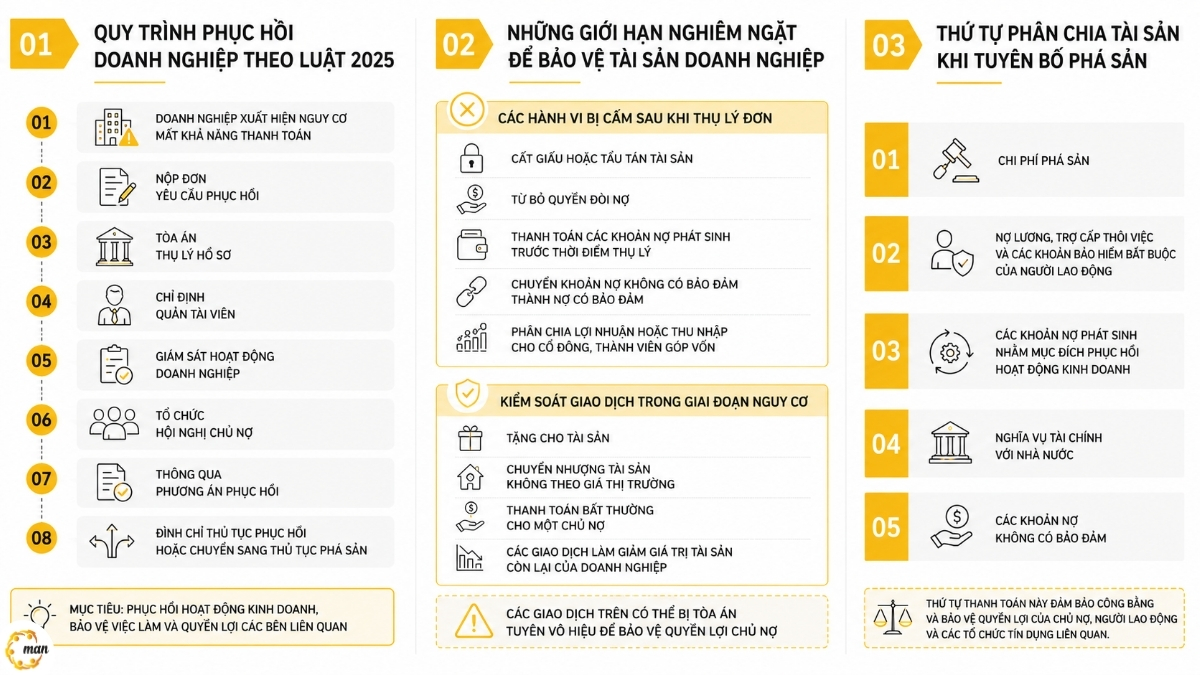
Business recovery process under the 2025 Law
The basic process includes:
- The business is at risk of insolvency.
- Submit an application for reinstatement.
- The court accepted the case.
- Appoint a Receiver.
- Monitoring business operations.
- Organize a creditors' meeting.
- Through the recovery plan.
- Suspend rehabilitation proceedings or proceed to bankruptcy proceedings.
Strict limits are in place to protect the assets of insolvent businesses.
To protect the collective interests of creditors and prevent asset dissipation, the law stipulates many strict control measures after the court accepts the case.
Prohibited actions after the application is processed.
Businesses and cooperatives are prohibited from:
- Concealing or disposing of assets.
- Relinquishing the right to collect debts.
- Pay off any debts incurred before the date of acceptance.
- Convert unsecured debt into secured debt.
- Distributing profits or income to shareholders or capital contributors.
Control transactions during periods of risk.
The law also stipulates that transactions showing signs of favoritism towards a group of creditors or resulting in the loss of assets may be declared invalid by the Court. Transactions commonly subject to review include:
- Gift of property.
- Transfer of assets at non-market prices.
- An extraordinary payment to a creditor.
- These transactions reduce the value of the company's remaining assets.
The order of asset distribution upon declaring bankruptcy.
In the event that a business cannot recover and is declared bankrupt, the remaining assets will be distributed in the following order of priority:
- Bankruptcy costs.
- Unpaid wages, severance pay, and mandatory insurance contributions for employees.
- The debts were incurred for the purpose of restoring business operations.
- Financial obligations to the State.
- Unsecured debts.
This is particularly important information for creditors, employees, and credit institutions that have financial relationships with the business.
The role of the Receiver in the recovery and bankruptcy process.
The insolvency administrator is considered the central figure in the entire process of resolving a recovery and bankruptcy case. Their main responsibilities include:
- Inventory and management of business assets.
- Verify the list of creditors and debtors.
- Monitoring the business operations of the company.
- Conduct the creditors' meeting as ordered by the court.
- We request that the transaction be declared void upon detection of signs of asset concealment.
- The organization will liquidate assets in accordance with regulations.
Businesses and creditors need to cooperate fully with the Receiver to ensure their legal rights are protected throughout the resolution process.
Those who need to pay special attention to the Bankruptcy and Recovery Law 2025
The new law directly impacts many entities involved in business operations.
- Business owner and legal representative: It is necessary to understand legal responsibilities to avoid penalties for violating regulations on rehabilitation and bankruptcy.
- Board of Directors, Board of Members: This group is crucial in selecting the business recovery and restructuring plan.
- Creditor: It is necessary to closely monitor the timelines, records, and rights to participate in the Creditors' Meeting in order to protect one's interests.
- Workers: They are entitled to priority in the payment of wages, severance pay, and insurance benefits as stipulated by law.
What preparations do businesses need to make before the Bankruptcy and Recovery Law of 2025 comes into effect?
To proactively adapt to the new regulations, businesses should:
- Review all accounts payable and loans that are due.
- Assess cash flow and solvency over the next 6–12 months.
- Check tax obligations and outstanding social insurance payments.
- Complete accounting system, financial statements and legal documents.
- Develop a restructuring plan in case signs of insolvency appear.
- Proactively seek advice from accounting, auditing, and legal professionals before disputes arise.
Frequently Asked Questions about the Bankruptcy and Recovery Act 2025
When will the Bankruptcy and Recovery Act 2025 come into effect?
How long does a business have to be in debt before it is considered insolvent?
Does the credit institution apply the recovery procedure under this law?
Is it possible to apply for rehabilitation online?
Conclude
The Bankruptcy and Recovery Law of 2025 not only changes the approach to financially distressed businesses but also opens up opportunities for restructuring and business recovery before resorting to bankruptcy. Proactively understanding the new regulations will help businesses minimize legal risks, protect assets, and build a suitable roadmap for handling difficulties in the coming period.
Contact information for MAN – Master Accountant Network
- Address: 19A, 43rd Street, Tan Thuan Ward, Ho Chi Minh City
- Mobile/Zalo: 0903 963 163 – 0903 428 622
- Email: man@man.net.vn
Content production is overseen by: Mr. Le Hoang Tuyen – Founder & CEO of MAN – Master Accountant Network, CPA Vietnam auditors with over 30 years of experience in accounting, auditing, and financial consulting.