



Professional license: CPA Vietnam Auditors
Experience: Over 30 years of experience in Accounting, Auditing, and Financial Consulting.
The legal procedure for closing a business is carried out through dissolution when the business meets the prescribed conditions. The business not only ceases operations but must also handle assets, liabilities, tax obligations, employees, and subsidiaries before completing the legal process. Currently, the dissolution registration procedure is regulated by Decree 168/2025/ND-CP, amended and supplemented by Decree 296/2026/ND-CP. Decree 296/2026/ND-CP was issued and came into effect on July 23, 2026.
Conditions for dissolving a business
A business can be dissolved when it falls under the cases stipulated by law, while ensuring that all debts and other financial obligations are paid and that it is not currently involved in any ongoing disputes in court or arbitration. This is a fundamental condition for determining whether a business can undergo voluntary dissolution. Current business registration regulations need to be compared with... Decree 168/2025/ND-CP and revisions at Decree 296/2026/ND-CP.
Cases of business dissolution
The termination of operations may arise from a business's own decision or from other legal circumstances stipulated by law. For businesses that proactively close down, correctly identifying the dissolution circumstances helps in selecting the appropriate authority to issue the resolution or decision and the corresponding documentation procedures.
- The operating period stated in the Charter has expired without a decision to extend it.
- Dissolution is carried out by resolution or decision of the competent authority within the enterprise.
- The company no longer has the minimum number of members required by law within the legally stipulated timeframe without undergoing the procedure to change its business type.
- The business registration certificate is revoked, except where the tax administration law provides otherwise.
For voluntary dissolution, the authority to make the decision depends on the type of business. Businesses should consult current regulations before issuing resolutions or decisions.
Conditions regarding debt and financial obligations
A business can only complete its dissolution after ensuring that all debts and other financial obligations are fully paid. Furthermore, the business must not be currently involved in any ongoing disputes in court or arbitration.
In accounting practice, all obligations should be reviewed before proceeding with liquidation, including:
- Accounts payable to suppliers and related parties.
- Wages and employee benefits.
- Employees' insurance obligations.
- Tax obligations and other payments due to the state budget.
- Loans, interest, and other financial obligations.
- Accounts receivable and the likelihood of recovery.
- The remaining assets need to be liquidated or disposed of.
Businesses should not rely solely on cash balances to assess their ability to dissolve. A comparison of liquidable assets, accounts receivable, and all payables is necessary to determine the actual source of funds.
Conditions regarding disputes in court or arbitration.
Businesses are not eligible for voluntary dissolution if they are currently involved in a dispute resolution process in court or arbitration. Before passing a resolution or decision to dissolve, businesses should review existing contracts, accounts receivable, accounts payable, and related disputes.
Business dissolution documents
The dissolution process is carried out in stages. Initially, the business submits the resolution or decision to dissolve, meeting minutes (if applicable), and a debt settlement plan (if any). After settling all debts and fulfilling all related conditions, the business then submits the dissolution registration application. Businesses can refer to the forms and instructions provided. National portal for business registration.
The notification file indicates that the dissolution process is underway.
Within 7 working days from the date of adoption of the resolution or decision on dissolution, the enterprise shall submit the dossier to the Provincial Business Registration Authority where its head office is located. The initial dossier includes the resolution or decision on dissolution, meeting minutes (if applicable), and a debt settlement plan (if any).
After receiving the resolution or decision on dissolution, the provincial business registration authority takes steps to publicly disclose information, update the legal status, and send relevant information to the tax authority and the civil enforcement agency as prescribed.
Business dissolution registration documents
After settling all debts, the business must submit its dissolution registration application within 5 working days to the provincial business registration authority where its head office is located. The application dossier must comply with current regulations and guidelines.
National portal for business registration before submitting.
According to the dissolution registration guidelines, the application file may include the following documents depending on the specific case:
- Announcement regarding the dissolution of the business.
- Report on the liquidation of company assets.
- A list of creditors and the amount of debt paid, including tax debts and contributions to social insurance, health insurance, and unemployment insurance for employees, as applicable.
The final documents should be compared with accounting records, payment vouchers, and tax records before submission. If the figures between the sets of documents are inconsistent, the business may have to re-process them before the procedure is completed.
Dissolution registration form
The national portal for business registration provides guidance on using forms according to regulations in effect at the time of the procedure. Businesses should check the current version of the forms instead of reusing documents from old files.
Notes on required documents for each type of business
The authority to issue a resolution or decision on dissolution varies depending on the type of business. Identifying the correct competent authority is the first step in ensuring that the resolution or decision on dissolution is legally valid.
| Type | The entity that passed the resolution or decision to dissolve |
| Private enterprise | Private business owner |
| One-member limited liability company | Company owner |
| Limited Liability Company with two or more members | Board of Members |
| Partnership company | Board of Members |
| Joint Stock Company | General Shareholders' Meeting |
The table above is only intended to identify the decision-making entity by type; the required documents and procedures still need to be compared with the regulations applicable at the time of submission.
Procedures for closing a business
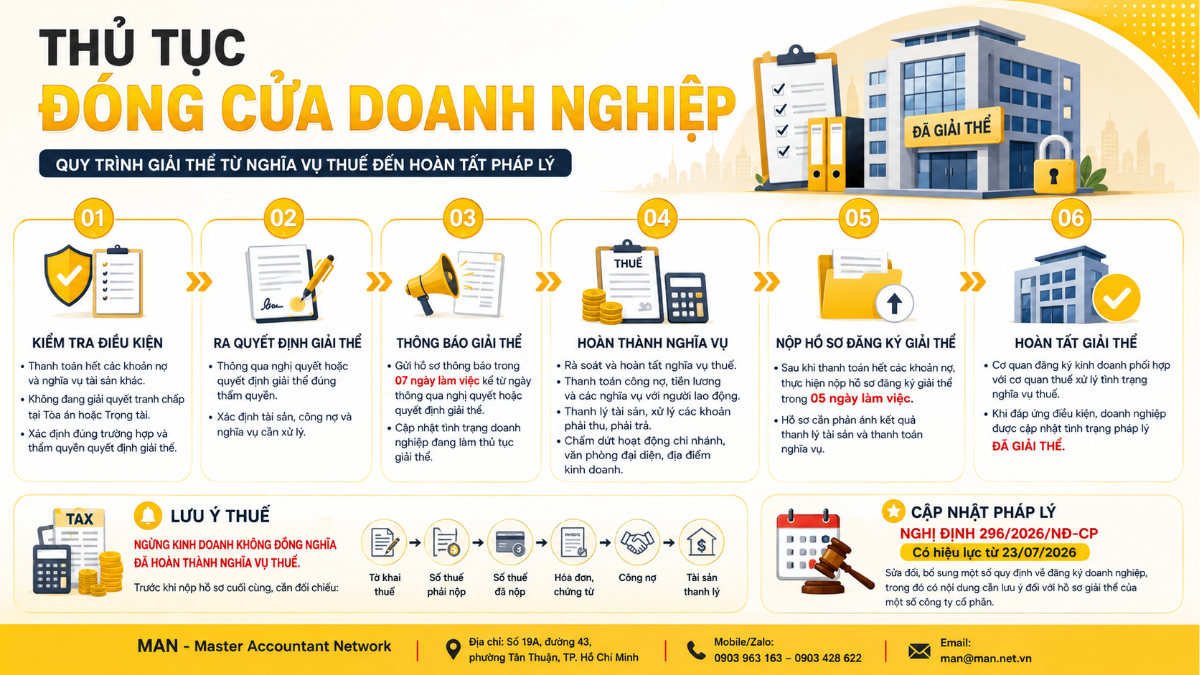
The process of closing a business through dissolution begins with the adoption of a resolution or decision, followed by notification that the business is undergoing dissolution procedures, settlement of obligations, termination of operations of subsidiary units, and submission of dissolution registration documents. These deadlines should be compared with the relevant regulations. Decree 296/2026/ND-CP and Decree 168/2025/ND-CP.
Step 1: Pass a resolution or decision to dissolve the organization.
Businesses must pass a resolution or decision for dissolution with the proper authority before beginning the dissolution registration process. At this stage, the business should preliminarily identify its debts, assets, contracts, and obligations to employees. Accountants should also create a list of obligations to be processed to manage the liquidation process.
Step 2: Notify the authorities that the business is undergoing dissolution procedures.
Within 7 working days from the date of adoption of the resolution or decision on dissolution, the enterprise shall submit the dossier to the provincial business registration authority where its head office is located. After receiving the dossier, the business registration authority shall publicly disclose the information and change the legal status of the enterprise to "undergoing dissolution procedures" as prescribed.
Moving to the "in-process dissolution" status does not mean the dissolution is complete. The business must still continue to pay its obligations, handle its subsidiaries, and submit dissolution registration documents.
Step 3: Pay off debts and fulfill tax obligations.
Businesses must ensure that all debts and other financial obligations are paid before completing the dissolution process. During this process, the business needs to reconcile accounts payable, obligations to employees, insurance obligations, tax obligations, loans, and liquidable assets.
The groups of obligations that need to be reviewed include:
- Accounts payable to suppliers and partners.
- Wages and benefits for employees.
- Insurance obligations.
- Tax obligations.
- Loans and financial obligations.
- Accounts receivable.
- Assets need to be liquidated.
According to dissolution regulations, businesses must ensure the settlement of all obligations before completing the procedure. Therefore, preparing a payment plan and reconciling accounting data are crucial parts of the dissolution process.
Step 4: Terminate the subsidiary unit's operations.
Before filing for business dissolution, the enterprise must complete the procedures for terminating the operations of its branches, representative offices, and business locations. For branches and representative offices, the enterprise needs to settle its obligations with the tax authorities according to regulations before registering the termination of operations.
Businesses often have many subsidiaries, so the legal status of the head office shouldn't be checked alone. Each branch, representative office, and business location needs to be reviewed separately.
Step 5: Submit the dissolution registration application.
Within five working days of settling all debts, the enterprise must submit the dissolution registration dossier to the provincial business registration authority where its head office is located. Before this date, the enterprise must complete the procedures for terminating the operations of its branches, representative offices, and business locations as prescribed.
For joint-stock companies that fall under this category, businesses need to check the requirement for a copy of the shareholder register according to the current amended regulations before completing the application.
Step 6: Update the dissolved business status.
After receiving the dissolution registration application, the provincial business registration authority sends the information to the tax authority. The tax authority then sends its opinion on the fulfillment of tax obligations within the prescribed deadline. If the business meets the conditions, the provincial business registration authority updates the legal status to dissolved.
If the tax authorities refuse the dissolution because the business has not fulfilled its tax obligations, the business must continue to address the outstanding obligations. Therefore, tax settlement is a direct part of the dissolution process and not something that can be skipped after filing the application.
If the application is not processed within the legally prescribed time and meets the conditions of the application processing mechanism, the Business Registration Authority may update the legal status as prescribed. This should not be interpreted as the standard dissolution time for all businesses.
Key deadlines to note when dissolving a business.
The deadlines in the dissolution procedure are calculated based on various events. Therefore, one should not mechanically add up the milestones of 7 days, 3 days, 5 days, and 2 days to conclude that the entire procedure will definitely be completed within a fixed timeframe. The actual time depends on tax obligations, debts, assets, and the status of the subsidiary. The milestones need to be compared with... Decree 296/2026/ND-CP.
| Subject | Duration | The event that serves as the basis for calculating the time limit. |
| Businesses | 7 working days | From the date the resolution or decision to dissolve was adopted. |
| Provincial Business Registration Authority | 3 working days | From the date of receipt of the resolution or decision on dissolution, as per applicable regulations. |
| Businesses | 05 working days | From the date all debts are paid off |
| Tax authorities | 2 working days | From the date of receiving information about the business's registration for dissolution, according to applicable regulations. |
| Provincial Business Registration Authority | 05 working days | From the date of receiving the dissolution registration application, when the conditions stipulated in the regulations are met. |
It's important to note that the above milestones do not represent the entire processing time for businesses. For example, the 2-working-day milestone is the processing time for the tax authority as stipulated in the relevant regulations, not the deadline for the business to fulfill all tax obligations.
Tax obligations when closing a business.
Tax obligations directly affect the ability to complete business closure procedures. After receiving the dissolution registration application, the provincial business registration authority sends the information to the tax authority; the tax authority then sends its opinion on the status of tax obligation fulfillment as prescribed. Businesses should proactively review their tax obligations from the beginning instead of waiting until the final step.
Review tax obligations before dissolution.
Businesses should review their tax obligations from the early stages of the dissolution process rather than waiting until the final filing. Early review helps identify outstanding payments and prevents situations where dissolution registration documents are prepared but tax data is incomplete.
From an accounting perspective, the following should be reconciled:
- The tax return has been submitted and is linked to the tax administration data.
- The amount of tax payable versus the amount already paid.
- There are still taxes to be processed.
- Invoices and supporting documents related to the liquidation process.
- Accounts receivable and accounts payable.
- Asset figures before and after liquidation.
For businesses that have been operating for a long time, periodic reviews are generally safer than simply checking the tax balance at the time of filing.
Handling outstanding tax obligations
If there are still tax obligations, businesses need to accurately identify the amounts to be processed and fulfill those obligations according to regulations before the procedure is completed. The fact that a business has ceased operations should not be equated with the fact that the business has fulfilled its tax obligations.
Businesses can refer to the business registration regulations at Decree 168/2025/ND-CP and the amendments at Decree 296/2026/ND-CP.
The relationship between tax obligations and dissolution registration documents.
The dissolution registration dossier must reflect the results of asset liquidation and debt settlement. According to dissolution registration guidelines, the asset liquidation report and the list of creditors, along with the amount of debt paid, are the contents that need to be prepared depending on the applicable case.
Businesses can check the documentation guidelines above. National portal for business registration before submitting.
The accountant in charge of dissolution should maintain a consistent set of data across accounting records, payment vouchers, tax records, and dissolution registration documents. This is a crucial control point to minimize discrepancies in figures.
Changes to note effective July 23, 2026
From July 23, 2026, Decree 296/2026/ND-CP This document amends and supplements several articles of Decree 168/2025/ND-CP on business registration. The document was issued by the Government on July 23, 2026 and takes effect on the same day.
Businesses can cross-reference the document with the official government source at
New points affecting dissolution procedures
For joint-stock companies that are not listed companies and are not registered for securities trading, Decree 296/2026/ND-CP includes an additional requirement regarding a copy of the shareholder register in the dissolution notification dossier. The deadline for businesses to submit dissolution registration dossiers still needs to be verified according to current regulations.
This point needs to be checked when preparing the dissolution application for joint-stock companies belonging to the applicable group. Businesses should not use the old dissolution application as the sole template if the application is prepared after July 23, 2026.
Note for joint-stock companies
Joint-stock companies that are not listed companies and are not registered for securities trading are a group that needs to pay attention to the shareholder register requirements when preparing dissolution documents according to the new regulations. Therefore, businesses need to accurately determine their status before completing the documents.
For accountants and record keepers, verifying shareholder status and comparing the shareholder register with internal records should be done before filing the application.
Common mistakes that prolong the dissolution process.
Prolonged dissolution procedures often stem from unresolved obligations, inconsistent data, or incomplete subsidiary registration processes. Further updates on business registration can be found at [link/website]. Blog Nara and compare it with official legal sources before applying it.
Tax obligations not yet fulfilled
If the tax authorities determine that a business has not fulfilled its tax obligations, the business must continue to address the outstanding debt. Therefore, a review of tax obligations should be conducted before submitting the dissolution application, rather than waiting for a response from the authorities.
Subordinate units not yet processed.
Before filing for business dissolution, branches, representative offices, and business locations must undergo the necessary procedures for ceasing operations as required by law. Businesses with multiple dependent units should create a separate list for each unit to check its registration status and related obligations.
The dissolution documents are inconsistent.
Information between the dissolution resolution or decision, asset liquidation report, creditor list, and dissolution registration file needs to be cross-referenced. For businesses that have been operating for many years, debt and asset figures may have changed significantly since their establishment.
Financial obligations have not been fully paid.
The dissolution requirements stipulate that the business must ensure the full payment of all debts and other financial obligations. Therefore, debts to employees, tax authorities, suppliers, banks, and other related parties must be determined before completing the procedure.
Confusing dissolution notice with dissolution registration.
After submitting the resolution or decision to dissolve, the business enters the "in the process of dissolution" state. This is not yet the state of being dissolved. The business must still continue to handle its obligations, terminate the operations of its subsidiaries, and submit dissolution registration documents.
Conclude
The business closure process is not simply about submitting dissolution documents; it's a complex process involving business registration, accounting, taxation, liabilities, assets, employees, and subsidiaries. Businesses need to correctly identify dissolution conditions, pass a resolution or decision with the appropriate authority, notify the authorities of the ongoing dissolution process, settle obligations, terminate the operations of subsidiaries, and complete the dissolution registration dossier.
The deadlines must be understood in accordance with the events that form the basis for calculating the timeframe, and should not be mechanically added together to form a fixed dissolution period. In particular, from July 23, 2026, Decree 296/2026/ND-CP amends and supplements Decree 168/2025/ND-CP, which includes noteworthy provisions regarding the dissolution dossiers of some joint-stock companies.
For businesses preparing to cease operations, reviewing tax obligations, liabilities, assets, and the legal status of subsidiaries from the outset will help minimize the need for reprocessing of documents and reduce risks during the dissolution process.
Sources of law and procedures used to examine the content: Government Electronic Portal and National portal for business registration.
Frequently Asked Questions about Business Closure Procedures
Can a business that owes taxes be dissolved?
Businesses must ensure that all debts and other financial obligations are paid in full to meet the dissolution requirements. During the dissolution registration process, the tax authorities will process information regarding the fulfillment of tax obligations as per regulations.
How long does it take to dissolve a business?
There is no fixed timeframe that applies to all businesses. The law stipulates various specific deadlines, such as the initial application submission deadline, the processing deadline for the business registration authority, the deadline for submitting documents after all debts have been paid, and the deadline for the tax authority to provide feedback.
What are the procedures for dissolving a business if it has branches?
Businesses with branches, representative offices, or business locations must complete the procedures for terminating the operations of these units before finalizing the business dissolution dossier as prescribed by law.