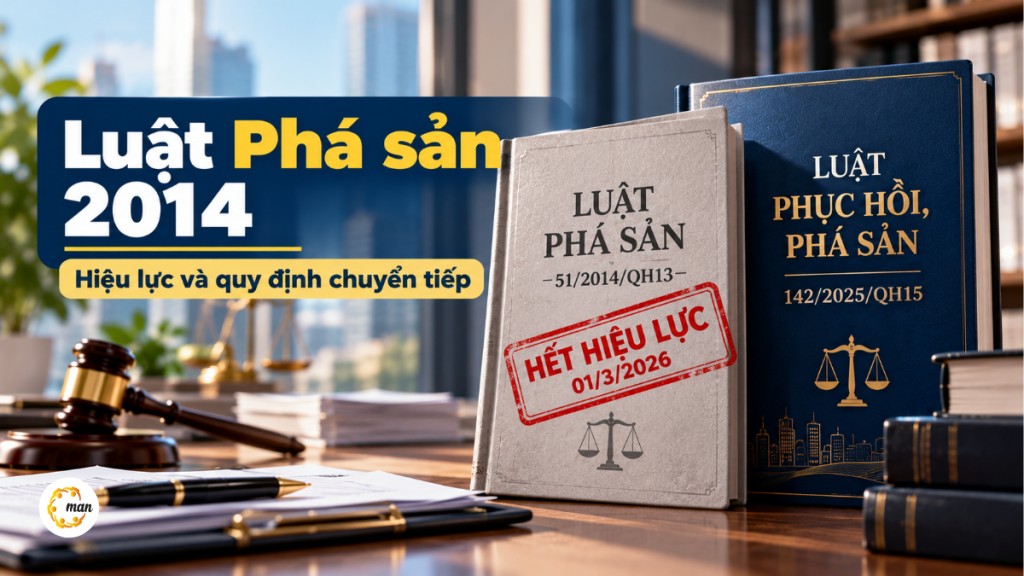



In the context of the 2026 economy, understanding the legal regulations on bankruptcy is a crucial tool for protecting the rights of owners and stakeholders. Based on the Bankruptcy Law No. 51/2014/QH13, bankruptcy proceedings are a special judicial process aimed at resolving debts fairly and orderly when a business is no longer able to maintain its financial flow.
Understanding insolvency correctly
To determine whether a business is subject to bankruptcy, it is necessary to refer precisely to Clause 1, Article 4. Bankruptcy Law 2014:
“"An insolvent enterprise or cooperative is one that fails to fulfill its debt payment obligations within three months of the due date."”
Determining the right time is not only a right but also a responsibility. Article 5 of this Law clearly stipulates that if a business becomes insolvent and its legal representative fails to file a petition for bankruptcy proceedings, the legal representative may be held liable for any resulting damages. This is a legal barrier to prevent debt delays that worsen the financial situation of creditors.
The 5-step process in corporate bankruptcy proceedings.
The bankruptcy resolution process is carried out through the People's Court system with the close supervision of a bankruptcy administrator or a company managing and liquidating assets.
Step 1: File a petition to initiate bankruptcy proceedings.
Based on Articles 5 to 10 of the 2014 Bankruptcy Law, the entities entitled to file a petition are specifically defined to ensure comprehensive coverage:
- Unsecured or partially secured creditors: Have the right to file a claim if the debt becomes due and remains unpaid after 3 months.
- Workers and union representatives: Based on Article 10, they have the right to file a lawsuit when a company fails to pay wages and other debts. Importantly, workers are not required to pay bankruptcy fees or advance bankruptcy costs.
- The legal representative: the Chairman of the Board of Directors, the Director, or the General Director is obligated to file an application immediately upon discovering insolvency.
- Shareholders or groups of shareholders: If they own 20% or more of the total number of common shares for a continuous period of at least 06 months, they have the right to file a claim when the joint-stock company becomes insolvent.
Step 2: The court accepts the application.
After receiving the application, the Court will review its validity within 3 working days. If the application is complete, the Judge will notify the applicant to pay the fees and advance bankruptcy costs. According to Article 18:
“"The date of acceptance of the application for bankruptcy proceedings is the date the judge receives the receipt for payment of bankruptcy fees and the receipt for advance payment of bankruptcy costs."”
An important point to note in 2026 is the application of electronic litigation systems, which will make filing applications and receiving acceptance notices faster. For businesses that have exhausted their finances, the Court may still accept cases if they fall under the exemption or reduction categories stipulated by law, ensuring their right to access justice.
Step 3: Making a decision to initiate bankruptcy proceedings.
Within 30 days of receiving the case, the judge must decide whether or not to open bankruptcy proceedings in accordance with Article 42. This is a milestone that completely changes the legal status of the business. As soon as this decision is made, the court will appoint a bankruptcy administrator.
From this point onwards, the enterprise is subject to significant restrictions on its financial autonomy. According to Clause 1, Article 48:
“"After a decision to initiate bankruptcy proceedings is made, enterprises and cooperatives are prohibited from engaging in the following activities: disposing of or transferring assets; paying unsecured debts; waiving the right to claim debts; and converting unsecured debts into secured debts using the enterprise's assets."”
Step 4: Organize a creditors' meeting.
The creditors' meeting is the highest decision-making body regarding the resolution of the enterprise's debt. According to Article 75, the meeting is only valid if a number of creditors representing at least 65% of the total unsecured debt participate.
The Conference has the power to adopt important resolutions in accordance with Article 81:
- Suspension of claim processing: If the business has rectified the debt situation or someone has agreed to pay the debt on its behalf.
- Business recovery: Businesses have 15 days to develop a recovery plan after the meeting approves the policy. The implementation period for the recovery plan is usually no more than 3 years, as per Article 89.
- Declaration of bankruptcy: If no agreement is reached on recovery or the recovery plan is not feasible.
Step 5: Declare bankruptcy and liquidate assets
When recovery is no longer possible, the judge issues a decision declaring bankruptcy. At this point, all of the company's assets will be converted into cash to pay off debts according to the absolute priority order in Article 54:
“The distribution of the assets of enterprises and cooperatives shall be carried out in the following order: a) Bankruptcy costs; b) Debts for wages, severance pay, social insurance, health insurance for employees, and other benefits under signed labor contracts and collective labor agreements; c) Debts incurred after the commencement of bankruptcy proceedings for the purpose of business recovery; d) Financial obligations to the State; unsecured debts payable to creditors on the list of creditors; secured debts that remain unpaid due to insufficient value of the collateral.”
The remaining value after all the above payments is made belongs to the private business owner, proprietor, or shareholders.
5 things to keep in mind for effective bankruptcy proceedings.

Based on the practical application of the Bankruptcy Law No. 51/2014/QH13, businesses need to pay attention to the following five core issues to minimize legal risks.
- Review invalid transactions before initiating proceedings: It is important to note Article 59 regarding transactions deemed invalid. If, within six months prior to the date of filing the application, the business carries out transactions such as gifting assets, paying off debts before they are due, or selling assets below market value, the Receiver has the right to request the Court to recover these assets.
- Coordinate fully with the Receiver: The bankruptcy administrator has significant authority in inventorying assets. According to Article 67, the business must submit an accurate list of creditors within 15 days of the commencement of proceedings. A lack of honesty during this period can lead to criminal charges for violating regulations on asset management in bankruptcy proceedings.
- Develop a recovery plan based on practical considerations: The business recovery plan under Article 87 must clearly state specific measures such as capital mobilization, product changes, and restructuring of the management system. A practical plan that not only saves the business but also protects jobs for workers is a top priority for the Court in 2026.
- Resolving collateral issues flexibly: According to Article 53, for secured debts, if the asset is necessary for business recovery, its disposal will be temporarily suspended. If it is not necessary, the asset will be sold to repay the debt. Understanding this clause gives businesses more time to negotiate with the bank.
- Strictly adhere to procedural deadlines: The 2014 Bankruptcy Law established extremely strict timelines. A 15-day delay in asset inventory or a failure to file a claim on the list of creditors often resulted in the loss of voting rights or the suspension of business recovery rights. In the context of digital litigation in 2026, these timelines are automatically monitored, requiring businesses to have a dedicated legal support team.
Frequently Asked Questions about Business Bankruptcy
Below is a summary of common legal issues that arise during the process of resolving corporate bankruptcy.
If a business has assets but lacks cash, is it considered insolvent?
After a business goes bankrupt, can the owner establish a new business?
Who is responsible for the costs of bankruptcy proceedings?
How are tax debts handled when a business goes bankrupt?
What rights does the trustee have over the business's operations?
A thorough understanding of Bankruptcy Law No. 51/2014/QH13 helps businesses withdraw from the market in a civilized manner, ensuring social responsibility and protecting their reputation for future business plans.
Contact information for MAN – Master Accountant Network
- Address: 19A, 43rd Street, Tan Thuan Ward, Ho Chi Minh City
- Mobile/Zalo: 0903 963 163 – 0903 428 622
- Email: man@man.net.vn
Other services
- Auditing: Auditing Services, Construction Auditing Services, Financial statement audit services
- Accounting and Taxation: Tax accounting services, Tax report, Transfer Pricing Advisory. Tax Accounting Services, Tax reporting services, Transfer Pricing Service, Affiliate Trading Service
- Legal aspects: Work permit services, Business registration certification services, Investment Certificate
- Other: Transfer Pricing Service, Affiliate Trading Service, Business Operations Consulting Services
Content production is overseen by: Mr. Le Hoang Tuyen – Founder & CEO of MAN – Master Accountant Network, CPA Vietnam with over 30 years of experience in accounting, auditing, and financial consulting.