



Professional license: CPA Vietnam Auditors
Experience: Over 30 years of experience in Accounting, Auditing, and Financial Consulting.
The dissolution of a joint-stock company is the process of terminating the business's operations and legal status after all debts have been paid and all financial obligations fulfilled. Unlike temporary suspension of business, this is an irreversible step, requiring the company to strictly adhere to the procedures of the 2020 Enterprise Law and fulfill its obligations to the tax authorities. For joint-stock companies, the decision-making authority rests with the General Meeting of Shareholders, and any shortcomings in tax matters or debt payments can result in the application being rejected.
What is the dissolution of a joint-stock company?
The dissolution of a joint-stock company is the legal termination of its operations and legal status, after all debts have been paid and all financial obligations fulfilled. The decision to dissolve voluntarily falls under the authority of the General Meeting of Shareholders according to the 2020 Enterprise Law.
From a legal standpoint, dissolution marks the end of a business's existence in the business registration system. After completion, the tax identification number is terminated, the company seal loses its legal validity, and the company can no longer enter into or conduct transactions in its own name. It's important to distinguish that dissolution only occurs when the business still has the ability to pay its debts; if it has become insolvent, the process shifts to bankruptcy proceedings with a completely different mechanism and handling authority.
Joint-stock companies have unique characteristics compared to other types of companies due to their structure with many shareholders and authority concentrated in the General Meeting of Shareholders. Therefore, the procedures are often more complex than others. Dissolution of a single-member limited liability company, especially in the process of organizing meetings and voting on resolutions.
Cases of dissolution of joint-stock companies
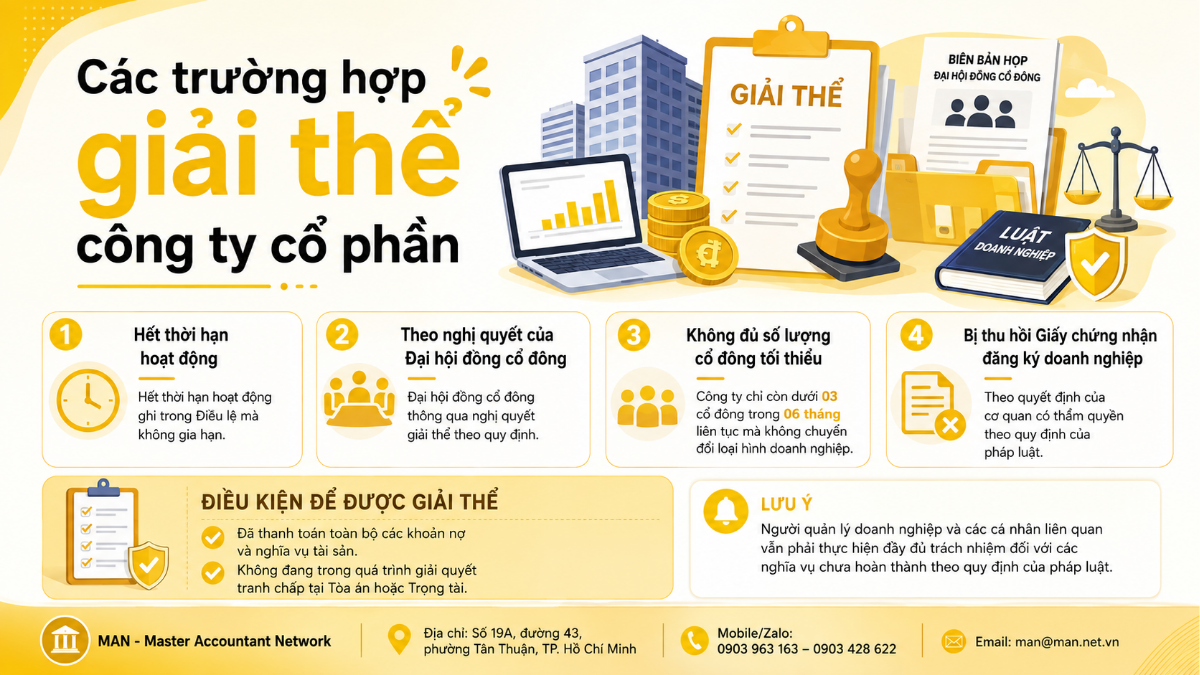
According to Article 207 Enterprise Law 2020, modified by Amended Enterprise Law 2025 (According to Decree No. 76/2025/QH15), a joint-stock company can be dissolved in four cases: the expiration of the operating period stated in the Charter without renewal, by resolution of the General Meeting of Shareholders, the absence of the minimum number of shareholders for 06 consecutive months, or the revocation of the Business Registration Certificate.
Voluntary dissolution
This category arises from the will of the business. The most common case is when the General Meeting of Shareholders proactively passes a resolution to cease operations due to ineffective business, restructuring, or a change in investment direction. In addition, when the Articles of Association stipulate a period of operation and this period expires without the shareholders deciding to extend it, the company is also subject to dissolution.
Compulsory dissolution
This group arises from violations of regulations or decisions of competent authorities. A joint-stock company is required to have a minimum of 3 shareholders according to Article 111 of the 2020 Enterprise Law; if the number of shareholders falls below this level and remains below this level for 6 consecutive months without undergoing the procedure to change the company type, the enterprise must be dissolved. In other cases, the business registration certificate is revoked or by court decision, in which case the procedure follows Article 209 of the 2020 Enterprise Law.
Conditions for dissolving a joint-stock company
Article 207, Clause 2 of the 2020 Enterprise Law stipulates that an enterprise can only be dissolved when it ensures the full payment of all debts and other financial obligations and is not currently involved in any ongoing disputes in court or arbitration. This is a prerequisite that cannot be overlooked before submitting the dissolution application.
This condition explains why tax and debt settlements are always the most difficult part of a joint-stock company dissolution application. The business must prove that it has settled all obligations to employees, tax authorities, social insurance agencies, and other creditors. If the company still has debts but lacks sufficient assets to pay them, the legal course of action is not dissolution but filing for bankruptcy proceedings. In reality, many businesses confuse these two concepts and choose the wrong course of action, leading to their applications being stalled. The issue... Can a company that still owes taxes be dissolved? Therefore, it always needs to be clarified right from the start.
Documents to prepare
The dissolution dossier for a joint-stock company is regulated by Article 210 of the 2020 Enterprise Law and submitted through two steps on the National Portal for Enterprise Registration. The core components include the resolution and minutes of the General Meeting of Shareholders, the dissolution notice, the asset liquidation report, and the list of creditors who have been paid.
According to the instructions of National portal for business registration, The file consists of two sets of documents corresponding to two submissions.
The documents required when notifying the dissolution include:
- Resolution of the General Meeting of Shareholders on the dissolution of the enterprise.
- Minutes of the General Shareholders' Meeting regarding the dissolution.
- A plan for resolving the debt, if any.
The documents required when registering for dissolution include:
- Notification of business dissolution, prepared according to Form No. 30, Appendix I issued with Circular No. 68/2025/TT-BTC.
- Report on the liquidation of company assets.
- A list of creditors and the amount of debt paid, including tax debts and outstanding social insurance, health insurance, and unemployment insurance contributions for employees.
Properly preparing the forms and ensuring that the data in the asset liquidation report matches the list of creditors is crucial to whether the application will be approved. See details below. business dissolution documents To ensure you are fully prepared before submitting.
Sequence and procedures for dissolving a joint-stock company.
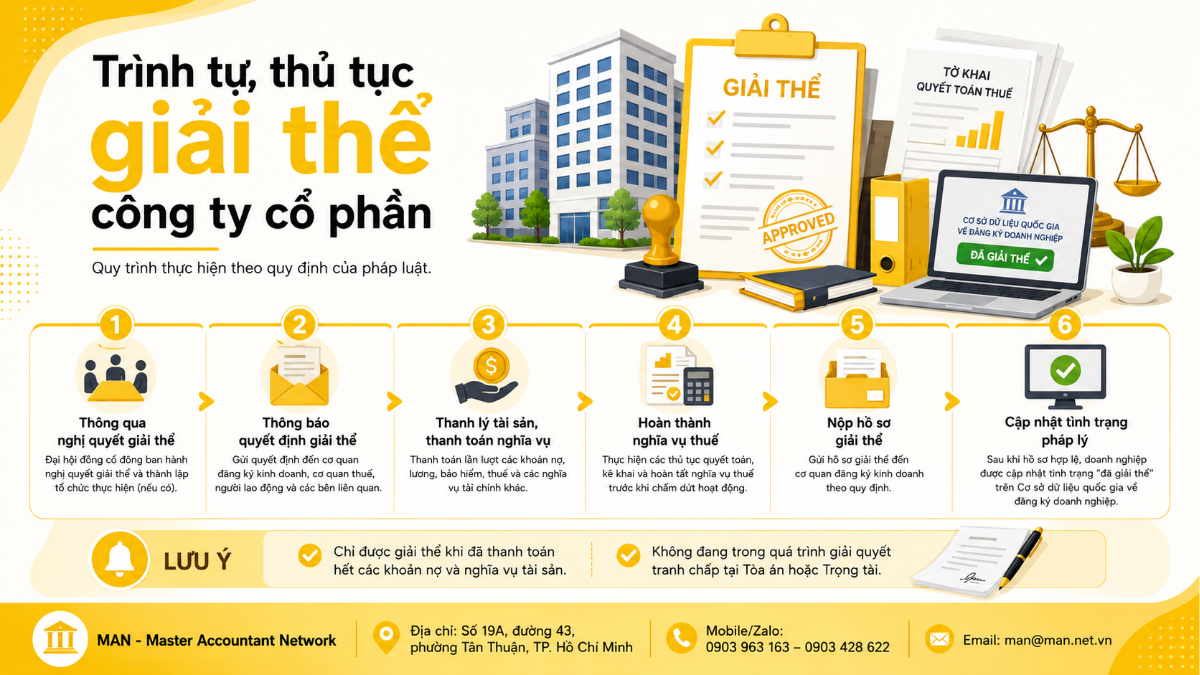
The procedure for dissolving a joint-stock company follows Article 208 of the 2020 Enterprise Law and consists of five steps: the General Meeting of Shareholders passes a resolution to dissolve the company, announces the dissolution status, liquidates assets and settles debts in order of priority, settles accounts and closes the tax code, and finally, submits the dissolution registration dossier.
Hold a General Shareholders' Meeting and pass a resolution to dissolve the company.
The dissolution resolution must clearly state the name, registered address, reason for dissolution, timeframe and procedures for liquidating contracts, and debt payment plan, as well as a plan for handling obligations arising from employment contracts. Within 7 working days of approval, the enterprise must send the resolution and meeting minutes to the Business Registration Authority, the tax authority, and all employees. Omitting to notify employees is a common mistake at this stage.
Announce the dissolution status on the National Portal.
Businesses submit a dissolution resolution along with a debt settlement plan, if any, to the Business Registration Authority so that the status can be updated to "in the process of dissolution" in the National Business Registration Database. From this point onwards, the information is made public to creditors and partners, creating a legal basis for the liquidation process.
Liquidate assets and pay off debts in order of priority.
The owner of a private enterprise, the Board of Members or the owner of a company, or the Board of Directors directly organizes the liquidation of assets, unless the Charter stipulates the establishment of a separate liquidation organization. Article 208 of the 2020 Enterprise Law stipulates the order of payment of debts as follows: first, wages, severance pay, social insurance, health insurance, unemployment insurance, and other employee benefits; next, tax debts; and finally, other debts. The process... asset liquidation A clear report is needed as it will be used for verification when submitting the application.
Tax settlement and tax code closure
This step dictates the entire process. Businesses must submit tax settlement documents, complete outstanding tax obligations, process unused invoices, and terminate their tax identification number at the tax authority. Only when the tax authority confirms that the business has fulfilled its obligations can the dissolution process proceed. Based on MAN – Master Accountant Network's experience, most prolonged or rejected dissolution cases stem from this stage, not from the registration procedure.
Submit the application for dissolution and removal of the business name.
After all debts have been settled, the legal representative submits the dissolution registration documents to the Business Registration Authority. The Business Registration Authority updates the legal status of the enterprise in the National Database of Business Registration, completing the removal of the company's name. It is important to note the following milestones. deadline for submitting dissolution documents To avoid incurring reporting obligations during the waiting period.
Actual time and cost
The time it takes to dissolve a joint-stock company depends primarily on fulfilling tax obligations and closing the tax registration number, which often takes several months, not just a few days for registration procedures. Businesses with outstanding taxes, invoices, or social insurance debts will take significantly longer.
Many business owners imagine dissolution as simply submitting a set of documents, but in reality, a large portion of the time is spent on tax settlement. A joint-stock company with a long operating history, numerous input and output invoices, or expenses that have not been fully explained, may take months for the tax authorities to review before agreeing to close its tax registration. Conversely, newly established businesses with few transactions will complete the process faster, but still have to fulfill all declaration obligations.
Regarding costs, businesses need to consider expenses such as fees, information disclosure costs, and service fees if they don't handle it themselves. The specific fees vary depending on the size of the file and the state of the books, making it difficult to give a fixed figure for all cases. More important than the number is preparing neat and tidy books and documents from the start, because the biggest costs often come from correcting accounting errors that have accumulated over many years.
Distinguishing between dissolution and bankruptcy of a joint-stock company.
Both dissolution and bankruptcy lead to the cessation of operations, but they differ in nature. Dissolution applies when a business is still able to pay all its debts and is handled by the Business Registration Authority. Bankruptcy applies when a business is unable to pay its debts and is handled by the People's Court.
Choosing the right approach from the start helps businesses avoid wasting time going back and forth between the two procedures. The table below summarizes the core differences.
| Criteria | Dissolve | Bankrupt |
| Terms and conditions apply | There is still a possibility of paying off all the debt. | Inability to pay debts when due. |
| The resolving agency | Business registration authority | People's Court |
| Legal basis | Enterprise Law 2020 | Bankruptcy law |
| The person conducting the operation. | Businesses organize liquidation themselves. | Insolvency administrator, a company that manages the liquidation of assets. |
| Result | Remove the name from the registration system. | Declaration of bankruptcy by court decision. |
In other words, if a business has sufficient assets to pay its debts, dissolution is the appropriate option; when assets are insufficient to pay off debts due, the business should consider bankruptcy proceedings to be resolved through judicial process.
Common errors that cause applications to be rejected.
Through practical consulting experience, the accounting and tax team at MAN – Master Accountant Network has found that many cases are returned or delayed simply because of preventable errors. Understanding these errors beforehand helps businesses significantly shorten processing time.
- Submitting a dissolution application before completing tax settlements and closing the tax identification number will result in the application being rejected.
- The resolution or minutes of the General Meeting of Shareholders lacked mandatory content such as the contract termination deadline or the debt repayment plan.
- Neglecting obligations to the social insurance agency, even though this is a debt category that should be prioritized for payment even before tax debts.
- Confusion between dissolution and bankruptcy occurs when a business has actually become insolvent, leading to the selection of the wrong procedure.
- Failure to notify employees within the required 7 working days creates the risk of future labor disputes.
Conclude
Dissolving a joint-stock company is a rigorous legal process, in which the conditions of settling all debts and fulfilling tax obligations play a crucial role. Businesses need to follow the five steps in the correct order as stipulated in Article 208 of the 2020 Enterprise Law, paying particular attention to the tax settlement stage, as this is where most of the paperwork is delayed. Clearly distinguishing between dissolution and bankruptcy from the outset also helps in choosing the right course of action, avoiding wasted time and costs.
If your business needs to review its accounting records, settle taxes, and complete all necessary procedures, MAN – Master Accountant Network's accounting and tax team can assist you to ensure the dissolution process is handled efficiently and legal risks are minimized.
Frequently Asked Questions
Can a joint-stock company that owes taxes be dissolved?
No. The mandatory condition is to pay off all debts, including tax debts, before dissolution. If the business is no longer able to pay its debts, the correct course of action is bankruptcy proceedings, not dissolution.
How long does it take to dissolve a joint-stock company?
There is no fixed timeline for all cases because the time depends on the tax settlement and registration process. Businesses with clear accounting records will be faster, while cases with outstanding issues from many years may take many months.
Does a company that has not yet generated revenue need to settle its taxes upon dissolution?
Yes. Even if no revenue has been generated, the business must still fulfill its obligations to declare and settle all relevant taxes and complete the procedure to terminate its tax identification number before its name can be removed from the tax register.
Who has the authority to decide on the dissolution of a joint-stock company?
For voluntary dissolution, the authority rests with the General Meeting of Shareholders through a resolution. For compulsory dissolution, the basis is a decision to revoke the Business Registration Certificate or a court decision.