



Can a business with tax debts exceeding 10 years go bankrupt? If a business has ceased operations, is no longer able to pay its debts, and has outstanding tax debts spanning many years, can it initiate bankruptcy proceedings to settle its tax obligations? This is an issue requiring a clear distinction between the conditions for bankruptcy, the debt payment process, and the conditions for tax debt forgiveness.
Businesses with tax debts exceeding 10 years may still be considered for bankruptcy proceedings if they meet the conditions under bankruptcy law. However, long-standing tax debts do not automatically grant bankruptcy rights or debt forgiveness. Debt forgiveness must be based on the legal status of the business, the outcome of asset liquidation, and the conditions for tax debt forgiveness as stipulated in current regulations.
Can a business that has been in tax debt for over 10 years declare bankruptcy?
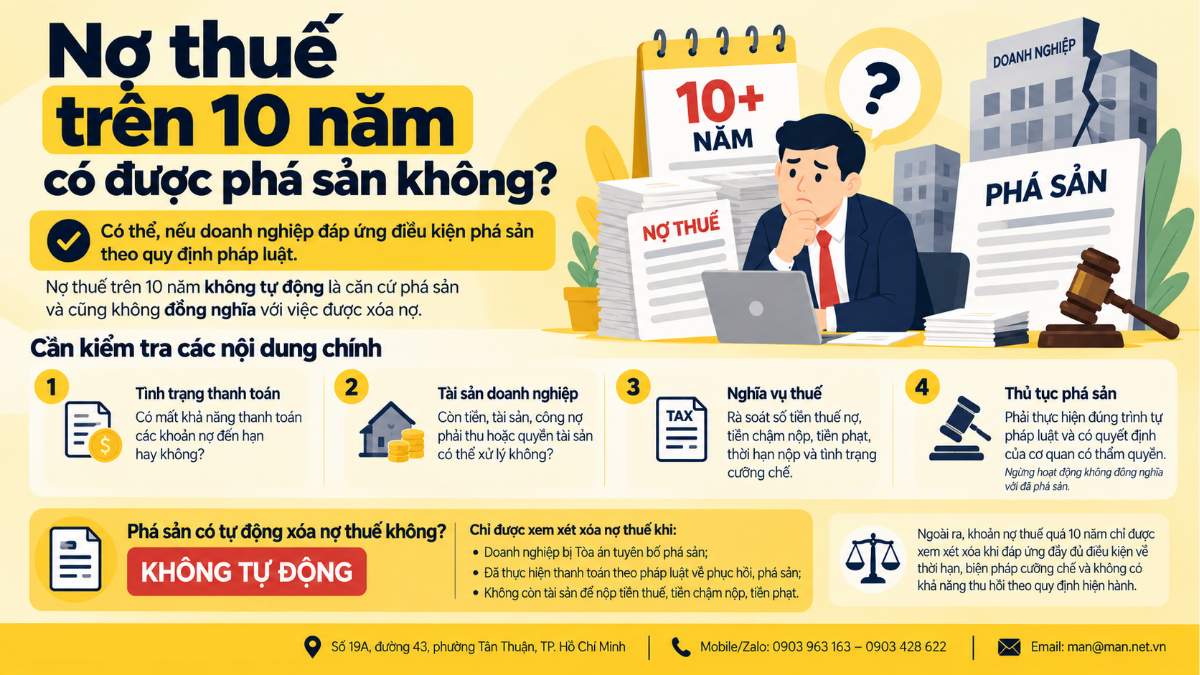
Is having tax debts for over 10 years sufficient grounds for bankruptcy?
The duration of a tax debt is not an independent basis for a business to be declared bankrupt. The conditions for bankruptcy must be determined according to bankruptcy law, with the focus being on the state of insolvency.
According to current regulations on rehabilitation and bankruptcy, businesses need to be assessed based on their insolvency status and the corresponding legal proceedings. You can find more information here. knowledge of business bankruptcy To differentiate the conditions, subjects, and processing stages, businesses with tax debts exceeding 10 years need to be assessed based on factors such as:
- Is the tax debt due for payment?.
- Does the business have the ability to pay its debts when they fall due?.
- Does the business still have assets, cash flow, or property rights that can be liquidated to pay off its debts?.
- Is the business currently operating, temporarily suspended, or has ceased operations?.
- Is there an obligation to file an application for bankruptcy proceedings as required by law?.
It is important to distinguish: A business ceasing operations or not generating revenue does not automatically mean it has been declared bankrupt. Bankruptcy is only established according to regulations when the correct legal procedures are followed and a decision is made by a competent authority.
Conditions under which a business with tax debts can initiate bankruptcy proceedings.
Businesses need to meet the criteria for insolvency and follow the procedures under Bankruptcy Law. The documentation typically includes information about the business, its financial status, a list of creditors, assets, and related obligations.
For businesses with long-standing tax debts, reviewing their tax obligations before filing an application is crucial. Businesses can refer to additional resources. corporate tax consulting To review tax declarations, settlements, and outstanding tax debts. The tax debt needs to be clearly identified in terms of the amount of tax, late payment penalties, fines, and enforcement status, if any.
It should not be understood that a business only needs to have tax debts outstanding for more than 10 years to be eligible to initiate bankruptcy proceedings.
Can tax debts over 10 years old be forgiven in the event of bankruptcy?
Tax debt can be waived when a business is declared bankrupt.
The Law on Tax Administration stipulates that the fulfillment of tax obligations in the event of a business bankruptcy shall be carried out according to the procedures of bankruptcy law.
According to Article 65 of the Tax Administration Law No. 78/2006/QH11, if a business declared bankrupt has made payments as prescribed by bankruptcy law but no longer has assets to pay taxes and penalties, it is eligible for debt forgiveness of taxes and penalties.
It's important to note that this condition isn't solely based on the fact that the business has long-standing tax debts. The business must go through bankruptcy proceedings and make payments as required. Only then, if it no longer has assets to pay taxes and penalties, will the debt forgiveness mechanism be considered.
References: Articles 54 and 65 of the Law on Tax Administration as cited in the article.Legal sources on the Government's Electronic Information Portal). When applying this in practice, further comparison is needed. The 2019 Tax Administration Law and related guidelines.
Tax debts over 10 years old that are unrecoverable will be written off.
In addition to cases where a business is declared bankrupt, tax laws also stipulate provisions regarding tax debts, late payment penalties, and fines that have been outstanding for more than 10 years since the tax payment deadline but are unrecoverable, after the tax authorities have applied coercive measures as prescribed.
This provision was added in Clause 3, Article 65 of the 2006 Law on Tax Administration under Law No. 21/2012/QH13.
However, it is necessary to distinguish clearly:
- Having tax debts outstanding for more than 10 years does not automatically mean they will be forgiven.
- The starting point for calculating the time limit must be determined.
- The application of coercive measures must be considered.
- There must be grounds to determine that a debt is uncollectible.
- The authority and procedures for debt cancellation must be determined in accordance with current regulations.
Therefore, businesses should not rely solely on the year the debt was incurred to conclude whether tax debt is eligible for forgiveness.
Does bankruptcy automatically erase tax debts?
No. Bankruptcy does not automatically erase tax debts.
Businesses need to complete bankruptcy procedures in accordance with the law. Debt forgiveness will only be considered when all legal conditions for tax debt, late payment penalty, and fine forgiveness are met, and appropriate documentation is provided.
In the case of a business being declared bankrupt, it is necessary to examine the payment results according to bankruptcy law, remaining assets, and debt write-off conditions under current regulations.
Comparing two tax debt forgiveness mechanisms
| Criteria | Debt write-off due to business bankruptcy | Debt forgiveness for debts overdue for more than 10 years. |
| Nature | Handling tax obligations after a business is declared bankrupt and making payments according to bankruptcy law. | Handling overdue and uncollectible debts. |
| Core conditions | The business has been declared bankrupt, has made payments in accordance with bankruptcy law, and no longer has assets to pay taxes or fines. | The debt meets the criteria of being due, enforceable, and uncollectible. |
| Is bankruptcy necessary? | Have | Not necessarily |
| Does it delete automatically? | Are not | Are not |
| Do you need supporting documents? | Have | Have |
| Is jurisdiction needed? | Have | Have |
The table above shows the legal distinctions. When applying this to a specific case, it is necessary to refer to the current regulations regarding the conditions, required documents, and authority for debt forgiveness.
Conditions for bankruptcy of a business that owes taxes.
Determining the state of insolvency
Businesses need to assess their ability to pay their debts when they fall due, not just tax debts. If the business has other debts such as bank loans, supplier debts, employee debts, or other financial obligations, a complete summary is necessary.
Determining insolvency requires reviewing financial records, liabilities, and the actual state of assets.
Identify the entity with the right or obligation to file the application.
Depending on the circumstances, businesses, creditors, or entities with rights and obligations under the Bankruptcy Law may file an application for bankruptcy proceedings. Businesses with tax debts need to correctly identify the applicant, the competent authority, and the necessary documents. It is not advisable to determine the procedure solely based on the fact that the business has ceased operations for many years.
Review your assets and tax obligations before filing your application.
This is a particularly important step for businesses that have been in tax arrears for over 10 years.
Needs to be checked:
- Fixed assets, inventory, cash, and deposits.
- Accounts receivable.
- Land use rights, property rights, and mortgaged assets.
- Unpaid tax obligations.
- Late payment penalties, fines, and enforcement orders.
- Tax declaration and settlement documents.
- Property transfer transactions that occurred prior to filing the application.
The review results help determine the ability to pay debts and avoid omissions when preparing bankruptcy documents.
The bankruptcy process for businesses with tax debts.
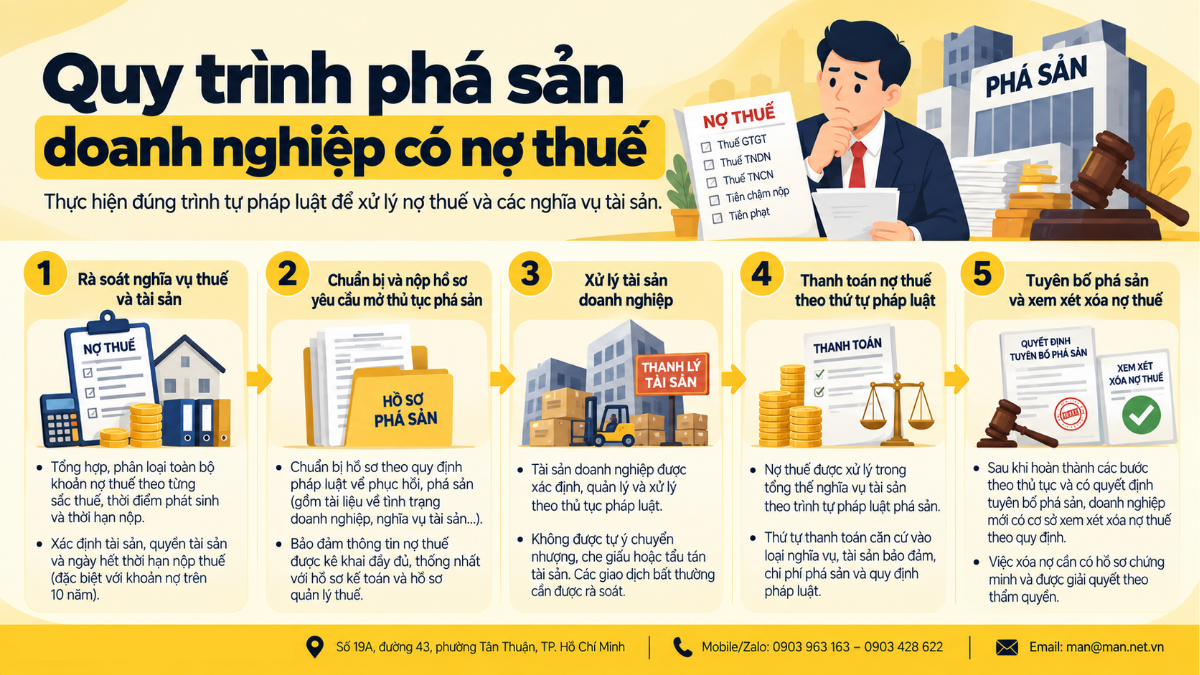
Review of corporate tax obligations and assets
First, businesses need to create a summary table of all tax obligations and assets. Debts should be categorized by tax type, date of origin, payment deadline, and processing status. For debts over 10 years, the tax payment deadline must be determined to assess eligibility for debt write-off, if any.
Prepare and file the application for initiating bankruptcy proceedings.
The file must be prepared in accordance with the legal regulations on rehabilitation and bankruptcy, including documents showing the company's status and financial obligations. Further verification is possible. Guidelines for the business bankruptcy process to determine the groups of documents that need to be prepared.
Businesses need to ensure that information regarding tax debts is fully and consistently declared in their accounting records and tax management records.
Handling of corporate assets
During bankruptcy proceedings, the company's assets are identified, managed, and disposed of according to legal procedures. Further information on this topic can be found in the following article. liquidation of assets in bankruptcy To gain a better understanding of asset inventory, disposal, and distribution.
Businesses are prohibited from arbitrarily transferring, concealing, or disposing of assets to evade payment obligations. Transactions showing signs of irregularities should be reviewed to mitigate the risk of disputes and legal liability.
Pay tax debts in the order of legality.
Tax debts are handled within the overall financial obligations of the enterprise according to the legal procedures for bankruptcy. Payment must be based on the type of obligation, collateral, bankruptcy costs, and the order of payment as stipulated.
It should not be assumed that all tax debts are always paid before all other debts. The order of payment must be determined according to the applicable laws at the time of processing the case.
Declaration of bankruptcy and consideration for tax debt forgiveness.
After completing the bankruptcy procedures and receiving a bankruptcy declaration, the business has grounds to consider eligibility for tax debt forgiveness as stipulated by law. Debt forgiveness requires supporting documentation and must be processed by the competent authority. Businesses should not assume that their debt has been forgiven simply because a bankruptcy declaration has been issued.
Legal risks associated with bankruptcy proceedings to settle tax debts.
Misunderstanding about the right to tax debt forgiveness.
A common risk is that businesses assume tax debts over 10 years old are automatically forgiven. This understanding can lead to inappropriate bankruptcy planning or neglecting tax filing obligations.
Failure to fully declare assets and liabilities.
If a business fails to fully disclose its assets, liabilities, or related obligations, the bankruptcy process can lead to disputes and legal liabilities. In particular, it is necessary to examine transferred assets, mortgaged assets, accounts receivable, and transactions that occurred prior to filing the application.
Transfer or disposal of assets
Transferring assets to avoid payment obligations may be subject to legal scrutiny. Businesses should not engage in unusual transactions before bankruptcy to reduce their assets available to pay creditors.
Responsibilities of managers and representatives
For limited liability companies or joint-stock companies, it is necessary to distinguish between the obligations of the legal entity and the individual responsibilities of the managers or legal representatives.
It cannot be automatically concluded that the director is obligated to use personal assets to pay all of the company's tax debts. However, personal liability may arise if there are violations of the law, guarantee obligations, or other personal obligations as stipulated by regulations.
The file does not qualify for debt forgiveness.
A business may have completed bankruptcy proceedings, but the conditions for tax debt forgiveness still need to be considered separately. If the documentation does not demonstrate the necessary conditions, the debt forgiveness may not be approved.
Example: A business that owes taxes since 2015 wants to file for bankruptcy.
Company A incurred tax debt starting in 2015. By 2026, the business is no longer operating, has no cash flow, and wishes to file for bankruptcy.
Situation analysis
- Step 1: Determine the tax debt period.
The debt has been outstanding for over 10 years. However, the exact tax payment deadline and the debt status need to be determined.
- Step 2: Check for bankruptcy conditions
Company A must be assessed for its ability to pay its debts when they fall due. Inactivity in business does not automatically mean insolvency.
- Step 3: Inspect the property
If the company still has assets, those assets must be declared and disposed of according to bankruptcy procedures. Assets cannot be disregarded simply because the business has ceased operations for a long time.
- Step 4: Consider writing off tax debt.
If a company is declared bankrupt, has made payments in accordance with bankruptcy law, and no longer has assets to pay taxes and fines, it may be considered for debt forgiveness under the regulations.
However, it cannot be concluded that the debt should be written off simply because it was incurred in 2015.
Checklist before filing for bankruptcy
To minimize errors when processing the application, businesses should review the following before filing for bankruptcy:
- Determine the total amount of tax owed.
- Check for late payment penalties and fines.
- Determine the tax filing deadline.
- Check the status of tax enforcement.
- Review all of the company's assets.
- Check accounts receivable and accounts payable.
- Prepare accounting, financial, and tax records.
- Identify the entity that has the right or obligation to file the application.
- Check the competent authority for handling bankruptcy proceedings.
- Assessing eligibility for tax debt forgiveness after bankruptcy.
Legal basis, sources of reference, and considerations for application.
The documents that need to be compared when processing the actual application include:
- Law on Tax Administration No. 38/2019/QH14 and current amending, supplementing, and guiding documents.
- Law on Rehabilitation, Bankruptcy and related regulations.
- Regulations regarding the cancellation of tax debts, late payment penalties, and fines.
- Regulations on the management and disposal of assets and payment of obligations in bankruptcy proceedings..
Note: Regulations regarding the cancellation of tax debts older than 10 years should be compared with the current regulations at the time of processing. Do not mechanically apply historical data or conclude on debt cancellation based solely on the debt's existence.
Related content to refer to
- A step-by-step guide to the business bankruptcy process. – Please refer to the application processing steps and procedures.
- Liquidation of assets in bankruptcy – Learn how to inventory, process, and distribute assets.
- What's new in the Bankruptcy and Recovery Law of 2025? – Update the legal framework.
- Corporate tax consulting – Review tax obligations, declaration documents, and tax settlements.
For businesses with large, long-standing tax debts or those facing enforcement action, it is advisable to review their records with a professional firm specializing in tax, accounting, and bankruptcy law before choosing a course of action.
Professional license: CPA Vietnam Auditors
Experience: Over 30 years of experience in Accounting, Auditing, and Financial Consulting.
Frequently Asked Questions
Can a business that has been in tax debt for over 10 years declare bankruptcy?
It may be considered if the conditions for insolvency are met and procedures under the Bankruptcy Law are followed. A tax debt period exceeding 10 years is not an independent condition for bankruptcy.
Does bankruptcy automatically erase tax debts?
No. Businesses must meet the conditions for debt forgiveness as stipulated by law. In the case of a business being declared bankrupt, the payment results and remaining assets need to be considered.
Does a bankrupt business have to pay its tax debts?
Tax debts are handled according to the order of payment of asset obligations in bankruptcy proceedings. The remaining amount to be paid depends on the assets and the order of payment as stipulated by law.
Can tax debts overdue for more than 10 years be written off if the company is not bankrupt?
It may be considered if all legal conditions regarding tax debts overdue for more than 10 years, enforcement measures, and the inability to recover the debt are met. Not all debts overdue for more than 10 years are eligible for forgiveness.
Is the director required to use personal assets to pay off tax debts?
This is not a given. A distinction must be made between corporate obligations and personal liability arising from violations of the law, guarantees, or private obligations.
Can someone who is facing tax enforcement file for bankruptcy?
The conditions for bankruptcy, the state of enforcement, and applicable legal regulations must be considered. Being subject to tax enforcement should not be interpreted as automatically exempting from or preventing any bankruptcy proceedings.