


The procedure for dissolving a business goes beyond simply submitting a termination application. Businesses must meet dissolution requirements, pass a resolution or decision to dissolve, handle assets and debts, fulfill tax obligations, settle employee benefits, and register the dissolution with the provincial business registration authority.
According to current regulations, after settling all debts, businesses must submit dissolution registration documents within 5 working days. This process needs to be synchronized between business registration documents, accounting, tax, accounts payable, and subsidiary units to avoid delays in processing.
The content is compiled in accordance with the regulations on business dissolution currently in effect, focusing on the following: The Law on Enterprises was consolidated in Document 67/VBHN-VPQH., Decree 168/2025/ND-CP and Decree 296/2026/ND-CP. Law No. 76/2025/QH15 and Decree 168/2025/ND-CP take effect from July 1, 2025; Decree 296/2026/ND-CP takes effect from July 23, 2026.
Conditions for a business to be dissolved
A business can be dissolved when it ensures that all debts and other financial obligations are paid in full, and it is not currently involved in any ongoing disputes in court or arbitration. These are two core legal conditions according to Article 207 of the Enterprise Law.
The ability to pay off all debts and financial obligations.
Dissolution is carried out when a business is able to handle its financial obligations. Before deciding to dissolve, the business needs to review all its debts and identify the sources of assets to be used for payment.
The review should cover the following main groups of obligations:
- Obligations towards employees, including wages, benefits, and related entitlements.
- Obligations regarding social insurance, health insurance, and unemployment insurance.
- Taxes still to be paid.
- Accounts payable to suppliers, customers, and partners.
- Loans and other financial obligations.
If a business becomes unable to pay its debts when they fall due, it is necessary to assess the application of bankruptcy law instead of automatically opting for dissolution procedures. Businesses can refer to the following article for more information. Comparison of business dissolution and bankruptcy to differentiate between these two mechanisms.
Not currently in dispute resolution
Businesses cannot be dissolved while in the process of resolving disputes in court or arbitration. Therefore, checking the conditions for dissolution should not be limited to tax debts but should also consider contract disputes, outstanding debts, and ongoing legal cases.
Fulfill all obligations before the dissolution process is complete.
To complete the dissolution registration, the business must settle its financial obligations and related rights. The dissolution registration dossier must include a list of creditors and the amount of debt paid, including tax debts and social insurance, health insurance, and unemployment insurance contributions for employees, if any.
Therefore, accountants need to reconcile accounts payable, tax records, insurance records, and labor records before the business moves on to the final stage of completing the dissolution registration process.
Cases where businesses undergo dissolution.
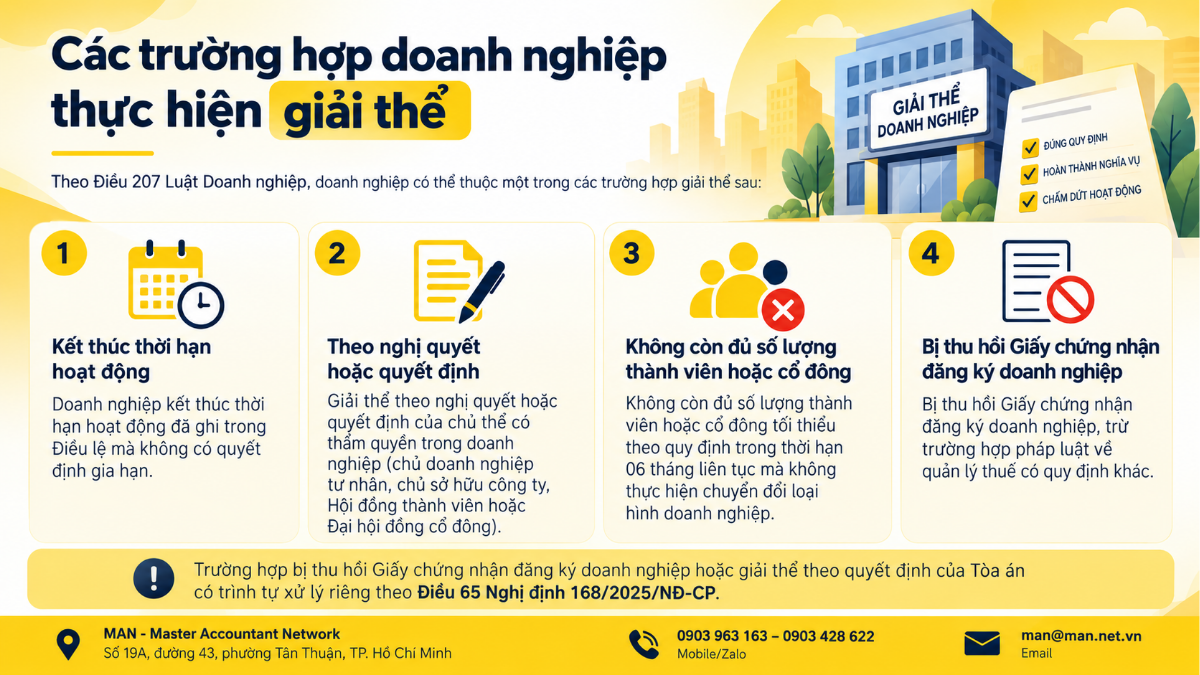
According to Article 207 of the Enterprise Law, an enterprise may be dissolved in one of the following cases:
- The operating period stated in the Charter has expired without a decision to extend it.
- Dissolution is carried out by resolution or decision of the competent authority within the enterprise.
- The company no longer has the minimum number of members or shareholders required by law for a continuous period of 06 months without changing its business type.
- The business registration certificate is revoked, except where the tax administration law provides otherwise.
In particular, cases where the business registration certificate is revoked or the business is dissolved by a court decision have a separate procedure as stipulated in Article 65 of Decree 168/2025/ND-CP.
Dissolution by resolution or decision of the enterprise
This is a case where a business proactively ceases operations pursuant to a resolution or decision of a competent authority. Depending on the type of business, the authority may rest with the owner of a private enterprise, the owner of a company, the Board of Members, or the General Meeting of Shareholders.
Dissolved due to the expiration of the operating period.
A business is considered dissolved when its operating period, as stated in its charter, expires without a decision to extend it. Before the expiration date, the business should proactively review its assets, liabilities, contracts, employees, and tax obligations to prepare for the cessation of operations.
Dissolved due to no longer having the minimum number of members or shareholders.
If a business no longer has the minimum number of members or shareholders required by law for a continuous period of 6 months without changing its business type, it falls under the category of businesses that must be dissolved according to Article 207 of the Enterprise Law.
Dissolution occurs due to the revocation of the business registration certificate or by court decision.
This case needs to be distinguished from voluntary dissolution. Article 65 of Decree 168/2025/ND-CP stipulates a separate procedure for registering dissolution for enterprises whose business registration certificates have been revoked or which are dissolved by court decision.
Documents required for the business dissolution procedure.
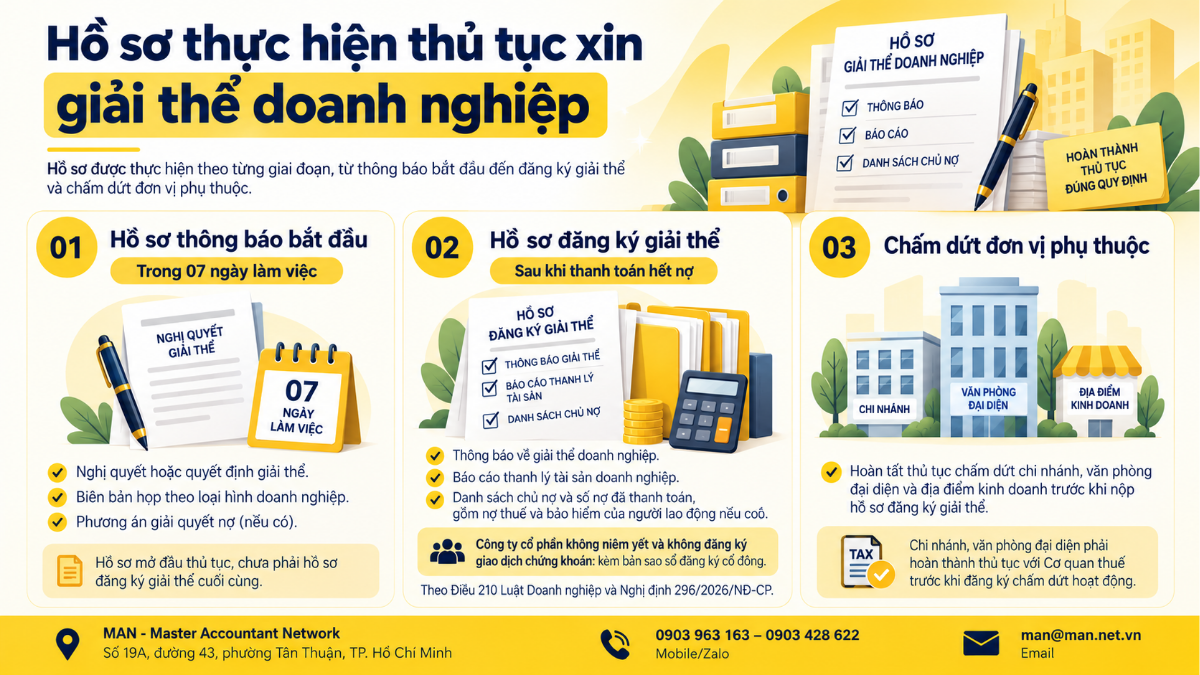
The dissolution process is not a single set of documents submitted from the outset, but rather a series of steps. It's important to distinguish between the notification of commencement of the procedure, the dissolution registration documents after fulfilling obligations, and the documents for handling subsidiaries. Businesses can refer to this information for further details. business dissolution documents to review each group of documents.
Notification file indicating the commencement of dissolution proceedings.
Within 7 working days from the date of adoption of the resolution or decision on dissolution, the enterprise must submit the dossier to the provincial business registration authority where its head office is located. Depending on the type of enterprise, the initial set of documents that need to be reviewed includes:
- Resolution or decision to dissolve.
- Minutes of the meeting of the Board of Members or the General Meeting of Shareholders, in cases where required by law.
- A plan for resolving any outstanding debts.
This is the initial filing for the dissolution process, not the final registration for dissolution.
Business dissolution registration documents
After settling all debts, the business must submit its dissolution registration documents within 5 working days. According to Article 210 of the Enterprise Law, the core documents include:
- Announcement regarding the dissolution of the business.
- Report on the liquidation of company assets.
- A list of creditors and the amount of debt paid, including tax debts and social insurance, health insurance, and unemployment insurance contributions for employees, if applicable.
Specifically for unlisted joint-stock companies that are not registered for securities trading, the current regulations, as amended by Decree 296/2026/ND-CP, require that the notification of dissolution in the business registration dossier must be accompanied by a copy of the shareholder register.
The legal representative and responsible parties must ensure the truthfulness and accuracy of the records. Therefore, the asset liquidation report and the list of creditors must accurately reflect the actual situation of the business.
Documents for the termination of operations of a subsidiary unit
Before filing for business dissolution, the enterprise must complete the procedures for terminating the operations of its branches, representative offices, and business locations as prescribed by law.
For branches and representative offices, Article 66 of Decree 168/2025/ND-CP requires them to complete tax obligations with the Tax Authority before registering for cessation of operations. This is a step that is easily overlooked for businesses with many dependent units.
Procedures for applying for business dissolution
The dissolution process has many timelines, but each timeline is associated with a different entity and task. Further reference is possible. Procedures for dissolving a business according to current regulations. to check the entire process.
The table below helps distinguish key milestones and avoid confusion between business deadlines and government agency processing deadlines:
| Timeline | Subject | Main content |
| 7 working days | Businesses | Submit the resolution or decision on dissolution and related documents. |
| 3 working days | Business registration authority | Post and update the status of ongoing dissolution procedures. |
| 05 working days | Businesses | Submit the dissolution application after all debts have been paid. |
| 2 working days | Tax authorities | Submit feedback on fulfilling tax obligations. |
| 05 working days | Business registration authority | Handling legal issues after receiving dissolution registration documents. |
| 180 days | Business/Business Registration Authority | Milestones related to the annulment of the dissolution decision or the mechanism for updating the status as prescribed. |
Step 1 – Pass a resolution or decision to dissolve the organization.
Businesses must pass a resolution or decision for dissolution that is within the proper authority. The resolution or decision should clearly state the reasons for dissolution, the timeframe and procedures for liquidating contracts, settling debts, and the plan for handling obligations arising from employment contracts.
Step 2 – Send the dissolution notice within 7 working days.
Within 7 working days from the date of adoption of the resolution or decision on dissolution, the enterprise must submit the required documents to the provincial business registration authority where its head office is located. The 7-day deadline is the responsibility of the enterprise and is calculated from the date the resolution or decision on dissolution is adopted.
Step 3 – The business registration authority processes the application within 3 working days.
Within 3 working days from the date of receiving the resolution or decision on dissolution, the provincial business registration authority shall publish the information and change the legal status of the enterprise to "undergoing dissolution procedures" on the National Database of Business Registration, and simultaneously send the information to the tax authority and the civil enforcement agency.
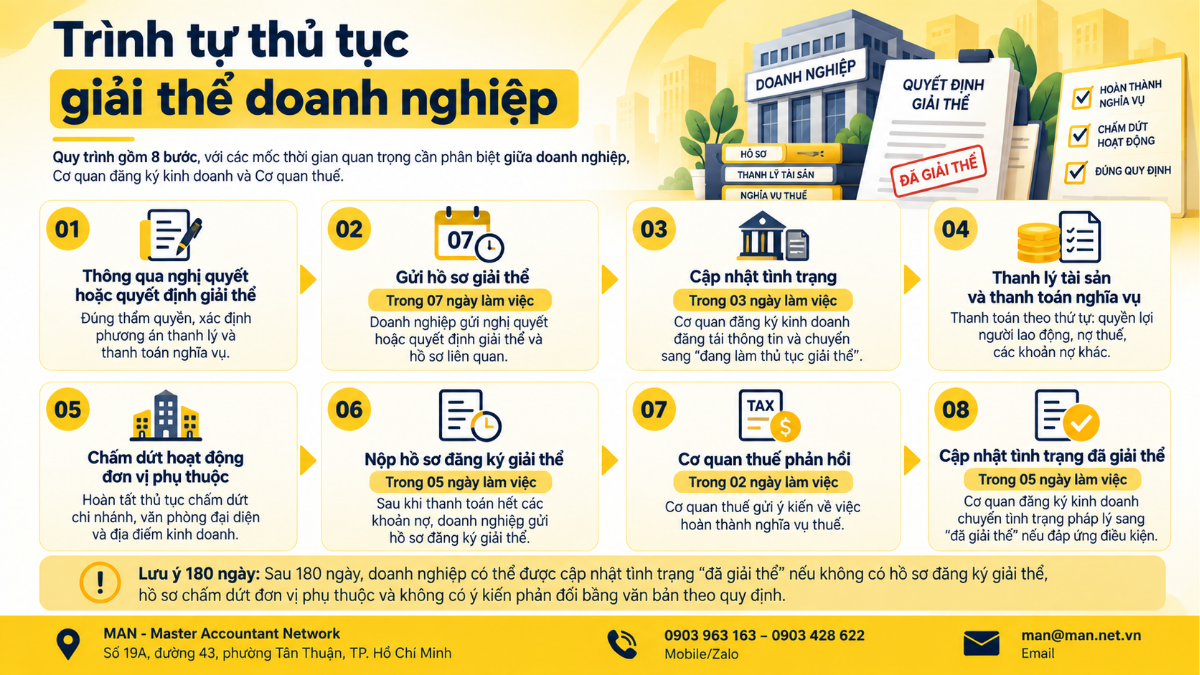
Step 4 – Liquidate assets and fulfill obligations
During the dissolution process, a business must liquidate its assets and settle its obligations in the legally prescribed order. According to Article 208 of the Enterprise Law, debts are paid in the following order: employee benefits; tax debts; and other debts. After settling dissolution costs and debts, the remaining assets are then distributed to the private business owner, members, shareholders, or owners in proportion to their ownership.
Step 5 – Terminate the subsidiary unit's operations
Before filing for dissolution, businesses must complete the procedures for terminating the operations of their branches, representative offices, and business locations. For branches and representative offices, tax obligations must be settled according to Article 66 of Decree 168/2025/ND-CP before registering for termination of operations.
Step 6 – Submit the dissolution registration documents within 5 working days.
After settling all debts, the business must submit its dissolution registration documents to the provincial business registration authority within 05 working days. This date is calculated from the date the business settles all debts, not from the date the resolution or decision to dissolve is passed.
Step 7 – Tax authority responds regarding tax obligations
After receiving the dissolution registration application, the provincial business registration authority sends the information to the tax authority. Within 2 working days of receiving the information, the tax authority sends its opinion on the fulfillment of the enterprise's tax obligations. If the tax obligations are not fulfilled and the tax authority rejects the application, the enterprise must continue to process the application.
Step 8 – Update the legal status to dissolved.
Within 5 working days from the date of receiving the dissolution registration application, the provincial business registration authority shall change the legal status of the enterprise to "dissolved" if no objection is received from the tax authority or confirmation is received that the enterprise has fulfilled its tax obligations. It is important to distinguish between the 5-day deadline for the enterprise to submit the application and the 5-day deadline for the registration authority to process the application.
Tax obligations when dissolving a business.
Tax obligations directly affect the ability to complete the business dissolution process. Filing for dissolution does not mean the business can disregard outstanding tax obligations. Businesses can refer to the following information. Tax obligations upon dissolution To conduct a more thorough review of the tax and accounting aspects.
Review tax obligations before dissolution.
Before proceeding to the dissolution registration phase, businesses should review their accounting records, tax returns, financial statements, and the status of any outstanding taxes. The goal is to ensure that the data used in the dissolution application accurately reflects the actual situation.
Priority areas to check include tax declaration status, outstanding tax liabilities, employee-related obligations, and tax issues of branches or representative offices if the business has subsidiaries.
Handling outstanding tax payments
Tax debts are among the obligations that must be paid during the dissolution process. If the Tax Authority determines that the business has not fulfilled its obligations and issues a refusal, the dissolution registration process cannot be completed according to normal procedures.
This does not mean that a business with outstanding tax debts cannot begin any steps of the dissolution process. The core issue is that the obligations must be settled so that the business meets the conditions for completing the dissolution.
The role of the Tax Authority in the dissolution process
The business registration agency and the tax authority perform different functions. The business registration agency receives and processes dissolution registrations, while the tax authority responds regarding whether the business has fulfilled its tax obligations.
Therefore, business registration documents and accounting and tax records should be processed in parallel instead of being considered two completely separate processes.
The agency responsible for receiving and submitting dissolution documents.
According to current regulations, the application is submitted to the provincial business registration authority where the enterprise's head office is located. National Public Service Portal The procedure can now be completed in person, online, or via postal service, with no fee.
The agency receiving the application
According to Decree 168/2025/ND-CP, the provincial-level business registration agency is the business registration agency under the Department of Finance of the province or centrally-administered city. Businesses should note the current name and structure of the agency when referring to older guidelines, especially articles published before Decree 168/2025/ND-CP came into effect.
Application submission methods
According to the procedures published on the National Public Service Portal, businesses can choose one of the following methods:
- Submit in person.
- Submit online.
- Submit via postal service.
The procedure for registering for business dissolution is announced with a fee of 0 VND; the processing time for registration is 05 working days from the date of receipt of the business dissolution registration application.
Common mistakes when applying for business dissolution
Most errors don't stem from a single form but arise from businesses mistaking deadlines, omitting obligations, or using outdated instructions. Issues requiring particular attention include:
- Confusing the 7-day, 3-day, 5-day, and 2-day milestones.
- Use the old guidelines regarding the receiving agency.
- Omitting branches, representative offices, or business locations.
- Tax obligations and employee rights have not been fully addressed.
- Confusing voluntary dissolution with the case of business registration certificate revocation.
- Using outdated records or forms.
Incorrect deadlines: 7 days, 3 days, 5 days, and 2 days.
These timelines are not interchangeable as they are associated with different tasks. Businesses should refer to the timeline in the process section instead of just memorizing a number like 5 days or 7 days.
Use the old guidelines regarding the receiving agency.
Decree 168/2025/ND-CP takes effect from July 1, 2025, and Decree 296/2026/ND-CP further amends regulations on business registration from July 23, 2026. Therefore, the old guidelines regarding the receiving agency, required documents, or procedures may no longer be relevant.
Omitting branches, representative offices, or business locations.
A subsidiary may have ceased actual operations but still exist in registration. Businesses need to review all branches, representative offices, and business locations before finalizing the company dissolution process.
Tax obligations and employee benefits have not been fully settled.
Debts related to employees and tax debts are among the priority debts to be paid before other debts, according to Article 208 of the Enterprise Law. Failure to settle these obligations could directly affect the ability to complete the dissolution process.
Confusing voluntary dissolution with the case of business registration certificate revocation.
Article 64 of Decree 168/2025/ND-CP regulates the dissolution process for cases corresponding to points a, b, and c of Clause 1, Article 207 of the Enterprise Law, while cases of revocation of the Business Registration Certificate or dissolution by court decision are handled according to Article 65.
Using outdated records or forms.
Since the legal system for business registration has changed in 2025 and will continue to be amended in 2026, businesses should not reuse an old set of documents without comparing them with the currently effective regulations.
In particular, unlisted joint-stock companies that are not registered for securities trading should note the additional requirement regarding a copy of the shareholder register as stipulated in Decree 296/2026/ND-CP.
Revoke the resolution or decision to dissolve the business.
Businesses that have begun the dissolution process can still revoke the resolution or decision to dissolve if they meet the conditions in Article 64 of Decree 168/2025/ND-CP. The 180-day period needs to be properly understood as it relates both to the right to revoke the decision and to the mechanism for updating the legal status of the business.
When can a business reverse its dissolution decision?
Within 180 days from the date the provincial business registration authority receives the resolution or decision on dissolution, if the enterprise does not proceed with the dissolution and its legal status has not changed to "dissolved," the enterprise may send a notice of cancellation along with the corresponding resolution or decision on cancellation.
How is the 180-day deadline applied?
The 180-day milestone needs to be distinguished in two situations:
- Within 180 days: a business can carry out the procedure to revoke a resolution or decision to dissolve if it meets the conditions.
- After 180 days: if there are no dissolution registration documents, no documents for the termination of operations of subsidiary units, and no written objections as prescribed, the provincial business registration authority shall change the legal status to "dissolved" according to the mechanism in Article 64 of Decree 168/2025/ND-CP.
Therefore, 180 days should not be simply described as a “dissolution waiting period”.
Cancellation notification procedure
Businesses submit a notice of cancellation, along with a resolution or decision on cancellation, to the provincial business registration authority. Within one working day of receiving the notice, the registration authority publishes the information and restores the legal status of the business and its subsidiaries as prescribed.
MAN assists with business dissolution procedures.
For businesses with incomplete accounting records, outstanding tax obligations, numerous debts, or branches, representative offices, and business locations, the dissolution process needs to be implemented simultaneously in terms of accounting, taxation, and business registration.
MAN – Master Accountant Network can assist businesses in reviewing documentation, reconciling accounting and tax obligations, preparing dissolution documents, handling matters related to subsidiaries, and monitoring the completion of procedures. Businesses can refer to the following: Business dissolution services in Ho Chi Minh City To determine the scope of work appropriate to the actual situation of the case file.
Before implementation, businesses should clearly identify three issues: what obligations remain to be paid, the current status of their tax records, and which dependent units have not yet ceased operations. A thorough review from the outset helps to develop a suitable processing plan and minimize problems at the final stage.
Conclude
The procedure for dissolving a business is a complex process involving business registration, asset liquidation, debt settlement, tax obligations, employee benefits, and handling of subsidiaries. Businesses need to differentiate between the 7-day, 3-day, 5-day, and 2-day timeframes according to the specific tasks and entities involved, rather than applying a single timeframe to the entire process.
Besides preparing the correct documentation, businesses need to ensure that debts and financial obligations are settled in the correct order, tax obligations are fulfilled, and the operations of subsidiaries are terminated before completing the dissolution registration. For cases where the business registration certificate is revoked or dissolution is ordered by a court, a separate procedure must be applied instead of using the full voluntary dissolution process.
Professional license: CPA Vietnam Auditors
Experience: Over 30 years of experience in Accounting, Auditing, and Financial Consulting.
Frequently Asked Questions about the Business Dissolution Procedure
Can a business that owes taxes be dissolved?
Businesses must settle their tax obligations to complete the dissolution process. Outstanding tax debts should not be interpreted as preventing a business from beginning any steps of the dissolution process; however, if tax obligations are not fulfilled and the tax authorities issue a refusal, the business cannot complete the dissolution registration process as usual.
After all debts have been paid off, how long do I have to file for dissolution registration?
Businesses must submit their dissolution registration documents within 5 working days from the date all debts are settled. This differs from the 7 working days required to submit the dissolution resolution or decision in the initial stages.
Is it possible to reverse a dissolution decision after giving notice?
Yes. Within 180 days from the date the provincial business registration authority receives the resolution or decision on dissolution, if the enterprise does not proceed with the dissolution and its legal status has not changed to "dissolved," the enterprise may carry out the cancellation procedure according to Article 64 of Decree 168/2025/ND-CP.