



Professional license: CPA Vietnam Auditors
Experience: Over 30 years of experience in Accounting, Auditing, and Financial Consulting.
Registering for business dissolution is not simply about submitting documents to terminate its legal status. Businesses must also handle assets, pay debts, fulfill tax obligations, settle employee benefits, and cease operations of branches, representative offices, and business locations, if any. The process needs to be reviewed against regulations in effect at the time of implementation.
Current regulations on business dissolution registration
Business dissolution registration is currently carried out on the basis of the Enterprise Law and the regulations on business registration currently in effect. Decree 168/2025/ND-CP was issued on June 30, 2025 and came into effect on July 1, 2025; Decree 296/2026/ND-CP was issued and came into effect on July 23, 2026, amending and supplementing some articles of Decree 168/2025/ND-CP. Comparison is possible. Law on Enterprises No. 59/2020/QH14 on the Government's electronic portal.
Official source: Decree 168/2025/ND-CP on the Government's electronic portal.; Decree 296/2026/ND-CP on the Government's electronic portal.
Legal documents that need to be based on
Businesses should distinguish between two groups of regulations: those concerning the conditions and circumstances for dissolution, and those concerning the required documents and registration procedures. Comparing regulations to the correct ones helps prevent the use of changed forms or procedures.
- Law No. 76/2025/QH15 amending and supplementing a number of articles of the Enterprise Law was promulgated on June 17, 2025 and came into effect on July 1, 2025.
- Decree 168/2025/ND-CP on business registration, issued on June 30, 2025, takes effect from July 1, 2025.
- Decree 296/2026/ND-CP amends and supplements Decree 168/2025/ND-CP, issued and effective July 23, 2026.
- Circular 121/2026/TT-BTC amends and supplements Circular 68/2025/TT-BTC on forms used in business registration and household business registration, issued and effective August 21, 2026.
It can be compared directly. Law No. 76/2025/QH15 and Circular 121/2026/TT-BTC on the Government's electronic portal.
Updated regulations on business dissolution in 2026
Decree 296/2026/ND-CP takes effect from July 23, 2026, and amends some provisions of Decree 168/2025/ND-CP. For dissolution registration applications, businesses need to check the current regulations at the time of submission, especially if the business is a joint-stock company that is not a listed company and is not registered for securities trading.
Circular 121/2026/TT-BTC takes effect from August 21, 2026, and amends and supplements Circular 68/2025/TT-BTC regarding forms for business registration and household business registration. Therefore, the set of forms used for the application needs to be checked again before signing and submitting.
Business dissolution registration documents
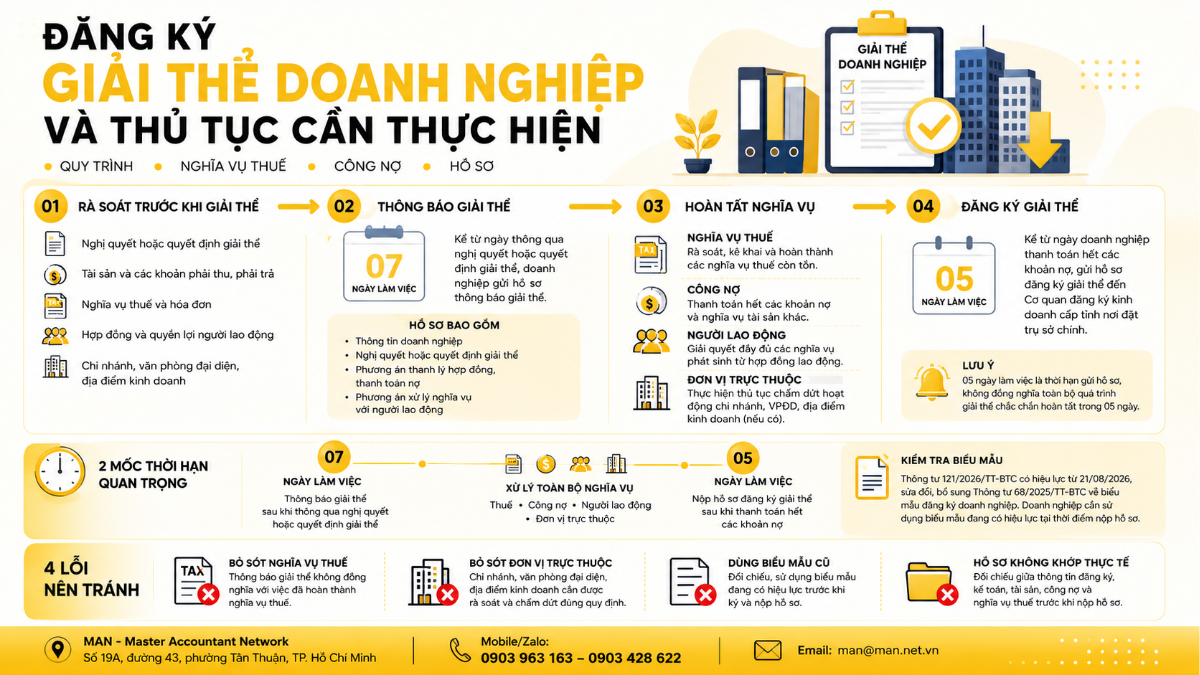
Dissolution documents must be prepared according to the correct stages of the procedure. Businesses should not combine the step of notifying the dissolution with the step of registering the dissolution after all debts have been paid, as each stage has its own timeline and required documents as stipulated by regulations.
Dissolution notification file
Within 7 working days from the date of adoption of the resolution or decision on dissolution, the enterprise must submit the required documents to the provincial business registration authority where its head office is located. The documents must comply with current regulations and the type of enterprise.
The resolution or decision on dissolution must include key information related to the business, the reasons for dissolution, the timeframe and procedures for liquidating contracts, settling debts, and the plan for handling obligations arising from employment contracts.
Dissolution registration documents after debt payment
Within 05 working days from the date of full payment of all debts, the enterprise shall submit the dissolution registration dossier to the provincial business registration authority where its head office is located. The dossier components must be checked according to the regulations in effect at the time of submission.
For joint-stock companies that are not listed companies and are not registered for securities trading, businesses need to pay special attention to the requirement for a copy of the shareholder register as stipulated in the amended Decree 296/2026/ND-CP.
Procedure and timeframe for registering business dissolution.
For businesses that proactively dissolve under the provisions of the Enterprise Law, the actual procedure should be implemented in the following sequence: making a dissolution decision, notifying the dissolution, handling assets and liabilities, fulfilling tax obligations, terminating the operations of subsidiary units, and submitting the dissolution registration dossier.
Step 1: Pass a resolution or decision to dissolve the organization.
First, the business must pass a resolution or decision for dissolution with the proper authority. This document should specify the reasons for dissolution, the timeframe and procedures for liquidating contracts, settling debts, and the plan for handling obligations arising from employment contracts.
Step 2: Notify the company that it is undergoing dissolution procedures.
Within 7 working days from the date of adoption of the resolution or decision to dissolve, the enterprise must submit the notification documents as prescribed. This deadline should be noted separately in the dissolution plan to avoid confusion with the 5 working days deadline for the dissolution registration documents after all debts have been settled.
Step 3: Pay off debts and fulfill tax obligations.
A business can only complete its dissolution when it meets the conditions regarding the payment of debts and other financial obligations, and is not currently involved in any ongoing disputes in court or arbitration. Tax obligations should be reviewed along with liabilities and assets, rather than being checked only at the end of the process.
Step 4: Terminate the operations of the subsidiary unit.
If the business has branches, representative offices, or business locations, the status of each unit must be reviewed, and procedures for terminating operations must be followed according to regulations before completing the business dissolution process.
Step 5: Submit the dissolution registration documents.
After settling all debts, the business must submit its dissolution registration documents within 5 working days to the provincial business registration authority where its head office is located. This 5-day deadline is for submitting the documents and should not be interpreted as a guaranteed timeframe for the entire dissolution process to be completed.
Key milestones should be tracked separately:
- Seven working days from the date of adoption of the resolution or decision to dissolve the organization, the required notification documents must be submitted.
- Five working days from the date all debts are settled to submit the dissolution registration documents.
The actual time for the entire process depends on the status of accounts receivable, tax obligations, assets, subsidiaries, and whether additional documentation is required.
Register for business dissolution online.
Online business registration is a method of submitting electronic documents through the National Business Registration Information System. Submitting documents online does not alter the dissolution conditions or financial obligations that the business must fulfill.
When preparing electronic documents, businesses need to ensure that the declared information is consistent with legal documents, accounting records, and the actual situation. The forms must be compared with the regulations in effect at the time of submission.
You can check the registration procedure and system information at National portal for business registration.
Conditions and obligations that must be fulfilled before dissolution
The conditions for dissolution are not limited to the registration documents. Businesses need to simultaneously address liabilities, assets, tax obligations, employees, and subsidiaries to ensure that the cessation of operations does not create outstanding obligations.
Pay off debts and fulfill tax obligations.
Tax obligations should be reviewed as soon as a business begins planning its dissolution. Accountants need to reconcile accounting data, invoices, accounts receivable, accounts payable, and tax obligations to identify outstanding issues before preparing the final documentation.
For further information on recurring tax tasks and record keeping, businesses can refer to the following: MAN's comprehensive tax reporting services.
Liquidation of assets and handling of employee benefits.
The liquidation of assets must be linked to the identification and settlement of liabilities. The resolution or decision to dissolve the company should also outline a plan for handling obligations arising from employment contracts. The company should fully identify all amounts payable before confirming that all obligations have been fulfilled.
Terminate the operations of subordinate units.
Businesses with branches, representative offices, or business locations need to create and review each unit separately. Omitting a subsidiary unit is a reason why the termination of operations record does not reflect the actual status of the business.
Cases of business dissolution
The Enterprise Law stipulates several cases in which an enterprise may or must be dissolved, including the expiration of its operating period without a decision to extend it, dissolution by resolution or decision of a competent authority, failure to have the minimum number of members or shareholders within the legally prescribed period without changing its legal form, and the revocation of its business registration certificate as prescribed.
Dissolution by decision of the enterprise
This is a case where a business proactively ceases operations in accordance with a resolution or decision of a competent authority. The business must still meet the dissolution conditions and complete the registration procedures as stipulated in current regulations.
Dissolved due to expiration of operating period or insufficient number of members.
When a business is subject to dissolution due to the expiration of its operating period or the failure to meet the minimum number of members or shareholders required by law, it is necessary to correctly identify the legal basis and the time of occurrence in order to choose the appropriate procedure.
Dissolved due to revocation of the business registration certificate.
The procedure for revoking a business registration certificate is separate. Businesses should not equate this with dissolution by voluntary decision, as the underlying circumstances and processing of the documents may differ.
Common mistakes when dissolving a business
Errors often arise when businesses focus solely on registration documents without simultaneously reviewing tax obligations, liabilities, assets, and subsidiaries. With business registration documents, the person handling the procedure is responsible for the legality, truthfulness, and accuracy of the declared information.
They only filed the dissolution documents but haven't settled their tax obligations yet.
A dissolution notice does not mean the business has fulfilled its tax obligations. Accountants should review tax obligations at the same time as planning for liquidation and debt settlement.
Omitting branches, representative offices, or business locations.
If a business has subsidiaries, the legal status of each subsidiary needs to be checked separately. Only addressing the head office while neglecting branches, representative offices, or business locations may result in an incomplete termination process.
Use the old form.
Circular 121/2026/TT-BTC takes effect from August 21, 2026, and amends and supplements Circular 68/2025/TT-BTC regarding forms used in business registration and household business registration. Businesses need to check the currently valid set of forms before signing and submitting their applications.
The records do not accurately reflect the actual situation.
The information on the application should be consistent with the actual status of the business. Before signing the application, it is advisable to compare the accounting records, liabilities, assets, tax obligations, and business registration information to minimize the need for further additions or revisions.
If you need a more in-depth review of tax obligations during dissolution, you can refer to the following article. Tax obligations when dissolving a business and the new process. of NATO.
For cases requiring an overview of the overall process, this article Procedures for dissolving a company according to current regulations. It can be used as supplementary reference material.
For joint-stock companies, further verification may be necessary. Procedures for dissolving a joint-stock company and tax obligations. to review the specific points.
Businesses can also refer to this. Business dissolution To view an overview of the conditions and legal nature of the procedure.
Conclude
Registering for business dissolution is a process that simultaneously involves business registration, taxes, assets, liabilities, employees, and subsidiaries. Businesses should not focus solely on the final set of documents but should prepare from the initial steps of passing a resolution or decision to dissolve, notifying the authorities of the dissolution, handling financial obligations, and completing all related procedures.
Two key milestones to note are the 7-day deadline for submitting the initial notification documents and the 5-day deadline for submitting the dissolution registration documents after all debts have been settled. Additionally, the forms and required documents must be checked against the regulations in effect at the time of submission.
From an accounting and tax practice perspective, reviewing the legal status, liabilities, assets, and tax obligations from the outset helps businesses minimize additional documentation and reduce risks arising during the cessation of operations.
If your business needs assistance with the dissolution process, you can refer to the following: MAN's comprehensive business dissolution service To view the scope of work and support procedures.
Frequently Asked Questions about Business Dissolution
Is it possible to dissolve a business while still owing taxes?
Businesses must settle all debts and other financial obligations before completing the dissolution process. Tax obligations, therefore, need to be addressed during the cessation of operations and should not be considered something that can be overlooked after the business has submitted its dissolution notice.
How long do I have to wait before filing for dissolution after all my debts have been paid?
According to the current regulations, as amended by Decree 296/2026/ND-CP, enterprises must submit their dissolution registration documents within 05 working days from the date of full payment of all debts.
After a dissolution decision is made, does the branch have to be closed?
Businesses with branches, representative offices, or business locations must follow the procedures for terminating the operations of these units as required by regulations. This is a crucial step that needs to be reviewed before finalizing the business dissolution documents.