



The procedure for dissolving a company goes beyond simply issuing a resolution or decision to cease operations. Businesses must also handle assets, settle debts, fulfill tax obligations, resolve employee benefits, and terminate the operations of any branches, representative offices, or business locations, if applicable.
According to current regulations, a business can only be dissolved when it ensures that all debts and other financial obligations are paid and it is not currently involved in any disputes in court or arbitration. From July and August 2026, the process will also see notable updates from Decree 296/2026/ND-CP and Circular 121/2026/TT-BTC.
Expertise: The content is compiled and reviewed from the perspective of corporate accounting, tax, and legal matters by the MAN – Master Accountant Network team. Application to each business requires comparison with existing records and actual obligations.
Conditions for carrying out the procedure to dissolve a company
Businesses wishing to proceed with company dissolution must fall under one of the cases permitted by law for dissolution and meet the conditions regarding solvency. The main basis is the Enterprise Law No. 59/2020/QH14, amended and supplemented by Law No. 76/2025/QH15.
It can be compared directly. Law on Enterprises No. 59/2020/QH14 and Law No. 76/2025/QH15 when determining the applicable legal basis.
Cases of business dissolution
Article 207 of the Enterprise Law stipulates that an enterprise may be dissolved in the following cases:
- The company's operating period, as stated in its Articles of Association, has expired without a decision to extend it.
- Dissolution is carried out by resolution or decision of the business owner, company owner, Board of Members, or General Meeting of Shareholders, depending on the type of business.
- The company no longer has the minimum number of members or shareholders required by law for a continuous period of 06 months without carrying out the procedure to change its business type.
- The business registration certificate is revoked, except where the Law on Tax Administration provides otherwise.
This article focuses on cases where a business proactively dissolves itself through a resolution or decision of a competent authority. Cases where the business registration certificate is revoked or dissolution is ordered by a court have their own procedures.
Conditions regarding liabilities and financial obligations
The core requirement is that the business must ensure that all debts and other financial obligations are paid off, and that it is not currently involved in any disputes in court or arbitration. Therefore, before starting the procedure, the business should simultaneously review its liabilities, tax obligations, obligations to employees, assets, and outstanding contracts.
Regarding the order of payment, businesses should prioritize payments related to employees before settling tax debts and other liabilities. This should be consistently reflected in asset liquidation records and the list of creditors.
Procedures for applying for company dissolution
The procedure for dissolving a company in a typical case includes passing a resolution or decision, submitting information about the dissolution, liquidating assets and settling obligations, terminating the operations of subsidiary units, submitting the dissolution registration dossier, and completing coordination with the Tax Authority. The current procedural basis is Decree 168/2025/ND-CP, amended by Decree 296/2026/ND-CP.
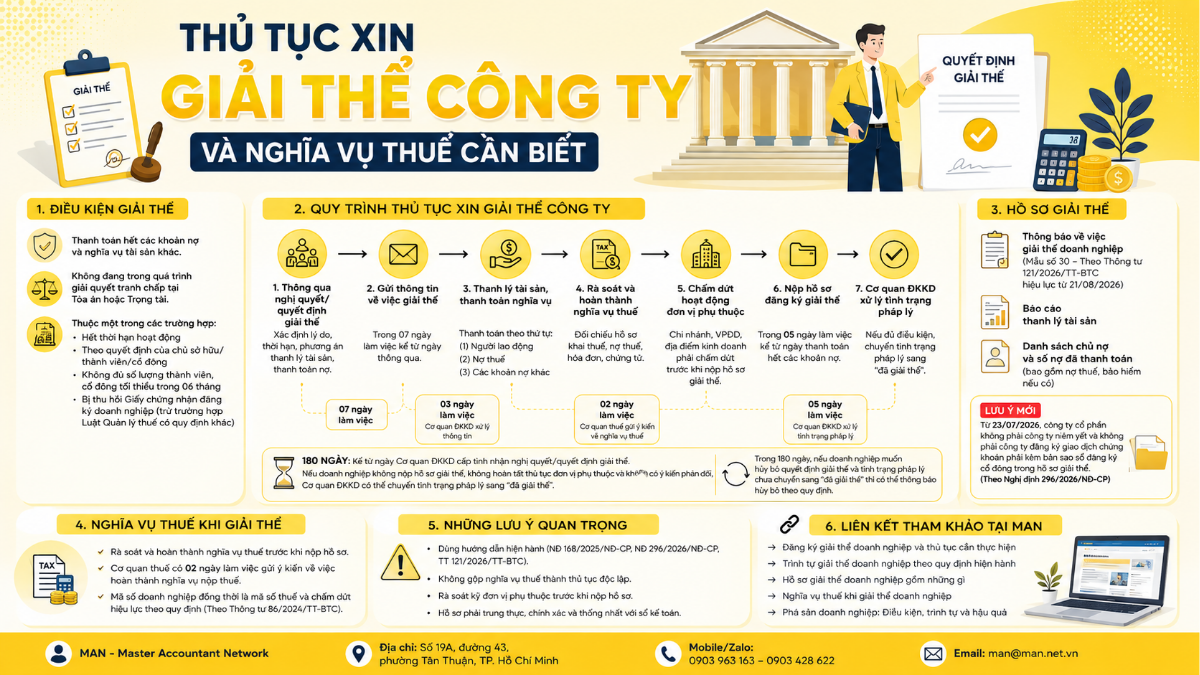
The original text can be referenced in Decree 168/2025/ND-CP and the amended Decree 296/2026/ND-CP.
Step 1: Pass a resolution or decision to dissolve the organization.
A resolution or decision on dissolution is the first step. The document must include the contents as stipulated in Article 208 of the Enterprise Law, including the name and address of the enterprise, the reason for dissolution, the timeframe and procedures for liquidating contracts, settling debts, the plan for handling obligations arising from labor contracts, and the signature of the authorized person.
The authority to make decisions depends on the type of business. After a resolution or decision is made, the business organizes the liquidation of assets and develops a plan to handle outstanding obligations.
Step 2: Submit information about dissolution
Within 7 working days from the date of adoption of the resolution or decision on dissolution, the enterprise shall submit the required documents to the provincial business registration authority where its head office is located.
Within 3 working days of receiving the resolution or decision on dissolution, the provincial business registration authority shall publish the information, update the legal status of the enterprise to "in the process of dissolution," and send the information to the tax authority and the civil enforcement agency as prescribed.
This step does not mean the business has been dissolved. The business must still continue to liquidate assets, settle obligations, and complete the final paperwork.
Step 3: Liquidate assets and settle obligations.
After the dissolution decision is approved, the enterprise organizes the liquidation of assets and payment of debts. Debts are handled in the order of priority specified in Article 208 of the Enterprise Law:
- Unpaid wages, severance pay, social insurance, health insurance, unemployment insurance, and other employee benefits as stipulated by law.
- Tax debt.
- Other debts.
After settling dissolution costs and all debts, the remaining assets are distributed to the private business owner, members, shareholders, or owners as stipulated. For a more in-depth review of liabilities and payment procedures, please refer to the following article. Registering for business dissolution and the necessary procedures. on MAN's content system.
Step 4: Review and fulfill tax obligations
Tax obligations must be addressed concurrently with the dissolution process. Businesses need to review their tax returns, outstanding taxes, invoices, supporting documents, and related obligations before submitting their dissolution registration application.
According to Decree 168/2025/ND-CP, after receiving the dissolution registration dossier, the provincial business registration authority sends the information to the tax authority. The tax authority has 2 working days to send its opinion on the fulfillment of tax obligations.
Businesses can refer to the article for more in-depth information. Tax obligations when dissolving a business and the new process..
Step 5: Terminate the subsidiary unit's operations.
Before filing for business dissolution, it is necessary to terminate the operations of any branches, representative offices, and business locations, if applicable. Businesses should check both their business registration data and internal records to avoid overlooking dependent units that have ceased operations in practice but have not been legally terminated.
If you need to verify the documents, you can refer to the following. What documents are required for business dissolution according to current regulations?.
Step 6: Submit the dissolution registration application.
Within five working days of settling all debts, the enterprise must submit its dissolution registration dossier to the provincial business registration authority where its head office is located. The basic dossier includes a notice of enterprise dissolution; a report on asset liquidation; a list of creditors and the amount of debt paid, including tax debts and employee insurance contributions, if any.
From August 21, 2026, businesses need to use the current forms according to Circular 121/2026/TT-BTC. For dissolution procedures, Form No. 30 is the form to note. You can check the form and instructions by business type directly on the website. National portal for business registration.
Step 7: The business registration authority processes the legal status.
After receiving the dissolution registration application, the provincial business registration authority sends the information to the tax authority to determine the status of tax obligation fulfillment. If the conditions are met, within 05 working days from the date of receiving the dissolution registration application, the provincial business registration authority updates the legal status of the enterprise to dissolved as prescribed.
If the tax authorities determine that a business has not fulfilled its tax obligations, the business must continue to settle the outstanding debt before the procedure is completed.
Key dates to note in the company dissolution process.
The timelines below begin with different legal events. Therefore, it is not advisable to mechanically add up these periods to determine the total dissolution time for all businesses.
| Timeline | Content |
| 7 working days | The business submits the dissolution resolution/decision and required documents after the decision is approved. |
| 3 working days | The business registration authority processes the information after receiving the resolution or decision on dissolution. |
| 05 working days | Businesses can file for dissolution registration from the date all debts are paid off. |
| 2 working days | The tax authorities will send their opinion on the fulfillment of tax obligations after receiving the dissolution registration information. |
| 05 working days | The business registration authority will process the legal status after receiving the dissolution registration application if all conditions are met. |
| 180 days | The mechanism for handling legal situations in cases where a business fails to complete the procedures and does not raise any objections as stipulated by law. |
The 180-day deadline is a conditional processing mechanism, not a default timeframe for all businesses to be dissolved. Businesses need to monitor the status of their application and the accompanying conditions before applying this deadline.
What documents are required for the company dissolution application?
The dissolution registration documents should be prepared after the business has settled all legally required obligations. In addition to the legal documents, the accountant needs to prepare data to prove the liquidation of assets, settlement of debts, and tax obligations.
Business dissolution registration documents
According to Article 210 of the Enterprise Law and current enterprise registration guidelines, the dissolution registration dossier includes the following main documents:
- Notice of business dissolution.
- Report on the liquidation of company assets.
- A list of creditors and the amount of debt paid, including tax debts and contributions to social insurance, health insurance, and unemployment insurance for employees, if applicable.
Form No. 30 is the notification form for business dissolution in the current form system. Businesses should download the form directly from the official source instead of using a circulating file whose update date is unknown.
New notes for joint-stock companies
From July 23, 2026, Decree 296/2026/ND-CP amends Decree 168/2025/ND-CP. For joint-stock companies that are not listed companies and are not registered for securities trading, the required documents include a copy of the shareholder register.
Businesses in this group need to compare the requirements of Decree 296/2026/ND-CP with the current Form No. 30 under Circular 121/2026/TT-BTC before submitting their application. The revised content is published at Decree 296/2026/ND-CP and the new form at Circular 121/2026/TT-BTC.
Documents and work related to tax obligations.
Dissolution records must accurately reflect the debt payment status, including tax debts. Therefore, accountants should reconcile the figures in the books with the tax liability data before preparing the asset liquidation report and the list of creditors.
For businesses with a long operating history, numerous invoices, or multiple tax filing periods, it is advisable to create a separate reconciliation statement between accounting records, tax returns, and tax liability data to detect discrepancies before filing.
Tax obligations in the company dissolution process
Tax obligations are a crucial part of the company dissolution process. Businesses must settle tax debts and address issues related to tax registration, invoices, and documentation based on their current status. Furthermore, the termination of the tax identification number should be distinguished from updating the company's legal status.
Current regulations on tax registration are stipulated as follows: Circular 86/2024/TT-BTC.
Review tax obligations before dissolution.
Before submitting the final documents, businesses should check the following groups of obligations:
- The tax return is incomplete or missing.
- Outstanding taxes, late payment penalties, or financial obligations based on actual data.
- Status of invoices and documents.
- Obligations arising at branches, representative offices, or business locations, if any.
- Accounts receivable and payable need to be processed to complete the asset liquidation report.
Early review helps to limit the situation where dissolution registration applications have been submitted but cannot be completed due to outstanding tax obligations or unresolved related data.
Processing invoices and documents
Businesses need to check the status of invoices, receipts, and related tax declaration records. They shouldn't just compare the amount of tax due while ignoring tax declaration periods, invoice data, or accounting documents.
Records should also be organized by period and by business group so that explanations can be provided when reconciliation is required during the tax obligation processing.
Obligations to customs authorities
If a business is involved in import and export activities, it is necessary to separately review any outstanding customs obligations before finalizing the dissolution process. The fact that import and export activities have ceased should not be automatically considered as having fulfilled all related obligations.
For cases where there are outstanding declarations, payments due, or customs documents, businesses should cross-reference them with actual data before preparing the final dissolution documents.
Termination of tax identification number
The termination of a tax identification number is governed by tax registration regulations, while the conversion of a business's legal status to dissolved is governed by business registration laws. These two processes are related but should not be treated as a single procedure.
Under the current procedure, the Business Registration Authority sends information to the Tax Authority to obtain their opinion on fulfilling tax obligations. Therefore, businesses should proactively address their tax obligations beforehand and monitor the coordination between agencies during the dissolution registration process.
Special circumstances to note when carrying out the procedure for dissolving a company.
Not all businesses have the same level of complexity. Cases with specific dependencies, assets, liabilities, or grounds for dissolution require individual review before selecting a procedure.
The company has branches, representative offices, or business locations.
Businesses with subsidiaries must complete the procedures for terminating the operations of their branches, representative offices, and business locations before submitting their dissolution application. This is one of the easily overlooked points when a business has ceased operations at a location but has not yet completed the termination procedures on the business registration system.
The company has assets or liabilities.
Businesses that still have assets must organize their liquidation and use appropriate resources to settle obligations in order of priority. Accounts receivable also need to be reviewed to determine their recoverability before finalizing the asset liquidation report.
If the business is still involved in a dispute in court or arbitration, the conditions for dissolution need to be assessed before proceeding with the final paperwork.
Dissolution occurs due to the revocation of the business registration certificate or by court decision.
In cases where a business has its business registration certificate revoked or is dissolved by a legally effective court decision, there is a separate procedure as stipulated in Article 209 of the Enterprise Law and Article 65 of Decree 168/2025/ND-CP.
Businesses should not apply the voluntary dissolution process as is to this case because the legal basis and criteria for handling it are different.
Common mistakes when carrying out the procedure for dissolving a company.
Common errors often stem from using outdated guidelines, failing to cross-check tax obligations, or omitting dependent entities. Some notable errors include:
Use the old guidelines regarding the business registration authority.
Decree 168/2025/ND-CP uses the term "Provincial Business Registration Authority" in the dissolution process. Businesses should review the guidance documents developed before the current business registration system came into effect.
Confusing tax obligations with dissolution registration documents.
It should not be understood that fulfilling tax obligations and registering for dissolution are two completely separate procedures. The current process involves coordination between the Business Registration Authority and the Tax Authority, where opinions on tax obligations are part of the application processing.
Omitting dependent units
Branches, representative offices, and business locations need to be inspected before filing for dissolution. A unit that has ceased operations in practice but has not legally terminated may still affect the processing progress.
New documents are missing for some joint-stock companies.
From July 23, 2026, joint-stock companies that are not listed companies and not registered for securities trading should note the requirement for a copy of the shareholder register in their application documents, as stipulated in the amended regulations.
Failure to settle debts and obligations to employees.
A resolution or decision to dissolve does not waive payment obligations. The business must still settle employee benefits, tax debts, and other debts according to their priority order.
Experience in reviewing dissolution documents from an accounting and tax perspective.
A complete dissolution application requires not only sufficient documentation but also consistency between legal records, accounting books, tax obligations, and the actual state of the business. Before submitting the application, you can review it according to four main groups:
- Legal status: check the type of business, grounds for dissolution, registered office, and all subsidiaries.
- Tax status: comparing tax returns, outstanding tax amounts, invoices, supporting documents, and other outstanding obligations.
- Liabilities and assets: confirming accounts receivable and payable balances; developing asset disposal plans; determining payment order.
- Dissolution documents: compare the dissolution resolution or decision, asset liquidation report, list of creditors and amounts of debt paid.
One notable risk is that legal records show the business has made the payment, but accounting records or documents do not prove the transaction. Conversely, accounting figures may have been processed, but tax obligations or subsidiary obligations may not yet be fulfilled, which can also prolong the process.
If a business needs to review its entire process, it can refer to this article for further information. Procedures for dissolving a business according to current regulations. of NATO.
Activities prohibited since the dissolution decision.
Since the decision to dissolve was made, managers and related parties must comply with the restrictions under the Enterprise Law. Actions to be particularly avoided include:
- Concealing or disposing of assets.
- Waiving or reducing the right to claim a debt.
- Convert unsecured debt into secured debt using the company's assets.
- Signing new contracts, except for those related to the dissolution process.
- Pledging, mortgaging, gifting, or leasing property in cases prohibited by law.
- Raising capital through all means.
The continuation of the necessary procedures for liquidation and completion of dissolution must be distinguished from the arising of new business transactions that do not serve the purpose of dissolution.
Conclude
The procedure for dissolving a company must be carried out in the correct order, from passing a resolution or decision, notification, asset liquidation, debt settlement, tax obligation handling, and termination of subsidiary operations to submitting the dissolution registration application.
The milestones of 7 working days, 5 working days, 2 working days, and 180 days are associated with different legal events. Businesses need to determine the correct starting point for each milestone instead of applying a fixed schedule to all cases.
Notably, Decree 296/2026/ND-CP takes effect from July 23, 2026, and Circular 121/2026/TT-BTC takes effect from August 21, 2026. Therefore, businesses need to check the forms and required documents at the time of implementation, especially for joint-stock companies that require attention to the shareholder register.
Reviewing the legal status, tax obligations, liabilities, assets, and subsidiaries before submitting an application is a crucial step to minimize the risk of delays or reprocessing.
Main legal basis
The following texts are official sources used to compare the content of this article:
- Law on Enterprises No. 59/2020/QH14.
- Law No. 76/2025/QH15 amends and supplements a number of articles of the Enterprise Law.
- Decree 168/2025/ND-CP on business registration.
- Decree 296/2026/ND-CP amends and supplements Decree 168/2025/ND-CP.
- Circular 121/2026/TT-BTC amends the business registration form.
- Circular 86/2024/TT-BTC on tax registration.
Mr. Le Hoang Tuyen
Professional license: CPA Vietnam Auditors
Experience: Over 30 years of experience in Accounting, Auditing, and Financial Consulting.
Frequently Asked Questions about the Company Dissolution Procedure
What are the steps involved in the company dissolution procedure?
In a typical dissolution process, a business typically proceeds by passing a resolution or decision, submitting dissolution information, liquidating assets and settling obligations, terminating subsidiaries, filing a dissolution registration application, and completing the legal procedures.
What conditions must a company meet to be dissolved?
The business must be eligible for dissolution, have secured full payment of all debts and other financial obligations, and not be currently involved in any ongoing disputes in court or arbitration.
Does a company need to fulfill its tax obligations when it is dissolved?
Yes. Tax debt is one of the obligations that must be addressed during dissolution. The tax authorities participate in the process of verifying the fulfillment of tax obligations through a coordinated mechanism as stipulated in Decree 168/2025/ND-CP.